 |
PDBsum entry 1lvm

|
|
|
|
|
|

|

|

|

|
|

|
|

|
|

|
|

|
|

|
|

|
|
|
 |

|

|
|
|
|
|
|
|
|
|
|
|
|
|
|
|
|
|
|
|
|
|
|
|
|
|
|
|
|
|
|
|
|
|
|
|
Viral protein
|
PDB id
|
|
|
|
1lvm
|
|
|
|
|
|
|
|
|
|
|
|
|
|
|

|

|

|
|
|
|
|
|
|
|
 |
Contents |
 |
|
|
|
|
|
|
|
|
|
|
|
|
* Residue conservation analysis
|
|
|
|
|
|
PDB id:
|
|
|
|
| Name: |
|
Viral protein
|
|
|
Title:
|
|
Catalytically active tobacco etch virus protease complexed with product
|
|
Structure:
|
|
Catalytic domain of the nuclear inclusion protein a (nia). Chain: a, b. Fragment: residues 1-221. Engineered: yes. Mutation: yes. Oligopeptide substrate for the protease. Chain: c, d. Fragment: residues 302-310. Engineered: yes.
|
|
Source:
|
|
Tobacco etch virus. Organism_taxid: 12227. Expressed in: escherichia coli. Expression_system_taxid: 562.
|
|
Biol. unit:
|
|
 Dimer (from
)
Dimer (from
)
|
|
Resolution:
|
|
|
1.80Å
|
R-factor:
|
0.171
|
R-free:
|
0.230
|
|
|
Authors:
|
|
J.Phan,A.Zdanov,A.G.Evdokimov,J.E.Tropea,H.K.Peters Iii,R.B.Kapust, M.Li,A.Wlodawer,D.S.Waugh
|
Key ref:

|
|
J.Phan
et al.
(2002).
Structural basis for the substrate specificity of tobacco etch virus protease.
J Biol Chem,
277,
50564-50572.
PubMed id:
DOI:

|
|
|
Date:
|
|
|
28-May-02
|
Release date:
|
27-Nov-02
|
|
|
|
|
|
|
PROCHECK
|

|
|
|
|
|
Headers
|
|
|
|
References
|
|
|
|
|
|

|
|
P04517
(POLG_TEV) -
Genome polyprotein from Tobacco etch virus
|
|
|
|
Seq:
Struc:
|
|
|
|
3054 a.a.
229 a.a.*
|
|

|

|
|
|
|
|
|
|
|
|
|
|
|
Key: |
 |
PfamA domain |
|
|
 |
Secondary structure |
|
 |
CATH domain |
|
|
*
PDB and UniProt seqs differ
at 9 residue positions (black
crosses)
|
|
|
|
|
|
|
|
|
|
|
|
|
Enzyme class 2:
|
|
E.C.2.7.7.48
- RNA-directed Rna polymerase.
|
|
|
|
|
|
|
Reaction:
|
|
RNA(n) + a ribonucleoside 5'-triphosphate = RNA(n+1) + diphosphate
|
|
|
|
|
|
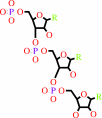 RNA(n)
|
+
|
ribonucleoside 5'-triphosphate
|
=
|
RNA(n+1)
|
+
|
 diphosphate
|
|
|
|
|
|
|
|
|
|
Enzyme class 3:
|
|
E.C.3.4.21.-
- ?????
|
|
|
|
|
|
|
Enzyme class 4:
|
|
E.C.3.4.22.44
- nuclear-inclusion-a endopeptidase.
|
|
|
|
|
|
|
Reaction:
|
|
Hydrolyzes glutaminyl bonds, and activity is further restricted by preferences for the amino acids in P6 - P1' that vary with the species of potyvirus, e.g. Glu-Xaa-Xaa-Tyr-Xaa-Gln+(Ser or Gly) for the enzyme from tobacco etch virus. The natural substrate is the viral polyprotein, but other proteins and oligopeptides containing the appropriate consensus sequence are also cleaved.
|
|
|
|
|
|
Enzyme class 5:
|
|
E.C.3.4.22.45
- helper-component proteinase.
|
|
|
|
|
|
|
Reaction:
|
|
Hydrolyzes a Gly-|-Gly bond at its own C-terminus, commonly in the sequence -Tyr-Xaa-Val-Gly-|-Gly, in the processing of the potyviral polyprotein.
|
|
|
|
|
|
Enzyme class 6:
|
|
E.C.3.6.4.-
- ?????
|
|
|
|
|
|
|
|
|
|
Note, where more than one E.C. class is given (as above), each may
correspond to a different protein domain or, in the case of polyprotein
precursors, to a different mature protein.
|
|
|
|
Molecule diagrams generated from .mol files obtained from the
KEGG ftp site
|
|
|
|
|
|
|
|
|
|
|
|
|
|
 |
|
|
|
|
|
|
| |
|
|
| |
|
DOI no:
|
J Biol Chem
277:50564-50572
(2002)
|
|
PubMed id:
|
|
|
|
|
|
| |
|
Structural basis for the substrate specificity of tobacco etch virus protease.
|
|
J.Phan,
A.Zdanov,
A.G.Evdokimov,
J.E.Tropea,
H.K.Peters,
R.B.Kapust,
M.Li,
A.Wlodawer,
D.S.Waugh.
|
|
|
|
|
| |
ABSTRACT
|
|
|
|
| |
|
|
Because of its stringent sequence specificity, the 3C-type protease from tobacco
etch virus (TEV) is frequently used to remove affinity tags from recombinant
proteins. It is unclear, however, exactly how TEV protease recognizes its
substrates with such high selectivity. The crystal structures of two TEV
protease mutants, inactive C151A and autolysis-resistant S219D, have now been
solved at 2.2- and 1.8-A resolution as complexes with a substrate and product
peptide, respectively. The enzyme does not appear to have been perturbed by the
mutations in either structure, and the modes of binding of the product and
substrate are virtually identical. Analysis of the protein-ligand interactions
helps to delineate the structural determinants of substrate specificity and
provides guidance for reengineering the enzyme to further improve its utility
for biotechnological applications.
|
|
|
|
|
|
| |
Selected figure(s)
|
|
|
|
| |
|
|

|
|

|
|
Figure 1.
Fig. 1. Ribbon models of the TEV (C151A) and TEV(S219D)
protease structures. A, stereo diagram of the S219D monomer
(molecule A). The residues that compose the catalytic triad and
the N-terminal His tag are depicted as ball-and-stick models
(carbon, violet; nitrogen, blue; oxygen, red; and sulfur,
yellow). The peptide product is also colored blue to distinguish
it from the protein. B, the C151A dimer. C, the S219D dimer.
Molecule B (red) is shown in the same orientation in B and C to
illustrate the difference between the two dimers. The peptides
are colored blue. Residue 151, which is Ala in the C151A
protease and Cys in the S219D protease, is depicted as a
ball-and-stick model. Residues 230-236, which are visible only
in molecule A of the S219D protease, are colored yellow.
|
|
Figure 4.
Fig. 4. Stereo diagram of the peptide substrate bound to
TEV (C151A) protease. A ribbon model of the enzyme active-site
cleft and a ball-and-stick model of the peptide substrate are
overlaid on difference electron density contoured at 1.5  from an
omit map. The carbon atoms in the substrate and the catalytic
triad residues in the protease are colored yellow and green,
respectively. from an
omit map. The carbon atoms in the substrate and the catalytic
triad residues in the protease are colored yellow and green,
respectively.
|
|
|
|
|
|
| |
The above figures are
reprinted
by permission from the ASBMB:
J Biol Chem
(2002,
277,
50564-50572)
copyright 2002.
|
|
| |
Figures were
selected
by an automated process.
|
|
|
|
|
|
|
|
|
|
|
|
|
|
|
|
 |
 |
 |
|
Literature references that cite this PDB file's key reference
|
|
|
| |
PubMed id
|
|
Reference
|
|
|
|
|
|
G.Kostallas,
P.Ã.….Löfdahl,
and
P.Samuelson
(2011).
Substrate profiling of tobacco etch virus protease using a novel fluorescence-assisted whole-cell assay.
|
| |
PLoS One,
6,
e16136.
|
|
|
|
|
|
|
J.A.Ashby,
C.E.Stevenson,
G.E.Jarvis,
D.M.Lawson,
and
A.J.Maule
(2011).
Structure-Based Mutational Analysis of eIF4E in Relation to sbm1 Resistance to Pea Seed-Borne Mosaic Virus in Pea.
|
| |
PLoS One,
6,
e15873.
|
|
|
PDB code:
|
|
|
|
|
|
|
|
S.Cui,
J.Wang,
T.Fan,
B.Qin,
L.Guo,
X.Lei,
J.Wang,
M.Wang,
and
Q.Jin
(2011).
Crystal structure of human enterovirus 71 3C protease.
|
| |
J Mol Biol,
408,
449-461.
|
|
|
PDB code:
|
|
|
|
|
|
|
|
P.Sun,
B.P.Austin,
J.Tözsér,
and
D.S.Waugh
(2010).
Structural determinants of tobacco vein mottling virus protease substrate specificity.
|
| |
Protein Sci,
19,
2240-2251.
|
|
|
PDB code:
|
|
|
|
|
|
|
|
T.Moulaei,
S.R.Shenoy,
B.Giomarelli,
C.Thomas,
J.B.McMahon,
Z.Dauter,
B.R.O'Keefe,
and
A.Wlodawer
(2010).
Monomerization of viral entry inhibitor griffithsin elucidates the relationship between multivalent binding to carbohydrates and anti-HIV activity.
|
| |
Structure,
18,
1104-1115.
|
|
|
PDB codes:
|
|
|
|
|
|
|
|
X.Chen,
E.Pham,
and
K.Truong
(2010).
TEV protease-facilitated stoichiometric delivery of multiple genes using a single expression vector.
|
| |
Protein Sci,
19,
2379-2388.
|
|
|
|
|
|
|
A.C.Puhl,
C.Giacomini,
G.Irazoqui,
F.Batista-Viera,
A.Villarino,
and
H.Terenzi
(2009).
Covalent immobilization of tobacco-etch-virus NIa protease: a useful tool for cleavage of the histidine tag of recombinant proteins.
|
| |
Biotechnol Appl Biochem,
53,
165-174.
|
|
|
|
|
|
|
C.Taxis,
G.Stier,
R.Spadaccini,
and
M.Knop
(2009).
Efficient protein depletion by genetically controlled deprotection of a dormant N-degron.
|
| |
Mol Syst Biol,
5,
267.
|
|
|
|
|
|
|
D.J.Williams,
H.L.Puhl,
and
S.R.Ikeda
(2009).
Rapid modification of proteins using a rapamycin-inducible tobacco etch virus protease system.
|
| |
PLoS One,
4,
e7474.
|
|
|
|
|
|
|
L.E.Metzger,
and
C.R.Raetz
(2009).
Purification and characterization of the lipid A disaccharide synthase (LpxB) from Escherichia coli, a peripheral membrane protein.
|
| |
Biochemistry,
48,
11559-11571.
|
|
|
|
|
|
|
L.D.Cabrita,
D.Gilis,
A.L.Robertson,
Y.Dehouck,
M.Rooman,
and
S.P.Bottomley
(2007).
Enhancing the stability and solubility of TEV protease using in silico design.
|
| |
Protein Sci,
16,
2360-2367.
|
|
|
|
|
|
|
P.G.Blommel,
and
B.G.Fox
(2007).
A combined approach to improving large-scale production of tobacco etch virus protease.
|
| |
Protein Expr Purif,
55,
53-68.
|
|
|
|
|
|
|
S.Curry,
N.Roqué-Rosell,
P.A.Zunszain,
and
R.J.Leatherbarrow
(2007).
Foot-and-mouth disease virus 3C protease: recent structural and functional insights into an antiviral target.
|
| |
Int J Biochem Cell Biol,
39,
1-6.
|
|
|
|
|
|
|
T.R.Sweeney,
N.Roqué-Rosell,
J.R.Birtley,
R.J.Leatherbarrow,
and
S.Curry
(2007).
Structural and mutagenic analysis of foot-and-mouth disease virus 3C protease reveals the role of the beta-ribbon in proteolysis.
|
| |
J Virol,
81,
115-124.
|
|
|
PDB code:
|
|
|
|
|
|
|
|
J.R.Mesters,
J.Tan,
and
R.Hilgenfeld
(2006).
Viral enzymes.
|
| |
Curr Opin Struct Biol,
16,
776-786.
|
|
|
|
|
|
|
L.D.Cabrita,
W.Dai,
and
S.P.Bottomley
(2006).
A family of E. coli expression vectors for laboratory scale and high throughput soluble protein production.
|
| |
BMC Biotechnol,
6,
12.
|
|
|
|
|
|
|
J.Tözsér,
J.E.Tropea,
S.Cherry,
P.Bagossi,
T.D.Copeland,
A.Wlodawer,
and
D.S.Waugh
(2005).
Comparison of the substrate specificity of two potyvirus proteases.
|
| |
FEBS J,
272,
514-523.
|
|
|
|
|
|
|
K.Nakamura,
Y.Someya,
T.Kumasaka,
G.Ueno,
M.Yamamoto,
T.Sato,
N.Takeda,
T.Miyamura,
and
N.Tanaka
(2005).
A norovirus protease structure provides insights into active and substrate binding site integrity.
|
| |
J Virol,
79,
13685-13693.
|
|
|
PDB code:
|
|
|
|
|
|
|
|
W.B.Jeon,
D.J.Aceti,
C.A.Bingman,
F.C.Vojtik,
A.C.Olson,
J.M.Ellefson,
J.E.McCombs,
H.K.Sreenath,
P.G.Blommel,
K.D.Seder,
B.T.Burns,
H.V.Geetha,
A.C.Harms,
G.Sabat,
M.R.Sussman,
B.G.Fox,
and
G.N.Phillips
(2005).
High-throughput purification and quality assurance of Arabidopsis thaliana proteins for eukaryotic structural genomics.
|
| |
J Struct Funct Genomics,
6,
143-147.
|
|
|
|
|
|
|
Y.P.Shih,
H.C.Wu,
S.M.Hu,
T.F.Wang,
and
A.H.Wang
(2005).
Self-cleavage of fusion protein in vivo using TEV protease to yield native protein.
|
| |
Protein Sci,
14,
936-941.
|
|
|
|
|
|
|
D.Liu,
Y.Zhao,
X.Fan,
Y.Sun,
and
R.O.Fox
(2004).
Expression, crystallization and preliminary crystallographic analysis of YciE, a stress protein from Escherichia coli.
|
| |
Acta Crystallogr D Biol Crystallogr,
60,
1888-1889.
|
|
|
|
|
|
|
D.Liu,
Y.Zhao,
X.Fan,
Y.Sun,
and
R.O.Fox
(2004).
Escherichia coli stress protein YciF: expression, crystallization and preliminary crystallographic analysis.
|
| |
Acta Crystallogr D Biol Crystallogr,
60,
2389-2390.
|
|
|
|
|
|
|
P.Mestre,
G.Brigneti,
M.C.Durrant,
and
D.C.Baulcombe
(2003).
Potato virus Y NIa protease activity is not sufficient for elicitation of Ry-mediated disease resistance in potato.
|
| |
Plant J,
36,
755-761.
|
|
|
|
|
|
The most recent references are shown first.
Citation data come partly from CiteXplore and partly
from an automated harvesting procedure. Note that this is likely to be
only a partial list as not all journals are covered by
either method. However, we are continually building up the citation data
so more and more references will be included with time.
Where a reference describes a PDB structure, the PDB
code is
shown on the right.
|
|


 Links
Links


