
|
|
|
|
|
 |
Contents |
 |
|
|
|
|
|
|
|
|
|
|
|
|
* Residue conservation analysis
|
|
|
|
|
|
PDB id:
|
|
|
|
| Name: |
|
Gene regulation
|
|
|
Title:
|
|
X-ray structure of the orphan nuclear receptor err3 ligand-binding domain in the constitutively active conformation
|
|
Structure:
|
|
Estrogen-related receptor gamma. Chain: a, b. Fragment: ligand-binding domain. Synonym: err gamma-2. Nuclear receptor errg2. Estrogen-related receptor 3. Engineered: yes. Other_details: complex with a src1 coactivator peptide in the absence of ligand. Steroid receptor coactivator 1.
|
|
Source:
|
|
Homo sapiens. Human. Organism_taxid: 9606. Gene: nr3b3. Expressed in: escherichia coli bl21(de3). Expression_system_taxid: 469008. Synthetic: yes. Other_details: this sequence occurs naturally in humans
|
|
Biol. unit:
|
|
 Tetramer (from
)
Tetramer (from
)
|
|
Resolution:
|
|
|
2.70Å
|
R-factor:
|
0.233
|
R-free:
|
0.267
|
|
|
Authors:
|
|
H.Greschik,J.-M.Wurtz,S.Sanglier,W.Bourguet,A.Van Dorsselaer,D.Moras, J.-P.Renaud,Structural Proteomics In Europe (Spine)
|
Key ref:

|
|
H.Greschik
et al.
(2002).
Structural and functional evidence for ligand-independent transcriptional activation by the estrogen-related receptor 3.
Mol Cell,
9,
303-313.
PubMed id:
DOI:

|
|
|
Date:
|
|
|
25-Jan-02
|
Release date:
|
25-Jan-03
|
|
|
|
|
|
|
PROCHECK
|

|
|
|
|
|
Headers
|
|
|
|
References
|
|
|
|
|
|
|
|
|
|
|
|
Enzyme class:
|
|
Chain D:
E.C.2.3.1.48
- histone acetyltransferase.
|
|
|
|
|
|
|
Reaction:
|
|
L-lysyl-[protein] + acetyl-CoA = N6-acetyl-L-lysyl-[protein] + CoA + H+
|
|
|
|
|
|
L-lysyl-[protein]
|
+
|
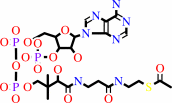 acetyl-CoA
|
=
|
N(6)-acetyl-L-lysyl-[protein]
|
+
|
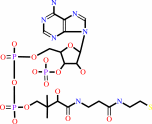 CoA
CoA
|
+
|
H(+)
|
|
|
|
|
|
|
|
|
|
|
|
|
Molecule diagrams generated from .mol files obtained from the
KEGG ftp site
|
|
|
|
|
|
|
|
|
|
|
|
|
|
 |
|
|
|
|
|
|
| |
|
|
| |
|
DOI no:
|
Mol Cell
9:303-313
(2002)
|
|
PubMed id:
|
|
|
|
|
|
| |
|
Structural and functional evidence for ligand-independent transcriptional activation by the estrogen-related receptor 3.
|
|
H.Greschik,
J.M.Wurtz,
S.Sanglier,
W.Bourguet,
A.van Dorsselaer,
D.Moras,
J.P.Renaud.
|
|
|
|
|
| |
ABSTRACT
|
|
|
|
| |
|
|
The crystal structure of the ligand binding domain (LBD) of the estrogen-related
receptor 3 (ERR3) complexed with a steroid receptor coactivator-1 (SRC-1)
peptide reveals a transcriptionally active conformation in absence of any
ligand. The structure explains why estradiol does not bind ERRs with significant
affinity. Docking of the previously reported ERR antagonists, diethylstilbestrol
and 4-hydroxytamoxifen, requires structural rearrangements enlarging the ligand
binding pocket that can only be accommodated with an antagonist LBD
conformation. Mutant receptors in which the ligand binding cavity is filled up
by bulkier side chains still interact with SRC-1 in vitro and are
transcriptionally active in vivo, but are no longer efficiently inactivated by
diethylstilbestrol or 4-hydroxytamoxifen. These results provide structural and
functional evidence for ligand-independent transcriptional activation by ERR3.
|
|
|
|
|
|
| |
Selected figure(s)
|
|
|
|
| |
|
|

|
|

|
|
Figure 2.
Figure 2. Schematic Representation of the Ligand binding
Pocket of the ERR3 LBD(A) In the crystal structure, the
positions of all shown side chains are well defined, with the
exception of that of E275, which exhibits high temperature
factors. All atoms are colored according to the following code:
carbon, gray; oxygen, red; nitrogen, blue; sulfur, yellow.(B)
View as in (A) with E2 docked into the empty ligand binding
cavity of ERR3. The position of E2 results from the
superposition of the ERR3 LBD and the ERα LBD/E2 complex.
Steric interference with the D-ring of E2 is mainly due to the
presence of F435 (L525 in hERα) and L345 (I424 in hERα) in
ERR3.(C) Schematic comparison of amino acid residues that form
the ligand binding pocket in hERR3 with the corresponding
residues of hERR2, hERR1, and hERα. Residues that are conserved
among all four receptors are depicted in yellow, and those
conserved among the ERR isotypes are colored in blue. Amino
acids of hERα that according to our modeling studies allow the
binding of E2 to ERs but not to ERRs are highlighted in red.
Important isotype-specific amino acid differences are colored in
green.
|
|
Figure 4.
Figure 4. In Vitro Interaction Between Wild-Type or Mutant
LBDs of ERR3 and the RID of SRC-1Two micrograms (about 70 pmol)
of partially purified His-tagged ERR3 LBD was preincubated for
10 min on ice with 4 μg (about 100 pmol) of GST-tagged SRC-1
RID or GST in the absence (A) or in the presence ([B] and [C])
of 10^−4 M 4-OHT or 10^−4 M DES. Complexes were separated on
native polyacrylamide gradient gels.
|
|
|
|
|
|
| |
The above figures are
reprinted
by permission from Cell Press:
Mol Cell
(2002,
9,
303-313)
copyright 2002.
|
|
| |
Figures were
selected
by the author.
|
|
|
|
|
|
|
|
|
|
|
|
|
|
|
|
 |
 |
 |
|
Literature references that cite this PDB file's key reference
|
|
|
| |
PubMed id
|
|
Reference
|
|
|
|
|
|
A.le Maire,
W.Bourguet,
and
P.Balaguer
(2010).
A structural view of nuclear hormone receptor: endocrine disruptor interactions.
|
| |
Cell Mol Life Sci,
67,
1219-1237.
|
|
|
PDB code:
|
|
|
|
|
|
|
|
E.Bonnelye,
F.Saltel,
A.Chabadel,
R.A.Zirngibl,
J.E.Aubin,
and
P.Jurdic
(2010).
Involvement of the orphan nuclear estrogen receptor-related receptor α in osteoclast adhesion and transmigration.
|
| |
J Mol Endocrinol,
45,
365-377.
|
|
|
|
|
|
|
H.He,
G.Xi,
and
X.Lu
(2010).
Molecular cloning, characterization, and expression analysis of an estrogen receptor-related receptor homologue in the cricket, Teleogryllus emma.
|
| |
J Insect Sci,
10,
188.
|
|
|
|
|
|
|
H.Venselaar,
R.P.Joosten,
B.Vroling,
C.A.Baakman,
M.L.Hekkelman,
E.Krieger,
and
G.Vriend
(2010).
Homology modelling and spectroscopy, a never-ending love story.
|
| |
Eur Biophys J,
39,
551-563.
|
|
|
|
|
|
|
L.Jin,
and
Y.Li
(2010).
Structural and functional insights into nuclear receptor signaling.
|
| |
Adv Drug Deliv Rev,
62,
1218-1226.
|
|
|
|
|
|
|
M.K.Gandhari,
C.R.Frazier,
J.S.Hartenstein,
J.F.Cloix,
M.Bernier,
and
I.W.Wainer
(2010).
Identification and characterization of estrogen receptor-related receptor alpha and gamma in human glioma and astrocytoma cells.
|
| |
Mol Cell Endocrinol,
315,
314-318.
|
|
|
|
|
|
|
P.Huang,
V.Chandra,
and
F.Rastinejad
(2010).
Structural overview of the nuclear receptor superfamily: insights into physiology and therapeutics.
|
| |
Annu Rev Physiol,
72,
247-272.
|
|
|
|
|
|
|
R.J.Andersen,
N.R.Mawji,
J.Wang,
G.Wang,
S.Haile,
J.K.Myung,
K.Watt,
T.Tam,
Y.C.Yang,
C.A.Bañuelos,
D.E.Williams,
I.J.McEwan,
Y.Wang,
and
M.D.Sadar
(2010).
Regression of castrate-recurrent prostate cancer by a small-molecule inhibitor of the amino-terminus domain of the androgen receptor.
|
| |
Cancer Cell,
17,
535-546.
|
|
|
|
|
|
|
S.M.Rangwala,
X.Wang,
J.A.Calvo,
L.Lindsley,
Y.Zhang,
G.Deyneko,
V.Beaulieu,
J.Gao,
G.Turner,
and
J.Markovits
(2010).
Estrogen-related receptor gamma is a key regulator of muscle mitochondrial activity and oxidative capacity.
|
| |
J Biol Chem,
285,
22619-22629.
|
|
|
|
|
|
|
X.Liu,
A.Matsushima,
H.Okada,
and
Y.Shimohigashi
(2010).
Distinction of the binding modes for human nuclear receptor ERRgamma between bisphenol A and 4-hydroxytamoxifen.
|
| |
J Biochem,
148,
247-254.
|
|
|
|
|
|
|
D.H.Volle,
M.Decourteix,
E.Garo,
J.McNeilly,
P.Fenichel,
J.Auwerx,
A.S.McNeilly,
K.Schoonjans,
and
M.Benahmed
(2009).
The orphan nuclear receptor small heterodimer partner mediates male infertility induced by diethylstilbestrol in mice.
|
| |
J Clin Invest,
119,
3752-3764.
|
|
|
|
|
|
|
M.B.Hock,
and
A.Kralli
(2009).
Transcriptional control of mitochondrial biogenesis and function.
|
| |
Annu Rev Physiol,
71,
177-203.
|
|
|
|
|
|
|
S.Bianco,
O.Lanvin,
V.Tribollet,
C.Macari,
S.North,
and
J.M.Vanacker
(2009).
Modulating estrogen receptor-related receptor-alpha activity inhibits cell proliferation.
|
| |
J Biol Chem,
284,
23286-23292.
|
|
|
|
|
|
|
S.Burendahl,
C.Danciulescu,
and
L.Nilsson
(2009).
Ligand unbinding from the estrogen receptor: a computational study of pathways and ligand specificity.
|
| |
Proteins,
77,
842-856.
|
|
|
|
|
|
|
C.Teyssier,
S.Bianco,
O.Lanvin,
and
J.M.Vanacker
(2008).
The orphan receptor ERRalpha interferes with steroid signaling.
|
| |
Nucleic Acids Res,
36,
5350-5361.
|
|
|
|
|
|
|
E.Bertil,
M.A.Bolzinger,
V.André,
P.Rousselle,
and
O.Damour
(2008).
Expression of oestrogen-related receptor alpha in human epidermis.
|
| |
Exp Dermatol,
17,
208-213.
|
|
|
|
|
|
|
E.Bonnelye,
N.Laurin,
P.Jurdic,
D.A.Hart,
and
J.E.Aubin
(2008).
Estrogen receptor-related receptor-alpha (ERR-alpha) is dysregulated in inflammatory arthritis.
|
| |
Rheumatology (Oxford),
47,
1785-1791.
|
|
|
|
|
|
|
H.Okada,
T.Tokunaga,
X.Liu,
S.Takayanagi,
A.Matsushima,
and
Y.Shimohigashi
(2008).
Direct evidence revealing structural elements essential for the high binding ability of bisphenol A to human estrogen-related receptor-gamma.
|
| |
Environ Health Perspect,
116,
32-38.
|
|
|
|
|
|
|
J.A.Villena,
and
A.Kralli
(2008).
ERRalpha: a metabolic function for the oldest orphan.
|
| |
Trends Endocrinol Metab,
19,
269-276.
|
|
|
|
|
|
|
M.Paris,
K.Pettersson,
M.Schubert,
S.Bertrand,
I.Pongratz,
H.Escriva,
and
V.Laudet
(2008).
An amphioxus orthologue of the estrogen receptor that does not bind estradiol: insights into estrogen receptor evolution.
|
| |
BMC Evol Biol,
8,
219.
|
|
|
|
|
|
|
P.Hu,
H.K.Kinyamu,
L.Wang,
J.Martin,
T.K.Archer,
and
C.Teng
(2008).
Estrogen induces estrogen-related receptor alpha gene expression and chromatin structural changes in estrogen receptor (ER)-positive and ER-negative breast cancer cells.
|
| |
J Biol Chem,
283,
6752-6763.
|
|
|
|
|
|
|
R.B.Riggins,
J.P.Lan,
Y.Zhu,
U.Klimach,
A.Zwart,
L.R.Cavalli,
B.R.Haddad,
L.Chen,
T.Gong,
J.Xuan,
S.P.Ethier,
and
R.Clarke
(2008).
ERRgamma mediates tamoxifen resistance in novel models of invasive lobular breast cancer.
|
| |
Cancer Res,
68,
8908-8917.
|
|
|
|
|
|
|
R.W.Collin,
E.Kalay,
M.Tariq,
T.Peters,
B.van der Zwaag,
H.Venselaar,
J.Oostrik,
K.Lee,
Z.M.Ahmed,
R.Caylan,
Y.Li,
H.A.Spierenburg,
E.Eyupoglu,
A.Heister,
S.Riazuddin,
E.Bahat,
M.Ansar,
S.Arslan,
B.Wollnik,
H.G.Brunner,
C.W.Cremers,
A.Karaguzel,
W.Ahmad,
F.P.Cremers,
G.Vriend,
T.B.Friedman,
S.Riazuddin,
S.M.Leal,
and
H.Kremer
(2008).
Mutations of ESRRB encoding estrogen-related receptor beta cause autosomal-recessive nonsyndromic hearing impairment DFNB35.
|
| |
Am J Hum Genet,
82,
125-138.
|
|
|
|
|
|
|
W.A.Alaynick
(2008).
Nuclear receptors, mitochondria and lipid metabolism.
|
| |
Mitochondrion,
8,
329-337.
|
|
|
|
|
|
|
A.M.Tremblay,
and
V.Giguère
(2007).
The NR3B subgroup: an ovERRview.
|
| |
Nucl Recept Signal,
5,
e009.
|
|
|
|
|
|
|
A.R.de Lera,
W.Bourguet,
L.Altucci,
and
H.Gronemeyer
(2007).
Design of selective nuclear receptor modulators: RAR and RXR as a case study.
|
| |
Nat Rev Drug Discov,
6,
811-820.
|
|
|
|
|
|
|
C.Bovet,
A.Wortmann,
S.Eiler,
F.Granger,
M.Ruff,
B.Gerrits,
D.Moras,
and
R.Zenobi
(2007).
Estrogen receptor-ligand complexes measured by chip-based nanoelectrospray mass spectrometry: an approach for the screening of endocrine disruptors.
|
| |
Protein Sci,
16,
938-946.
|
|
|
|
|
|
|
J.Kallen,
R.Lattmann,
R.Beerli,
A.Blechschmidt,
M.J.Blommers,
M.Geiser,
J.Ottl,
J.M.Schlaeppi,
A.Strauss,
and
B.Fournier
(2007).
Crystal structure of human estrogen-related receptor alpha in complex with a synthetic inverse agonist reveals its novel molecular mechanism.
|
| |
J Biol Chem,
282,
23231-23239.
|
|
|
PDB code:
|
|
|
|
|
|
|
|
L.Michalik,
V.Zoete,
G.Krey,
A.Grosdidier,
L.Gelman,
P.Chodanowski,
J.N.Feige,
B.Desvergne,
W.Wahli,
and
O.Michielin
(2007).
Combined simulation and mutagenesis analyses reveal the involvement of key residues for peroxisome proliferator-activated receptor alpha helix 12 dynamic behavior.
|
| |
J Biol Chem,
282,
9666-9677.
|
|
|
|
|
|
|
Z.Zhang,
and
C.T.Teng
(2007).
Interplay between estrogen-related receptor alpha (ERRalpha) and gamma (ERRgamma) on the regulation of ERRalpha gene expression.
|
| |
Mol Cell Endocrinol,
264,
128-141.
|
|
|
|
|
|
|
B.Herzog,
J.Cardenas,
R.K.Hall,
J.A.Villena,
P.J.Budge,
V.Giguère,
D.K.Granner,
and
A.Kralli
(2006).
Estrogen-related receptor alpha is a repressor of phosphoenolpyruvate carboxykinase gene transcription.
|
| |
J Biol Chem,
281,
99.
|
|
|
|
|
|
|
K.Lui,
Y.Huang,
H.L.Choi,
S.Yu,
K.B.Wong,
S.Chen,
and
F.L.Chan
(2006).
Molecular cloning and functional study of rat estrogen receptor-related receptor gamma in rat prostatic cells.
|
| |
Prostate,
66,
1600-1619.
|
|
|
|
|
|
|
L.Banci,
I.Bertini,
S.Cusack,
R.N.de Jong,
U.Heinemann,
E.Y.Jones,
F.Kozielski,
K.Maskos,
A.Messerschmidt,
R.Owens,
A.Perrakis,
A.Poterszman,
G.Schneider,
C.Siebold,
I.Silman,
T.Sixma,
G.Stewart-Jones,
J.L.Sussman,
J.C.Thierry,
and
D.Moras
(2006).
First steps towards effective methods in exploiting high-throughput technologies for the determination of human protein structures of high biomedical value.
|
| |
Acta Crystallogr D Biol Crystallogr,
62,
1208-1217.
|
|
|
|
|
|
|
L.Wang,
W.J.Zuercher,
T.G.Consler,
M.H.Lambert,
A.B.Miller,
L.A.Orband-Miller,
D.D.McKee,
T.M.Willson,
and
R.T.Nolte
(2006).
X-ray crystal structures of the estrogen-related receptor-gamma ligand binding domain in three functional states reveal the molecular basis of small molecule regulation.
|
| |
J Biol Chem,
281,
37773-37781.
|
|
|
PDB codes:
|
|
|
|
|
|
|
|
P.Ascenzi,
A.Bocedi,
and
M.Marino
(2006).
Structure-function relationship of estrogen receptor alpha and beta: impact on human health.
|
| |
Mol Aspects Med,
27,
299-402.
|
|
|
|
|
|
|
B.Windshügel,
J.Jyrkkärinne,
A.Poso,
P.Honkakoski,
and
W.Sippl
(2005).
Molecular dynamics simulations of the human CAR ligand-binding domain: deciphering the molecular basis for constitutive activity.
|
| |
J Mol Model,
11,
69-79.
|
|
|
|
|
|
|
F.A.Klein,
R.A.Atkinson,
N.Potier,
D.Moras,
and
J.Cavarelli
(2005).
Biochemical and NMR mapping of the interface between CREB-binding protein and ligand binding domains of nuclear receptor: beyond the LXXLL motif.
|
| |
J Biol Chem,
280,
5682-5692.
|
|
|
|
|
|
|
F.Molnár,
M.Matilainen,
and
C.Carlberg
(2005).
Structural determinants of the agonist-independent association of human peroxisome proliferator-activated receptors with coactivators.
|
| |
J Biol Chem,
280,
26543-26556.
|
|
|
|
|
|
|
J.Jyrkkärinne,
B.Windshügel,
J.Mäkinen,
M.Ylisirniö,
M.Peräkylä,
A.Poso,
W.Sippl,
and
P.Honkakoski
(2005).
Amino acids important for ligand specificity of the human constitutive androstane receptor.
|
| |
J Biol Chem,
280,
5960-5971.
|
|
|
|
|
|
|
J.Lengqvist,
G.Alvélius,
H.Jörnvall,
J.Sjövall,
T.Perlmann,
and
W.J.Griffiths
(2005).
Electrospray mass spectrometry for the direct accurate mass measurement of ligands in complex with the retinoid X receptor alpha ligand binding domain.
|
| |
J Am Soc Mass Spectrom,
16,
1631-1640.
|
|
|
|
|
|
|
W.Wang,
C.Zhang,
A.Marimuthu,
H.I.Krupka,
M.Tabrizizad,
R.Shelloe,
U.Mehra,
K.Eng,
H.Nguyen,
C.Settachatgul,
B.Powell,
M.V.Milburn,
and
B.L.West
(2005).
The crystal structures of human steroidogenic factor-1 and liver receptor homologue-1.
|
| |
Proc Natl Acad Sci U S A,
102,
7505-7510.
|
|
|
PDB codes:
|
|
|
|
|
|
|
|
Y.Y.Park,
S.W.Ahn,
H.J.Kim,
J.M.Kim,
I.K.Lee,
H.Kang,
and
H.S.Choi
(2005).
An autoregulatory loop controlling orphan nuclear receptor DAX-1 gene expression by orphan nuclear receptor ERRgamma.
|
| |
Nucleic Acids Res,
33,
6756-6768.
|
|
|
|
|
|
|
C.Frank,
F.Molnár,
M.Matilainen,
H.Lempiäinen,
and
C.Carlberg
(2004).
Agonist-dependent and agonist-independent transactivations of the human constitutive androstane receptor are modulated by specific amino acid pairs.
|
| |
J Biol Chem,
279,
33558-33566.
|
|
|
|
|
|
|
G.Benoit,
M.Malewicz,
and
T.Perlmann
(2004).
Digging deep into the pockets of orphan nuclear receptors: insights from structural studies.
|
| |
Trends Cell Biol,
14,
369-376.
|
|
|
|
|
|
|
H.Greschik,
R.Flaig,
J.P.Renaud,
and
D.Moras
(2004).
Structural basis for the deactivation of the estrogen-related receptor gamma by diethylstilbestrol or 4-hydroxytamoxifen and determinants of selectivity.
|
| |
J Biol Chem,
279,
33639-33646.
|
|
|
PDB codes:
|
|
|
|
|
|
|
|
J.Kallen,
J.M.Schlaeppi,
F.Bitsch,
I.Filipuzzi,
A.Schilb,
V.Riou,
A.Graham,
A.Strauss,
M.Geiser,
and
B.Fournier
(2004).
Evidence for ligand-independent transcriptional activation of the human estrogen-related receptor alpha (ERRalpha): crystal structure of ERRalpha ligand binding domain in complex with peroxisome proliferator-activated receptor coactivator-1alpha.
|
| |
J Biol Chem,
279,
49330-49337.
|
|
|
PDB code:
|
|
|
|
|
|
|
|
K.Suino,
L.Peng,
R.Reynolds,
Y.Li,
J.Y.Cha,
J.J.Repa,
S.A.Kliewer,
and
H.E.Xu
(2004).
The nuclear xenobiotic receptor CAR: structural determinants of constitutive activation and heterodimerization.
|
| |
Mol Cell,
16,
893-905.
|
|
|
PDB code:
|
|
|
|
|
|
|
|
P.J.Willy,
I.R.Murray,
J.Qian,
B.B.Busch,
W.C.Stevens,
R.Martin,
R.Mohan,
S.Zhou,
P.Ordentlich,
P.Wei,
D.W.Sapp,
R.A.Horlick,
R.A.Heyman,
and
I.G.Schulman
(2004).
Regulation of PPARgamma coactivator 1alpha (PGC-1alpha) signaling by an estrogen-related receptor alpha (ERRalpha) ligand.
|
| |
Proc Natl Acad Sci U S A,
101,
8912-8917.
|
|
|
|
|
|
|
S.Sanglier,
W.Bourguet,
P.Germain,
V.Chavant,
D.Moras,
H.Gronemeyer,
N.Potier,
and
A.Van Dorsselaer
(2004).
Monitoring ligand-mediated nuclear receptor-coregulator interactions by noncovalent mass spectrometry.
|
| |
Eur J Biochem,
271,
4958-4967.
|
|
|
|
|
|
|
C.Stehlin-Gaon,
D.Willmann,
D.Zeyer,
S.Sanglier,
A.Van Dorsselaer,
J.P.Renaud,
D.Moras,
and
R.Schüle
(2003).
All-trans retinoic acid is a ligand for the orphan nuclear receptor ROR beta.
|
| |
Nat Struct Biol,
10,
820-825.
|
|
|
PDB codes:
|
|
|
|
|
|
|
|
E.P.Sablin,
I.N.Krylova,
R.J.Fletterick,
and
H.A.Ingraham
(2003).
Structural basis for ligand-independent activation of the orphan nuclear receptor LRH-1.
|
| |
Mol Cell,
11,
1575-1585.
|
|
|
PDB code:
|
|
|
|
|
|
|
|
F.M.Sladek
(2003).
Nuclear receptors as drug targets: new developments in coregulators, orphan receptors and major therapeutic areas.
|
| |
Expert Opin Ther Targets,
7,
679-684.
|
|
|
|
|
|
|
K.Nam,
P.Marshall,
R.M.Wolf,
and
W.Cornell
(2003).
Simulation of the different biological activities of diethylstilbestrol (DES) on estrogen receptor alpha and estrogen-related receptor gamma.
|
| |
Biopolymers,
68,
130-138.
|
|
|
|
|
|
|
M.Hentschke,
C.Schulze,
U.Süsens,
and
U.Borgmeyer
(2003).
Characterization of calmodulin binding to the orphan nuclear receptor Errgamma.
|
| |
Biol Chem,
384,
473-482.
|
|
|
|
|
|
|
N.Potier,
I.M.Billas,
A.Steinmetz,
C.Schaeffer,
A.van Dorsselaer,
D.Moras,
and
J.P.Renaud
(2003).
Using nondenaturing mass spectrometry to detect fortuitous ligands in orphan nuclear receptors.
|
| |
Protein Sci,
12,
725-733.
|
|
|
|
|
|
|
Q.Xu,
and
C.Lee
(2003).
Discovery of novel splice forms and functional analysis of cancer-specific alternative splicing in human expressed sequences.
|
| |
Nucleic Acids Res,
31,
5635-5643.
|
|
|
|
|
|
|
S.N.Schreiber,
D.Knutti,
K.Brogli,
T.Uhlmann,
and
A.Kralli
(2003).
The transcriptional coactivator PGC-1 regulates the expression and activity of the orphan nuclear receptor estrogen-related receptor alpha (ERRalpha).
|
| |
J Biol Chem,
278,
9013-9018.
|
|
|
|
|
|
|
T.Ostberg,
M.Jacobsson,
A.Attersand,
A.Mata de Urquiza,
and
L.Jendeberg
(2003).
A triple mutant of the Drosophila ERR confers ligand-induced suppression of activity.
|
| |
Biochemistry,
42,
6427-6435.
|
|
|
|
|
|
|
T.Shiraki,
N.Sakai,
E.Kanaya,
and
H.Jingami
(2003).
Activation of orphan nuclear constitutive androstane receptor requires subnuclear targeting by peroxisome proliferator-activated receptor gamma coactivator-1 alpha. A possible link between xenobiotic response and nutritional state.
|
| |
J Biol Chem,
278,
11344-11350.
|
|
|
|
|
|
|
Y.Li,
M.H.Lambert,
and
H.E.Xu
(2003).
Activation of nuclear receptors: a perspective from structural genomics.
|
| |
Structure,
11,
741-746.
|
|
|
|
|
|
|
Z.Wang,
G.Benoit,
J.Liu,
S.Prasad,
P.Aarnisalo,
X.Liu,
H.Xu,
N.P.Walker,
and
T.Perlmann
(2003).
Structure and function of Nurr1 identifies a class of ligand-independent nuclear receptors.
|
| |
Nature,
423,
555-560.
|
|
|
PDB code:
|
|
|
|
|
|
|
|
M.Hentschke,
U.Süsens,
and
U.Borgmeyer
(2002).
Domains of ERRgamma that mediate homodimerization and interaction with factors stimulating DNA binding.
|
| |
Eur J Biochem,
269,
4086-4097.
|
|
|
|
|
|
|
V.Giguère
(2002).
To ERR in the estrogen pathway.
|
| |
Trends Endocrinol Metab,
13,
220-225.
|
|
|
|
|
|
The most recent references are shown first.
Citation data come partly from CiteXplore and partly
from an automated harvesting procedure. Note that this is likely to be
only a partial list as not all journals are covered by
either method. However, we are continually building up the citation data
so more and more references will be included with time.
Where a reference describes a PDB structure, the PDB
code is
shown on the right.
|
 |


 Links
Links


