|
|

|
|
PDB id:
|
|
|
|
| Name: |
|
De novo protein
|
|
|
Title:
|
|
X-ray structure of the coiled coil gcn4 acid base heterodimer acid- d12la16l base-d12la16l
|
|
Structure:
|
|
Gcn4 acid base heterodimer acid-d12la16l. Chain: a, c, f. Synonym: gabh all. Engineered: yes. Other_details: coiled coil acid strand. Gcn4 acid base heterodimer base-d12la16l. Chain: b, d, e. Synonym: gabh bll. Engineered: yes.
|
|
Source:
|
|
Synthetic: yes. Other_details: the peptide was chemically synthesized.. Other_details: the peptide was chemically synthesized.
|
|
Biol. unit:
|
|
 Tetramer (from
)
Tetramer (from
)
|
|
Resolution:
|
|
|
2.10Å
|
R-factor:
|
0.242
|
R-free:
|
0.296
|
|
|
Authors:
|
|
A.E.Keating,V.N.Malashkevich,B.Tidor,P.S.Kim
|
Key ref:

|
|
A.E.Keating
et al.
(2001).
Side-chain repacking calculations for predicting structures and stabilities of heterodimeric coiled coils.
Proc Natl Acad Sci U S A,
98,
14825-14830.
PubMed id:
DOI:

|
|
|
Date:
|
|
|
12-Nov-01
|
Release date:
|
28-Nov-01
|
|
|
|
|
|
|
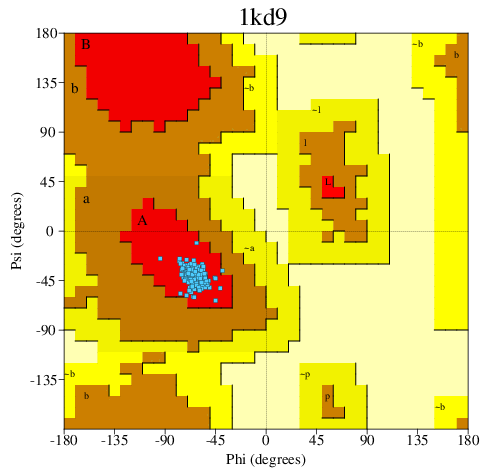
PROCHECK
|
|
|
|
|
|
Headers
|
|
|
|
References
|
|
|
|
|
|

|
|
No UniProt id for this chain
|
|
|
|
|
|
|
|
|
|
|
|
|
|
|
|
|
|
|
|
|
|
|
|
|
 |
|
|
|
|
|
|
| |
|
DOI no:
|
Proc Natl Acad Sci U S A
98:14825-14830
(2001)
|
|
PubMed id:
|
|
|
|
|
|
| |
|
Side-chain repacking calculations for predicting structures and stabilities of heterodimeric coiled coils.
|
|
A.E.Keating,
V.N.Malashkevich,
B.Tidor,
P.S.Kim.
|
|
|
|
|
| |
ABSTRACT
|
|
|
|
| |
|
|
An important goal in biology is to predict from sequence data the
high-resolution structures of proteins and the interactions that occur between
them. In this paper, we describe a computational approach that can make these
types of predictions for a series of coiled-coil dimers. Our method comprises a
dual strategy that augments extensive conformational sampling with molecular
mechanics minimization. To test the performance of the method, we designed six
heterodimeric coiled coils with a range of stabilities and solved x-ray crystal
structures for three of them. The stabilities and structures predicted by the
calculations agree very well with experimental data: the average error in
unfolding free energies is <1 kcal/mol, and nonhydrogen atoms in the
predicted structures superimpose onto the experimental structures with rms
deviations <0.7 A. We have also tested the method on a series of homodimers
derived from vitellogenin-binding protein. The predicted relative stabilities of
the homodimers show excellent agreement with previously published experimental
measurements. A critical step in our procedure is to use energy minimization to
relax side-chain geometries initially selected from a rotamer library. Our
results show that computational methods can predict interaction specificities
that are in good agreement with experimental data.
|
|
|
|
|
|
| |
Selected figure(s)
|
|
|
|
| |
|
|

|
|

|
|
Figure 1.
Fig. 1. Helical wheel diagram of the heterodimeric coiled
coil GABH. Substitutions of Val, Ile, and Leu were made at
positions d12 and a16 (yellow boxes) to give six peptides:
A[LI]B[LL], A[LL]B[LL], A[IV]B[LL], A[LL]B[IV], A[LI]B[IV], and
A[IV]B[IV] (notation: Acid[d12a16]Base[d12a16]). The linear
sequence is:
Ac-(E/K)VKQL(E/K)A(E/K)VEEd12(E/K)S(E/K)a16WHL(E/K)N(E/K)VARL(E/K)K(E/K)NAEC(E/K)A-NH[2];
the ACID peptide has E and the BASE peptide has K at positions
in parentheses.
|
|
Figure 6.
Fig. 6. Superposition of the x-ray and
MIN-FULL-calculated structures. The structures shown correspond
to the first entries in Table 3 for each peptide. The view is
from the C terminus of the peptide and includes positions a16
and d12.
|
|
|
|
| |
Figures were
selected
by the author.
|
|
|
|
|
|
|
|
|
|
|
|
|
|
|
|
 |
 |
 |
|
Literature references that cite this PDB file's key reference
|
|
|
| |
PubMed id
|
|
Reference
|
|
|
|
|
|
D.J.Mandell,
and
T.Kortemme
(2009).
Computer-aided design of functional protein interactions.
|
| |
Nat Chem Biol,
5,
797-807.
|
|
|
|
|
|
|
J.R.Apgar,
S.Hahn,
G.Grigoryan,
and
A.E.Keating
(2009).
Cluster expansion models for flexible-backbone protein energetics.
|
| |
J Comput Chem,
30,
2402-2413.
|
|
|
|
|
|
|
C.Xu,
and
J.Kopecek
(2008).
Genetically engineered block copolymers: influence of the length and structure of the coiled-coil blocks on hydrogel self-assembly.
|
| |
Pharm Res,
25,
674-682.
|
|
|
|
|
|
|
E.B.Hadley,
O.D.Testa,
D.N.Woolfson,
and
S.H.Gellman
(2008).
Preferred side-chain constellations at antiparallel coiled-coil interfaces.
|
| |
Proc Natl Acad Sci U S A,
105,
530-535.
|
|
|
|
|
|
|
I.Georgiev,
R.H.Lilien,
and
B.R.Donald
(2008).
The minimized dead-end elimination criterion and its application to protein redesign in a hybrid scoring and search algorithm for computing partition functions over molecular ensembles.
|
| |
J Comput Chem,
29,
1527-1542.
|
|
|
|
|
|
|
G.L.Butterfoss,
and
B.Kuhlman
(2006).
Computer-based design of novel protein structures.
|
| |
Annu Rev Biophys Biomol Struct,
35,
49-65.
|
|
|
|
|
|
|
J.H.Park,
and
R.G.Roeder
(2006).
GAS41 is required for repression of the p53 tumor suppressor pathway during normal cellular proliferation.
|
| |
Mol Cell Biol,
26,
4006-4016.
|
|
|
|
|
|
|
M.C.Saraf,
G.L.Moore,
N.M.Goodey,
V.Y.Cao,
S.J.Benkovic,
and
C.D.Maranas
(2006).
IPRO: an iterative computational protein library redesign and optimization procedure.
|
| |
Biophys J,
90,
4167-4180.
|
|
|
|
|
|
|
M.H.Ali,
C.M.Taylor,
G.Grigoryan,
K.N.Allen,
B.Imperiali,
and
A.E.Keating
(2005).
Design of a heterospecific, tetrameric, 21-residue miniprotein with mixed alpha/beta structure.
|
| |
Structure,
13,
225-234.
|
|
|
PDB code:
|
|
|
|
|
|
|
|
R.H.Lilien,
B.W.Stevens,
A.C.Anderson,
and
B.R.Donald
(2005).
A novel ensemble-based scoring and search algorithm for protein redesign and its application to modify the substrate specificity of the gramicidin synthetase a phenylalanine adenylation enzyme.
|
| |
J Comput Biol,
12,
740-761.
|
|
|
|
|
|
|
J.H.Fong,
A.E.Keating,
and
M.Singh
(2004).
Predicting specificity in bZIP coiled-coil protein interactions.
|
| |
Genome Biol,
5,
R11.
|
|
|
|
|
|
|
R.S.Tu,
and
M.Tirrell
(2004).
Bottom-up design of biomimetic assemblies.
|
| |
Adv Drug Deliv Rev,
56,
1537-1563.
|
|
|
|
|
|
|
R.W.Peterson,
P.L.Dutton,
and
A.J.Wand
(2004).
Improved side-chain prediction accuracy using an ab initio potential energy function and a very large rotamer library.
|
| |
Protein Sci,
13,
735-751.
|
|
|
|
|
|
|
J.J.Havranek,
and
P.B.Harbury
(2003).
Automated design of specificity in molecular recognition.
|
| |
Nat Struct Biol,
10,
45-52.
|
|
|
|
|
|
|
J.Mendes,
R.Guerois,
and
L.Serrano
(2002).
Energy estimation in protein design.
|
| |
Curr Opin Struct Biol,
12,
441-446.
|
|
|
|
|
|
|
R.L.Dunbrack
(2002).
Rotamer libraries in the 21st century.
|
| |
Curr Opin Struct Biol,
12,
431-440.
|
|
|
|
|
|
|
Y.B.Yu
(2002).
Coiled-coils: stability, specificity, and drug delivery potential.
|
| |
Adv Drug Deliv Rev,
54,
1113-1129.
|
|
|
|
|
|
The most recent references are shown first.
Citation data come partly from CiteXplore and partly
from an automated harvesting procedure. Note that this is likely to be
only a partial list as not all journals are covered by
either method. However, we are continually building up the citation data
so more and more references will be included with time.
Where a reference describes a PDB structure, the PDB
code is
shown on the right.
|
 |
|


 Links
Links


