 |
PDBsum entry 1jns

|
|
|
|
|
 |
Contents |
 |
|
|
|
|
|
|
|
|
* Residue conservation analysis
|
|
|
|
|
|
PDB id:
|
|
|
|
| Name: |
|
Isomerase
|
|
|
Title:
|
|
Nmr structure of the e. Coli peptidyl-prolyl cis/trans-isomerase parvulin 10
|
|
Structure:
|
|
Peptidyl-prolyl cis-trans isomerasE C. Chain: a. Synonym: parvulin, ppiasE C, rotamasE C. Engineered: yes
|
|
Source:
|
|
Escherichia coli. Organism_taxid: 562. Gene: para. Expressed in: escherichia coli. Expression_system_taxid: 562.
|
|
NMR struc:
|
|
18 models
|
|
|
Authors:
|
|
A.Kuehlewein,G.Voll,B.Schelbert,H.Kessler,G.Fischer,J.U.Rahfeld, G.Gemmecker
|
Key ref:

|
|
A.Kühlewein
et al.
(2004).
Solution structure of Escherichia coli Par10: The prototypic member of the Parvulin family of peptidyl-prolyl cis/trans isomerases.
Protein Sci,
13,
2378-2387.
PubMed id:
DOI:

|
|
|
Date:
|
|
|
25-Jul-01
|
Release date:
|
17-Jun-03
|
|
|
|
|
|
|
PROCHECK
|

|
|
|
|
|
Headers
|
|
|
|
References
|
|
|
|
|
|

|
|
P0A9L5
(PPIC_ECOLI) -
Peptidyl-prolyl cis-trans isomerase C from Escherichia coli (strain K12)
|
|
|
|
Seq:
Struc:
|
|
|
|
93 a.a.
92 a.a.
|
|

|

|
|
|
|
|
|
|
|
|
|
|
|
Key: |
 |
PfamA domain |
|
|
 |
Secondary structure |
|
 |
CATH domain |
|
|
|
|
|
|
|
|
|
|
|
|
|
Enzyme class:
|
|
E.C.5.2.1.8
- peptidylprolyl isomerase.
|
|
|
|
|
|
|
Reaction:
|
|
[protein]-peptidylproline (omega=180) = [protein]-peptidylproline (omega=0)
|
|
|
|
|
|
 Peptidylproline (omega=180)
|
=
|
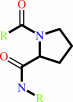 peptidylproline (omega=0)
|
|
|
|
|
|
|
|
|
|
|
|
|
Molecule diagrams generated from .mol files obtained from the
KEGG ftp site
|
|
|
|
|
|
|
|
|
|
|
|
|
|
 |
|
|
|
|
|
|
| |
|
|
| |
|
DOI no:
|
Protein Sci
13:2378-2387
(2004)
|
|
PubMed id:
|
|
|
|
|
|
| |
|
Solution structure of Escherichia coli Par10: The prototypic member of the Parvulin family of peptidyl-prolyl cis/trans isomerases.
|
|
A.Kühlewein,
G.Voll,
B.Hernandez Alvarez,
H.Kessler,
G.Fischer,
J.U.Rahfeld,
G.Gemmecker.
|
|
|
|
|
| |
ABSTRACT
|
|
|
|
| |
|
|
E. coli Par10 is a peptidyl-prolyl cis/trans isomerase (PPIase) from Escherichia
coli catalyzing the isomerization of Xaa-Pro bonds in oligopeptides with a broad
substrate specificity. The structure of E. coli Par10 has been determined by
multidimensional solution-state NMR spectroscopy based on 1207 conformational
constraints (1067 NOE-derived distances, 42 vicinal coupling-constant
restraints, 30 hydrogen-bond restraints, and 68 phi/psi restraints derived from
the Chemical Shift Index). Simulated-annealing calculations with the program
ARIA and subsequent refinement with XPLOR yielded a set of 18 convergent
structures with an average backbone RMSD from mean atomic coordinates of 0.50 A
within the well-defined secondary structure elements. E. coli Par10 is the
smallest known PPIase so far, with a high catalytic efficiency comparable to
that of FKBPs and cyclophilins. The secondary structure of E. coli Par10
consists of four helical regions and a four-stranded antiparallel beta-sheet.
The N terminus forms a beta-strand, followed by a large stretch comprising three
alpha-helices. A loop region containing a short beta-strand separates these
helices from a fourth alpha-helix. The C terminus consists of two more
beta-strands completing the four-stranded anti-parallel beta-sheet with strand
order 2143. Interestingly, the third beta-strand includes a Gly-Pro cis peptide
bond. The curved beta-strand forms a hydrophobic binding pocket together with
alpha-helix 4, which also contains a number of highly conserved residues. The
three-dimensional structure of Par10 closely resembles that of the human
proteins hPin1 and hPar14 and the plant protein Pin1At, belonging to the same
family of highly homologous proteins.
|
|
|
|
|
|
| |
Selected figure(s)
|
|
|
|
| |
|
|

|
|

|
|
Figure 3.
Figure 3. Topology of E. coli Par10. Filled arrows
symbolize experimental H[  ]-H[ ]NOE contacts;
open arrows reflect observed H[N]-H[N] NOEs within the ]-H[ ]NOE contacts;
open arrows reflect observed H[N]-H[N] NOEs within the  -sheet. -sheet.
|
|
Figure 6.
Figure 6. Orientation of the H-bonds in the -sheet and
putative substrate binding site of different Parvulins. (A)
Arrangement of the G75-P76 cis amide bond in E. coli Par10,
compared with the two homologous structures hPin1 and hPar14. In
spite of the bulge resulting from the cis peptide bond, the -sheet of E.
coli Par10 can form all four H-bonds whereas the structures of
hPar14 and hPin1 with trans-Pro are only stabilized by three
H-bonds in this region (figure produced with Insight II, MSI
Inc.). (B) Comparison of the putative binding pockets of hPar14
(PDB code 1eq3, green residues) and hPin1 (PDB code 1pin; red
residues) overlaid on the E. coli Par10 structure (PDB code
1jnt; blue residues, grey backbone). The labeled residues are
highly conserved in all parvulins and may be involved in the
catalytic activity of these parvulins (figure produced with
MOLMOL, version 2k.1; Koradi et al. 1996). (C) Connolly surface
of E. coli Par10. Helix 4 (left) and the curved -sheet form a
lipophilic gap (brown), enabling a lipophilic oligopeptide
substrate to bind (figure produced with the MOLCAD module of the
program Sybyl, version 6.3; Tripos AG).
|
|
|
|
|
|
| |
The above figures are
reprinted
by permission from the Protein Society:
Protein Sci
(2004,
13,
2378-2387)
copyright 2004.
|
|
| |
Figures were
selected
by the author.
|
|
|
|
|
|
|
|
|
|
|
|
|
|
|
|
 |
 |
 |
|
Literature references that cite this PDB file's key reference
|
|
|
| |
PubMed id
|
|
Reference
|
|
|
|
|
|
Å.�.Jaremko,
M.Jaremko,
I.Elfaki,
J.W.Mueller,
A.Ejchart,
P.Bayer,
and
I.Zhukov
(2011).
Structure and dynamics of the first archaeal parvulin reveal a new functionally important loop in parvulin-type prolyl isomerases.
|
| |
J Biol Chem,
286,
6554-6565.
|
|
|
PDB code:
|
|
|
|
|
|
|
|
H.L.Hyyryläinen,
B.C.Marciniak,
K.Dahncke,
M.Pietiäinen,
P.Courtin,
M.Vitikainen,
R.Seppala,
A.Otto,
D.Becher,
M.P.Chapot-Chartier,
O.P.Kuipers,
and
V.P.Kontinen
(2010).
Penicillin-binding protein folding is dependent on the PrsA peptidyl-prolyl cis-trans isomerase in Bacillus subtilis.
|
| |
Mol Microbiol,
77,
108-127.
|
|
|
|
|
|
|
U.Weininger,
R.P.Jakob,
M.Kovermann,
J.Balbach,
and
F.X.Schmid
(2010).
The prolyl isomerase domain of PpiD from Escherichia coli shows a parvulin fold but is devoid of catalytic activity.
|
| |
Protein Sci,
19,
6.
|
|
|
PDB code:
|
|
|
|
|
|
|
|
O.Heikkinen,
R.Seppala,
H.Tossavainen,
S.Heikkinen,
H.Koskela,
P.Permi,
and
I.Kilpeläinen
(2009).
Solution structure of the parvulin-type PPIase domain of Staphylococcus aureus PrsA--implications for the catalytic mechanism of parvulins.
|
| |
BMC Struct Biol,
9,
17.
|
|
|
PDB code:
|
|
|
|
|
|
|
|
J.W.Mueller,
and
P.Bayer
(2008).
Small family with key contacts: par14 and par17 parvulin proteins, relatives of pin1, now emerge in biomedical research.
|
| |
Perspect Medicin Chem,
2,
11-20.
|
|
|
|
|
|
|
N.Wehofsky,
C.Wespe,
V.Cerovsky,
A.Pech,
E.Hoess,
R.Rudolph,
and
F.Bordusa
(2008).
Ionic liquids and proteases: a clean alliance for semisynthesis.
|
| |
Chembiochem,
9,
1493-1499.
|
|
|
|
|
|
The most recent references are shown first.
Citation data come partly from CiteXplore and partly
from an automated harvesting procedure. Note that this is likely to be
only a partial list as not all journals are covered by
either method. However, we are continually building up the citation data
so more and more references will be included with time.
Where a reference describes a PDB structure, the PDB
code is
shown on the right.
|
|


 Links
Links


