 |
PDBsum entry 1jmf

|
|
|
|
|
 |
Contents |
 |
|
|
|
|
|
|
|
|
|
|
|
|
* Residue conservation analysis
|
|
|
|
|
|
|
|
|
|
|
Enzyme class:
|
|
E.C.2.1.1.45
- thymidylate synthase.
|
|
|
|
|
|
|
Pathway:
|
|
Folate Coenzymes
|
|
|
|
|
|
Reaction:
|
|
dUMP + (6R)-5,10-methylene-5,6,7,8-tetrahydrofolate = 7,8-dihydrofolate + dTMP
|
|
|
|
|
|
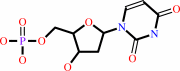 dUMP
dUMP
|
+
|
(6R)-5,10-methylene-5,6,7,8-tetrahydrofolate
Bound ligand (Het Group name = )
corresponds exactly
|
=
|
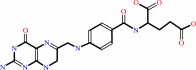 7,8-dihydrofolate
|
+
|
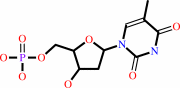 dTMP
dTMP
|
|
|
|
|
|
|
|
|
|
|
|
|
Molecule diagrams generated from .mol files obtained from the
KEGG ftp site
|
|
|
|
|
|
|
|
|
|
|
|
|
|
 |
|
|
|
|
|
|
| |
|
|
| |
|
DOI no:
|
J Mol Biol
276:113-129
(1998)
|
|
PubMed id:
|
|
|
|
|
|
| |
|
Contributions of orientation and hydrogen bonding to catalysis in Asn229 mutants of thymidylate synthase.
|
|
J.S.Finer-Moore,
L.Liu,
D.L.Birdsall,
R.Brem,
J.Apfeld,
D.V.Santi,
R.M.Stroud.
|
|
|
|
|
| |
ABSTRACT
|
|
|
|
| |
|
|
We have determined structures of binary and ternary complexes of five Asn229
variants of thymidylate synthase (TS) and related their structures to the
kinetic constants measured previously. Asn229 forms two hydrogen bonds to the
pyrimidine ring of the substrate 2'-deoxyuridine-5'-monophosphate (dUMP). These
hydrogen bonds constrain the orientation of dUMP in binary complexes with dUMP,
and in ternary complexes with dUMP and the TS cofactor,
5,10-methylene-5,6,7,8-tetrahydrofolate. In N229 mutants, where these hydrogen
bonds cannot be made, dUMP binds in a misoriented or more disordered fashion.
Most N229 mutants exhibit no activity for the dehalogenation of 5-bromo-dUMP,
which requires correct orientation of dUMP against Cys198. Since bound dUMP
forms the binding surface against which the pterin ring of cofactor binds,
misorientation of dUMP results in higher Km values for cofactor. At the same
time, binding of the cofactor aids in ordering and positioning dUMP for
catalysis. Hydrophobic mutants, such as N229I, favor an arrangement of solvent
molecules and side-chains around the ligands similar to that in a proposed
transition state for ternary complex formation in wild-type TS, and kcat values
are similar to the wild-type value. Smaller, more hydrophilic mutants favor
arrangements of the solvent and side-chains surrounding the ligands that do not
resemble the proposed transition state. These changes correspond to decreases in
kcat of up to 2000-fold, with only modest increases in Km or Kd. These results
are consistent with the proposal that the hydrogen-bonding network between
water, dUMP and side-chains in the active-site cavity contributes to catalysis
in TS. Asn229 has the unique ability to maintain this critical network, without
sterically interfering with dUMP binding.
|
|
|
|
|
|
| |
Selected figure(s)
|
|
|
|
| |
|
|

|
|

|
|
Figure 1.
Figure 1. Proposed mechanism for thymidylate synthase. In
this scheme, AH represents a general base, perhaps the ordered
water molecule Wat1.
|
|
Figure 2.
Figure 2. A drawing of the hydrogen-bond network involving
the pyrimidine ring of dUMP, surrounding residues, and ordered
water molecules in the L. casei TS binary complex with dUMP
[Finer-Moore et al 1993]. Conserved water molecules are labeled
consistently in all drawings.
|
|
|
|
|
|
| |
The above figures are
reprinted
by permission from Elsevier:
J Mol Biol
(1998,
276,
113-129)
copyright 1998.
|
|
| |
Figures were
selected
by an automated process.
|
|
|
|
|
|
|
|
|
|
|
|
|
|
|
|
 |
 |
 |
|
Literature references that cite this PDB file's key reference
|
|
|
| |
PubMed id
|
|
Reference
|
|
|
|
|
|
C.D.Andersson,
B.Y.Chen,
and
A.Linusson
(2010).
Mapping of ligand-binding cavities in proteins.
|
| |
Proteins,
78,
1408-1422.
|
|
|
|
|
|
|
W.E.Martucci,
M.A.Vargo,
and
K.S.Anderson
(2008).
Explaining an unusually fast parasitic enzyme: folate tail-binding residues dictate substrate positioning and catalysis in Cryptosporidium hominis thymidylate synthase.
|
| |
Biochemistry,
47,
8902-8911.
|
|
|
PDB codes:
|
|
|
|
|
|
|
|
Z.Newby,
T.T.Lee,
R.J.Morse,
Y.Liu,
L.Liu,
P.Venkatraman,
D.V.Santi,
J.S.Finer-Moore,
and
R.M.Stroud
(2006).
The role of protein dynamics in thymidylate synthase catalysis: variants of conserved 2'-deoxyuridine 5'-monophosphate (dUMP)-binding Tyr-261.
|
| |
Biochemistry,
45,
7415-7428.
|
|
|
PDB codes:
|
|
|
|
|
|
|
|
P.Variath,
Y.Liu,
T.T.Lee,
R.M.Stroud,
and
D.V.Santi
(2000).
Effects of subunit occupancy on partitioning of an intermediate in thymidylate synthase mutants.
|
| |
Biochemistry,
39,
2429-2435.
|
|
|
|
|
|
|
R.J.Morse,
S.Kawase,
D.V.Santi,
J.Finer-Moore,
and
R.M.Stroud
(2000).
Energetic contributions of four arginines to phosphate-binding in thymidylate synthase are more than additive and depend on optimization of "effective charge balance".
|
| |
Biochemistry,
39,
1011-1020.
|
|
|
PDB codes:
|
|
|
|
|
|
|
|
H.K.Song,
S.H.Sohn,
and
S.W.Suh
(1999).
Crystal structure of deoxycytidylate hydroxymethylase from bacteriophage T4, a component of the deoxyribonucleoside triphosphate-synthesizing complex.
|
| |
EMBO J,
18,
1104-1113.
|
|
|
PDB codes:
|
|
|
|
|
|
|
The most recent references are shown first.
Citation data come partly from CiteXplore and partly
from an automated harvesting procedure. Note that this is likely to be
only a partial list as not all journals are covered by
either method. However, we are continually building up the citation data
so more and more references will be included with time.
Where a reference describes a PDB structure, the PDB
codes are
shown on the right.
|
|


 Links
Links


