
|
|
|
|
|
 |
Contents |
 |
|
|
|
|
|
|
|
|
|
|
|
 180 a.a.
|
|
|
|
|
|
|
|
|
|
|
 180 a.a.
|
|
|
|
|
|
|
|
|
|
|
 13 a.a.
|
|
|
|
|
|
|
|
|
|
|
 198 a.a.
|
|
|
|
|
|
|
|
|
|
|
 241 a.a.
|
|
|
|
|
|
|
|
|
|
|
* Residue conservation analysis
|
|
|
|
|
|
PDB id:
|
|
|
|
| Name: |
|
Immune system
|
|
|
Title:
|
|
Crystal structure of a complex of a human alpha/beta-t cell receptor, influenza ha antigen peptide, and mhc class ii molecule, hla-dr4
|
|
Structure:
|
|
Hla class ii histocompatibility antigen, dr alpha chain. Chain: a. Fragment: extracellular domain. Synonym: hla-dr1, dra. Engineered: yes. Hla class ii histocompatibility antigen, dr-4 beta chain. Chain: b. Fragment: extracellular domain. Synonym: hla-dr4, drb1 0401.
|
|
Source:
|
|
Homo sapiens. Human. Organism_taxid: 9606. Expressed in: drosophila melanogaster. Expression_system_taxid: 7227. Expression_system_cell_line: schneider. Influenzavirus a. Organism_taxid: 197911. Expressed in: escherichia coli bl21(de3).
|
|
Biol. unit:
|
|
Pentamer (from
)
|
|
Resolution:
|
|
|
2.40Å
|
R-factor:
|
0.211
|
R-free:
|
0.246
|
|
|
Authors:
|
|
J.Hennecke,D.C.Wiley
|
|
Key ref:
|
|
J.Hennecke
and
D.C.Wiley
(2002).
Structure of a complex of the human alpha/beta T cell receptor (TCR) HA1.7, influenza hemagglutinin peptide, and major histocompatibility complex class II molecule, HLA-DR4 (DRA*0101 and DRB1*0401): insight into TCR cross-restriction and alloreactivity.
J Exp Med,
195,
571-581.
PubMed id:
|
|
|
Date:
|
|
|
21-May-01
|
Release date:
|
13-Mar-02
|
|
|
|
|
|
|
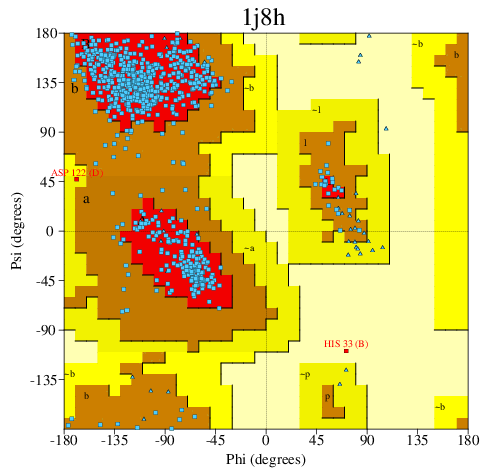
PROCHECK
|
|
|
|
|
|
Headers
|
|
|
|
References
|
|
|
|
|
|

|
|
P01903
(DRA_HUMAN) -
HLA class II histocompatibility antigen, DR alpha chain from Homo sapiens
|
|
|
|
Seq:
Struc:
|
|
|
|
254 a.a.
180 a.a.
|
|

|

|
|
|
|
|
|
|
|
|
|
|
|
|

|
|
P01911
(2B1F_HUMAN) -
HLA class II histocompatibility antigen, DRB1 beta chain from Homo sapiens
|
|
|
|
Seq:
Struc:
|
|
|
|
266 a.a.
180 a.a.*
|
|
|

|
|
|
|
|
|
|
|
|
|
|
|
|

|
|
P03437
(HEMA_I68A0) -
Hemagglutinin from Influenza A virus (strain A/Aichi/2/1968 H3N2)
|
|
|
|
Seq:
Struc:
|
|
|
|
566 a.a.
13 a.a.
|
|
|

|
|
|
|
|
|
|
|
|
|
|
|
|
|
|
|
|
|
|
|
|
|
 |
|
|
|
|
|
|
| |
|
|
J Exp Med
195:571-581
(2002)
|
|
PubMed id:
|
|
|
|
|
|
| |
|
Structure of a complex of the human alpha/beta T cell receptor (TCR) HA1.7, influenza hemagglutinin peptide, and major histocompatibility complex class II molecule, HLA-DR4 (DRA*0101 and DRB1*0401): insight into TCR cross-restriction and alloreactivity.
|
|
J.Hennecke,
D.C.Wiley.
|
|
|
|
|
| |
ABSTRACT
|
|
|
|
| |
|
|
The alpha/beta T cell receptor (TCR) HA1.7 specific for the hemagglutinin (HA)
antigen peptide from influenza A virus is HLA-DR1 restricted but cross-reactive
for the HA peptide presented by the allo-major histocompatibility complex (MHC)
class II molecule HLA-DR4. We report here the structure of the HA1.7/DR4/HA
complex, determined by X-ray crystallography at a resolution of 2.4 A. The
overall structure of this complex is very similar to the previously reported
structure of the HA1.7/DR1/HA complex. Amino acid sequence differences between
DR1 and DR4, which are located deep in the peptide binding groove and out of
reach for direct contact by the TCR, are able to indirectly influence the
antigenicity of the pMHC surface by changing the conformation of HA peptide
residues at position P5 and P6. Although TCR HA1.7 is cross-reactive for HA
presented by DR1 and DR4 and tolerates these conformational differences, other
HA-specific TCRs are sensitive to these changes. We also find a dependence of
the width of the MHC class II peptide-binding groove on the sequence of the
bound peptide by comparing the HA1.7/DR4/HA complex with the structure of DR4
presenting a collagen peptide. This structural study of TCR cross-reactivity
emphasizes how MHC sequence differences can affect TCR binding indirectly by
moving peptide atoms.
|
|
|
|
|
|
|
|
|
|
|
|
|
|
|
|
|
|
 |
 |
 |
|
Literature references that cite this PDB file's key reference
|
|
|
| |
PubMed id
|
|
Reference
|
|
|
|
|
|
J.M.Khan,
and
S.Ranganathan
(2011).
Understanding TR Binding to pMHC Complexes: How Does a TR Scan Many pMHC Complexes yet Preferentially Bind to One.
|
| |
PLoS One,
6,
e17194.
|
|
|
|
|
|
|
Y.Yin,
Y.Li,
M.C.Kerzic,
R.Martin,
and
R.A.Mariuzza
(2011).
Structure of a TCR with high affinity for self-antigen reveals basis for escape from negative selection.
|
| |
EMBO J,
30,
1137-1148.
|
|
|
PDB code:
|
|
|
|
|
|
|
|
M.A.Patarroyo,
A.Bermúdez,
C.López,
G.Yepes,
and
M.E.Patarroyo
(2010).
3D analysis of the TCR/pMHCII complex formation in monkeys vaccinated with the first peptide inducing sterilizing immunity against human malaria.
|
| |
PLoS One,
5,
e9771.
|
|
|
|
|
|
|
M.C.De Rosa,
B.Giardina,
C.Bianchi,
C.Carelli Alinovi,
D.Pirolli,
G.Ferraccioli,
M.De Santis,
G.Di Sante,
and
F.Ria
(2010).
Modeling the ternary complex TCR-Vbeta/CollagenII(261-273)/HLA-DR4 associated with rheumatoid arthritis.
|
| |
PLoS One,
5,
e11550.
|
|
|
|
|
|
|
J.B.Imboden
(2009).
The immunopathogenesis of rheumatoid arthritis.
|
| |
Annu Rev Pathol,
4,
417-434.
|
|
|
|
|
|
|
M.Harkiolaki,
S.L.Holmes,
P.Svendsen,
J.W.Gregersen,
L.T.Jensen,
R.McMahon,
M.A.Friese,
G.van Boxel,
R.Etzensperger,
J.S.Tzartos,
K.Kranc,
S.Sainsbury,
K.Harlos,
E.D.Mellins,
J.Palace,
M.M.Esiri,
P.A.van der Merwe,
E.Y.Jones,
and
L.Fugger
(2009).
T cell-mediated autoimmune disease due to low-affinity crossreactivity to common microbial peptides.
|
| |
Immunity,
30,
348-357.
|
|
|
PDB code:
|
|
|
|
|
|
|
|
Y.Xiao,
A.M.Lazaro,
C.Masaberg,
M.Haagenson,
C.Vierra-Green,
S.Spellman,
S.Dakshanamurthy,
J.Ng,
and
C.K.Hurley
(2009).
Evaluating the potential impact of mismatches outside the antigen recognition site in unrelated hematopoietic stem cell transplantation: HLA-DRB1*1454 and DRB1*140101.
|
| |
Tissue Antigens,
73,
595-598.
|
|
|
|
|
|
|
C.McBeth,
A.Seamons,
J.C.Pizarro,
S.J.Fleishman,
D.Baker,
T.Kortemme,
J.M.Goverman,
and
R.K.Strong
(2008).
A new twist in TCR diversity revealed by a forbidden alphabeta TCR.
|
| |
J Mol Biol,
375,
1306-1319.
|
|
|
PDB codes:
|
|
|
|
|
|
|
|
C.O'Brien,
D.R.Flower,
and
C.Feighery
(2008).
Peptide length significantly influences in vitro affinity for MHC class II molecules.
|
| |
Immunome Res,
4,
6.
|
|
|
|
|
|
|
E.J.Collins,
and
D.S.Riddle
(2008).
TCR-MHC docking orientation: natural selection, or thymic selection?
|
| |
Immunol Res,
41,
267-294.
|
|
|
|
|
|
|
F.Menconi,
M.C.Monti,
D.A.Greenberg,
T.Oashi,
R.Osman,
T.F.Davies,
Y.Ban,
E.M.Jacobson,
E.S.Concepcion,
C.W.Li,
and
Y.Tomer
(2008).
Molecular amino acid signatures in the MHC class II peptide-binding pocket predispose to autoimmune thyroiditis in humans and in mice.
|
| |
Proc Natl Acad Sci U S A,
105,
14034-14039.
|
|
|
|
|
|
|
I.Alvarez,
J.Collado,
X.Daura,
N.Colomé,
M.Rodríguez-García,
T.Gallart,
F.Canals,
and
D.Jaraquemada
(2008).
The rheumatoid arthritis-associated allele HLA-DR10 (DRB1*1001) shares part of its repertoire with HLA-DR1 (DRB1*0101) and HLA-DR4 (DRB*0401).
|
| |
Arthritis Rheum,
58,
1630-1639.
|
|
|
|
|
|
|
J.K.Archbold,
W.A.Macdonald,
S.R.Burrows,
J.Rossjohn,
and
J.McCluskey
(2008).
T-cell allorecognition: a case of mistaken identity or déjà vu?
|
| |
Trends Immunol,
29,
220-226.
|
|
|
|
|
|
|
P.Marrack,
K.Rubtsova,
J.Scott-Browne,
and
J.W.Kappler
(2008).
T cell receptor specificity for major histocompatibility complex proteins.
|
| |
Curr Opin Immunol,
20,
203-207.
|
|
|
|
|
|
|
S.Dai,
E.S.Huseby,
K.Rubtsova,
J.Scott-Browne,
F.Crawford,
W.A.Macdonald,
P.Marrack,
and
J.W.Kappler
(2008).
Crossreactive T Cells spotlight the germline rules for alphabeta T cell-receptor interactions with MHC molecules.
|
| |
Immunity,
28,
324-334.
|
|
|
PDB codes:
|
|
|
|
|
|
|
|
A.Bharat,
and
T.Mohanakumar
(2007).
Allopeptides and the alloimmune response.
|
| |
Cell Immunol,
248,
31-43.
|
|
|
|
|
|
|
A.M.Boots,
H.Hubers,
M.Kouwijzer,
L.den Hoed-van Zandbrink,
B.M.Westrek-Esselink,
C.van Doorn,
R.Stenger,
E.S.Bos,
M.J.van Lierop,
G.F.Verheijden,
C.M.Timmers,
and
C.J.van Staveren
(2007).
Identification of an altered peptide ligand based on the endogenously presented, rheumatoid arthritis-associated, human cartilage glycoprotein-39(263-275) epitope: an MHC anchor variant peptide for immune modulation.
|
| |
Arthritis Res Ther,
9,
R71.
|
|
|
|
|
|
|
B.E.Hansen,
A.H.Rasmussen,
B.K.Jakobsen,
L.P.Ryder,
and
A.Svejgaard
(2007).
Extraordinary cross-reactivity of an autoimmune T-cell receptor recognizing specific peptides both on autologous and on allogeneic HLA class II molecules.
|
| |
Tissue Antigens,
70,
42-52.
|
|
|
|
|
|
|
C.Mazza,
and
B.Malissen
(2007).
What guides MHC-restricted TCR recognition?
|
| |
Semin Immunol,
19,
225-235.
|
|
|
|
|
|
|
G.P.Bondinas,
A.K.Moustakas,
and
G.K.Papadopoulos
(2007).
The spectrum of HLA-DQ and HLA-DR alleles, 2006: a listing correlating sequence and structure with function.
|
| |
Immunogenetics,
59,
539-553.
|
|
|
|
|
|
|
N.J.Felix,
and
P.M.Allen
(2007).
Specificity of T-cell alloreactivity.
|
| |
Nat Rev Immunol,
7,
942-953.
|
|
|
|
|
|
|
E.Y.Jones,
L.Fugger,
J.L.Strominger,
and
C.Siebold
(2006).
MHC class II proteins and disease: a structural perspective.
|
| |
Nat Rev Immunol,
6,
271-282.
|
|
|
|
|
|
|
L.J.Carreño,
P.A.González,
and
A.M.Kalergis
(2006).
Modulation of T cell function by TCR/pMHC binding kinetics.
|
| |
Immunobiology,
211,
47-64.
|
|
|
|
|
|
|
M.G.Rudolph,
R.L.Stanfield,
and
I.A.Wilson
(2006).
How TCRs bind MHCs, peptides, and coreceptors.
|
| |
Annu Rev Immunol,
24,
419-466.
|
|
|
|
|
|
|
M.Sospedra,
P.A.Muraro,
I.Stefanová,
Y.Zhao,
K.Chung,
Y.Li,
M.Giulianotti,
R.Simon,
R.Mariuzza,
C.Pinilla,
and
R.Martin
(2006).
Redundancy in antigen-presenting function of the HLA-DR and -DQ molecules in the multiple sclerosis-associated HLA-DR2 haplotype.
|
| |
J Immunol,
176,
1951-1961.
|
|
|
|
|
|
|
S.Reichstetter,
N.E.Standifer,
K.A.Geubtner,
A.W.Liu,
S.L.Agar,
and
W.W.Kwok
(2006).
Cytotoxic herpes simplex type 2-specific, DQ0602-restricted CD4 T+-cell clones show alloreactivity to DQ0601.
|
| |
Immunology,
117,
350-357.
|
|
|
|
|
|
|
B.Hoppe,
G.A.Heymann,
H.Kiesewetter,
and
A.Salama
(2005).
Identification and characterization of a novel HLA-DRB1 allele, DRB1*0830*.
|
| |
Tissue Antigens,
66,
160-162.
|
|
|
|
|
|
|
D.Stepniak,
L.W.Vader,
Y.Kooy,
P.A.van Veelen,
A.Moustakas,
N.A.Papandreou,
E.Eliopoulos,
J.W.Drijfhout,
G.K.Papadopoulos,
and
F.Koning
(2005).
T-cell recognition of HLA-DQ2-bound gluten peptides can be influenced by an N-terminal proline at p-1.
|
| |
Immunogenetics,
57,
8.
|
|
|
|
|
|
|
H.Li,
S.Van Vranken,
Y.Zhao,
Z.Li,
Y.Guo,
L.Eisele,
and
Y.Li
(2005).
Crystal structures of T cell receptor (beta) chains related to rheumatoid arthritis.
|
| |
Protein Sci,
14,
3025-3038.
|
|
|
PDB codes:
|
|
|
|
|
|
|
|
J.M.Greer,
and
M.P.Pender
(2005).
The presence of glutamic acid at positions 71 or 74 in pocket 4 of the HLA-DRbeta1 chain is associated with the clinical course of multiple sclerosis.
|
| |
J Neurol Neurosurg Psychiatry,
76,
656-662.
|
|
|
|
|
|
|
M.Möllhoff,
H.B.Zanden,
P.R.Shiflett,
and
G.Gupta
(2005).
Modeling of receptor mimics that inhibit superantigen pathogenesis.
|
| |
J Mol Recognit,
18,
73-83.
|
|
|
|
|
|
|
Z.Pu,
S.B.Lovitch,
E.K.Bikoff,
and
E.R.Unanue
(2004).
T cells distinguish MHC-peptide complexes formed in separate vesicles and edited by H2-DM.
|
| |
Immunity,
20,
467-476.
|
|
|
|
|
|
|
Z.Zavala-Ruiz,
I.Strug,
B.D.Walker,
P.J.Norris,
and
L.J.Stern
(2004).
A hairpin turn in a class II MHC-bound peptide orients residues outside the binding groove for T cell recognition.
|
| |
Proc Natl Acad Sci U S A,
101,
13279-13284.
|
|
|
PDB codes:
|
|
|
|
|
|
|
|
B.Malissen
(2003).
Glimpses at TCR trans-species crossreactivity.
|
| |
Immunity,
19,
463-464.
|
|
|
|
|
|
|
C.E.Voorter,
B.G.Hepkema,
S.P.Lems,
and
E.M.van den Berg-Loonen
(2003).
Identification of three new DRB1 alleles, DRB1*0107, *0425 and *13012 and confirmation of DRB4*01033.
|
| |
Tissue Antigens,
61,
398-402.
|
|
|
|
|
|
|
D.Housset,
and
B.Malissen
(2003).
What do TCR-pMHC crystal structures teach us about MHC restriction and alloreactivity?
|
| |
Trends Immunol,
24,
429-437.
|
|
|
|
|
|
|
J.A.Hill,
D.Wang,
A.M.Jevnikar,
E.Cairns,
and
D.A.Bell
(2003).
The relationship between predicted peptide-MHC class II affinity and T-cell activation in a HLA-DRbeta1*0401 transgenic mouse model.
|
| |
Arthritis Res Ther,
5,
R40-R48.
|
|
|
|
|
|
|
M.E.Ressing,
D.van Leeuwen,
F.A.Verreck,
R.Gomez,
B.Heemskerk,
M.Toebes,
M.M.Mullen,
T.S.Jardetzky,
R.Longnecker,
M.W.Schilham,
T.H.Ottenhoff,
J.Neefjes,
T.N.Schumacher,
L.M.Hutt-Fletcher,
and
E.J.Wiertz
(2003).
Interference with T cell receptor-HLA-DR interactions by Epstein-Barr virus gp42 results in reduced T helper cell recognition.
|
| |
Proc Natl Acad Sci U S A,
100,
11583-11588.
|
|
|
|
|
|
|
G.F.Gao,
Z.Rao,
and
J.I.Bell
(2002).
Molecular coordination of alphabeta T-cell receptors and coreceptors CD8 and CD4 in their recognition of peptide-MHC ligands.
|
| |
Trends Immunol,
23,
408-413.
|
|
|
|
|
|
|
J.G.Luz,
M.Huang,
K.C.Garcia,
M.G.Rudolph,
V.Apostolopoulos,
L.Teyton,
and
I.A.Wilson
(2002).
Structural comparison of allogeneic and syngeneic T cell receptor-peptide-major histocompatibility complex complexes: a buried alloreactive mutation subtly alters peptide presentation substantially increasing V(beta) Interactions.
|
| |
J Exp Med,
195,
1175-1186.
|
|
|
PDB codes:
|
|
|
|
|
|
|
|
L.C.Wu,
D.S.Tuot,
D.S.Lyons,
K.C.Garcia,
and
M.M.Davis
(2002).
Two-step binding mechanism for T-cell receptor recognition of peptide MHC.
|
| |
Nature,
418,
552-556.
|
|
|
|
|
|
The most recent references are shown first.
Citation data come partly from CiteXplore and partly
from an automated harvesting procedure. Note that this is likely to be
only a partial list as not all journals are covered by
either method. However, we are continually building up the citation data
so more and more references will be included with time.
Where a reference describes a PDB structure, the PDB
code is
shown on the right.
|

| |


 Links
Links









