 |
PDBsum entry 1j7a

|
|
|
|
|
|

|

|

|

|
|

|
|

|
|

|
|
|
 |

|

|
|
|
|
|
|
|
|
|
|
|
|
|
|
|
|
|
|
|
|
|
|
|
|
|
|
|
|
|
|
|
|
Electron transport
|
PDB id
|
|
|
|
1j7a
|
|
|
|
|
|
|
|
|
|
|
|
|
|
|

|

|

|
|
|
|
|
|
|
|
 |
Contents |
 |
|
|
|
|
|
|
|
|
|
|
|
|
* Residue conservation analysis
|
|
|
|
|
|
PDB id:
|
|
|
|
| Name: |
|
Electron transport
|
|
|
Title:
|
|
Structure of the anabaena ferredoxin d68k mutant
|
|
Structure:
|
|
Ferredoxin i. Chain: a. Engineered: yes. Mutation: yes
|
|
Source:
|
|
Nostoc sp. Pcc. Organism_taxid: 103690. Strain: 7120. Expressed in: escherichia coli. Expression_system_taxid: 562.
|
|
Resolution:
|
|
|
|
Authors:
|
|
J.K.Hurley,A.M.Weber-Main,M.T.Stankovich,M.M.Benning,J.B.Thoden, J.L.Vanhooke,H.M.Holden,Y.K.Chae,B.Xia,H.Cheng,J.L.Markley, M.Martinez-Julvez,C.Gomez-Moreno,J.L.Schmeits,G.Tollen
|
Key ref:

|
|
J.K.Hurley
et al.
(1997).
Structure-function relationships in Anabaena ferredoxin: correlations between X-ray crystal structures, reduction potentials, and rate constants of electron transfer to ferredoxin:NADP+ reductase for site-specific ferredoxin mutants.
Biochemistry,
36,
11100-11117.
PubMed id:
DOI:
|
|
|
Date:
|
|
|
16-May-01
|
Release date:
|
23-May-01
|
|
|
Supersedes:
|
|
|
|
|
|
|
|
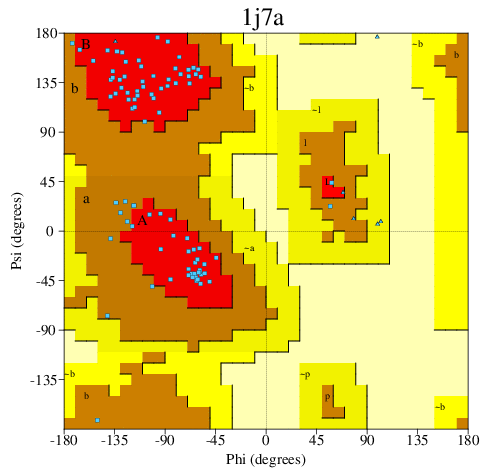
PROCHECK
|
|
|
|
|
|
Headers
|
|
|
|
References
|
|
|
|
|
|

|
|
P0A3C7
(FER1_NOSS1) -
Ferredoxin-1 from Nostoc sp. (strain PCC 7120 / SAG 25.82 / UTEX 2576)
|
|
|
|
Seq:
Struc:
|
|
|
|
99 a.a.
98 a.a.*
|
|

|

|
|
|
|
|
|
|
|
|
|
|
|
Key: |
 |
PfamA domain |
|
|
 |
Secondary structure |
|
 |
CATH domain |
|
|
*
PDB and UniProt seqs differ
at 1 residue position (black
cross)
|
|
|
|
|
|
|
|
|
|
|
|
|
|
|
|
|
 |
|
|
|
|
|
|
| |
|
DOI no:
|
Biochemistry
36:11100-11117
(1997)
|
|
PubMed id:
|
|
|
|
|
|
| |
|
Structure-function relationships in Anabaena ferredoxin: correlations between X-ray crystal structures, reduction potentials, and rate constants of electron transfer to ferredoxin:NADP+ reductase for site-specific ferredoxin mutants.
|
|
J.K.Hurley,
A.M.Weber-Main,
M.T.Stankovich,
M.M.Benning,
J.B.Thoden,
J.L.Vanhooke,
H.M.Holden,
Y.K.Chae,
B.Xia,
H.Cheng,
J.L.Markley,
M.Martinez-Júlvez,
C.Gómez-Moreno,
J.L.Schmeits,
G.Tollin.
|
|
|
|
|
| |
ABSTRACT
|
|
|
|
| |
|
|
A combination of structural, thermodynamic, and transient kinetic data on
wild-type and mutant Anabaena vegetative cell ferredoxins has been used to
investigate the nature of the protein-protein interactions leading to electron
transfer from reduced ferredoxin to oxidized ferredoxin:NADP+ reductase (FNR).
We have determined the reduction potentials of wild-type vegetative ferredoxin,
heterocyst ferredoxin, and 12 site-specific mutants at seven surface residues of
vegetative ferredoxin, as well as the one- and two-electron reduction potentials
of FNR, both alone and in complexes with wild-type and three mutant ferredoxins.
X-ray crystallographic structure determinations have been carried out for six of
the ferredoxin mutants. None of the mutants showed significant structural
changes in the immediate vicinity of the [2Fe-2S] cluster, despite large
decreases in electron-transfer reactivity (for E94K and S47A) and sizable
increases in reduction potential (80 mV for E94K and 47 mV for S47A).
Furthermore, the relatively small changes in Calpha backbone atom positions
which were observed in these mutants do not correlate with the kinetic and
thermodynamic properties. In sharp contrast to the S47A mutant, S47T retains
electron-transfer activity, and its reduction potential is 100 mV more negative
than that of the S47A mutant, implicating the importance of the hydrogen bond
which exists between the side chain hydroxyl group of S47 and the side chain
carboxyl oxygen of E94. Other ferredoxin mutations that alter both reduction
potential and electron-transfer reactivity are E94Q, F65A, and F65I, whereas
D62K, D68K, Q70K, E94D, and F65Y have reduction potentials and electron-transfer
reactivity that are similar to those of wild-type ferredoxin. In electrostatic
complexes with recombinant FNR, three of the kinetically impaired ferredoxin
mutants, as did wild-type ferredoxin, induced large (approximately 40 mV)
positive shifts in the reduction potential of the flavoprotein, thereby making
electron transfer thermodynamically feasible. On the basis of these
observations, we conclude that nonconservative mutations of three critical
residues (S47, F65, and E94) on the surface of ferredoxin have large parallel
effects on both the reduction potential and the electron-transfer reactivity of
the [2Fe-2S] cluster and that the reduction potential changes are not the
principal factor governing electron-transfer reactivity. Rather, the kinetic
properties are most likely controlled by the specific orientations of the
proteins within the transient electron-transfer complex.
|
|
|
|
|
|
|
|
|
|
|
|
|
|
|
|
|
|
 |
 |
 |
|
Literature references that cite this PDB file's key reference
|
|
|
| |
PubMed id
|
|
Reference
|
|
|
|
|
|
K.Johnson-Winters,
A.R.Nordstrom,
A.C.Davis,
G.Tollin,
and
J.H.Enemark
(2010).
Effects of large-scale amino acid substitution in the polypeptide tether connecting the heme and molybdenum domains on catalysis in human sulfite oxidase.
|
| |
Metallomics,
2,
766-770.
|
|
|
|
|
|
|
K.Johnson-Winters,
A.R.Nordstrom,
S.Emesh,
A.V.Astashkin,
A.Rajapakshe,
R.E.Berry,
G.Tollin,
and
J.H.Enemark
(2010).
Effects of interdomain tether length and flexibility on the kinetics of intramolecular electron transfer in human sulfite oxidase.
|
| |
Biochemistry,
49,
1290-1296.
|
|
|
|
|
|
|
C.Feng,
A.L.Dupont,
N.J.Nahm,
D.E.Spratt,
J.T.Hazzard,
J.B.Weinberg,
J.G.Guillemette,
G.Tollin,
and
D.K.Ghosh
(2009).
Intraprotein electron transfer in inducible nitric oxide synthase holoenzyme.
|
| |
J Biol Inorg Chem,
14,
133-142.
|
|
|
|
|
|
|
M.Hirasawa,
J.N.Tripathy,
R.Somasundaram,
M.K.Johnson,
M.Bhalla,
J.P.Allen,
and
D.B.Knaff
(2009).
The interaction of spinach nitrite reductase with ferredoxin: a site-directed mutation study.
|
| |
Mol Plant,
2,
407-415.
|
|
|
|
|
|
|
M.Medina
(2009).
Structural and mechanistic aspects of flavoproteins: photosynthetic electron transfer from photosystem I to NADP+.
|
| |
FEBS J,
276,
3942-3958.
|
|
|
|
|
|
|
M.Winkler,
S.Kuhlgert,
M.Hippler,
and
T.Happe
(2009).
Characterization of the key step for light-driven hydrogen evolution in green algae.
|
| |
J Biol Chem,
284,
36620-36627.
|
|
|
|
|
|
|
M.Medina,
R.Abagyan,
C.Gómez-Moreno,
and
J.Fernandez-Recio
(2008).
Docking analysis of transient complexes: interaction of ferredoxin-NADP+ reductase with ferredoxin and flavodoxin.
|
| |
Proteins,
72,
848-862.
|
|
|
|
|
|
|
C.H.Tung,
J.W.Huang,
and
J.M.Yang
(2007).
Kappa-alpha plot derived structural alphabet and BLOSUM-like substitution matrix for rapid search of protein structure database.
|
| |
Genome Biol,
8,
R31.
|
|
|
|
|
|
|
P.Sobrado,
K.S.Lyle,
S.P.Kaul,
M.M.Turco,
I.Arabshahi,
A.Marwah,
and
B.G.Fox
(2006).
Identification of the binding region of the [2Fe-2S] ferredoxin in stearoyl-acyl carrier protein desaturase: insight into the catalytic complex and mechanism of action.
|
| |
Biochemistry,
45,
4848-4858.
|
|
|
|
|
|
|
A.Suzuki,
and
D.B.Knaff
(2005).
Glutamate synthase: structural, mechanistic and regulatory properties, and role in the amino acid metabolism.
|
| |
Photosynth Res,
83,
191-217.
|
|
|
|
|
|
|
N.Cassan,
B.Lagoutte,
and
P.Sétif
(2005).
Ferredoxin-NADP+ reductase. Kinetics of electron transfer, transient intermediates, and catalytic activities studied by flash-absorption spectroscopy with isolated photosystem I and ferredoxin.
|
| |
J Biol Chem,
280,
25960-25972.
|
|
|
|
|
|
|
C.Feng,
H.L.Wilson,
J.K.Hurley,
J.T.Hazzard,
G.Tollin,
K.V.Rajagopalan,
and
J.H.Enemark
(2003).
Role of conserved tyrosine 343 in intramolecular electron transfer in human sulfite oxidase.
|
| |
J Biol Chem,
278,
2913-2920.
|
|
|
|
|
|
|
C.Feng,
H.L.Wilson,
J.K.Hurley,
J.T.Hazzard,
G.Tollin,
K.V.Rajagopalan,
and
J.H.Enemark
(2003).
Essential role of conserved arginine 160 in intramolecular electron transfer in human sulfite oxidase.
|
| |
Biochemistry,
42,
12235-12242.
|
|
|
|
|
|
|
M.Faro,
B.Schiffler,
A.Heinz,
I.Nogués,
M.Medina,
R.Bernhardt,
and
C.Gómez-Moreno
(2003).
Insights into the design of a hybrid system between Anabaena ferredoxin-NADP+ reductase and bovine adrenodoxin.
|
| |
Eur J Biochem,
270,
726-735.
|
|
|
|
|
|
|
I.Bertini,
C.Luchinat,
A.Provenzani,
A.Rosato,
and
P.R.Vasos
(2002).
Browsing gene banks for Fe2S2 ferredoxins and structural modeling of 88 plant-type sequences: an analysis of fold and function.
|
| |
Proteins,
46,
110-127.
|
|
|
|
|
|
|
J.L.Casaus,
J.A.Navarro,
M.Hervás,
A.Lostao,
M.A.De la Rosa,
C.Gómez-Moreno,
J.Sancho,
and
M.Medina
(2002).
Anabaena sp. PCC 7119 flavodoxin as electron carrier from photosystem I to ferredoxin-NADP+ reductase. Role of Trp(57) and Tyr(94).
|
| |
J Biol Chem,
277,
22338-22344.
|
|
|
|
|
|
|
J.T.Jarrett,
and
J.T.Wan
(2002).
Thermal inactivation of reduced ferredoxin (flavodoxin):NADP+ oxidoreductase from Escherichia coli.
|
| |
FEBS Lett,
529,
237-242.
|
|
|
|
|
|
|
M.Faro,
C.Gómez-Moreno,
M.Stankovich,
and
M.Medina
(2002).
Role of critical charged residues in reduction potential modulation of ferredoxin-NADP+ reductase.
|
| |
Eur J Biochem,
269,
2656-2661.
|
|
|
|
|
|
|
M.Faro,
S.Frago,
T.Mayoral,
J.A.Hermoso,
J.Sanz-Aparicio,
C.Gómez-Moreno,
and
M.Medina
(2002).
Probing the role of glutamic acid 139 of Anabaena ferredoxin-NADP+ reductase in the interaction with substrates.
|
| |
Eur J Biochem,
269,
4938-4947.
|
|
|
PDB code:
|
|
|
|
|
|
|
|
A.V.Grinberg,
F.Hannemann,
B.Schiffler,
J.Müller,
U.Heinemann,
and
R.Bernhardt
(2000).
Adrenodoxin: structure, stability, and electron transfer properties.
|
| |
Proteins,
40,
590-612.
|
|
|
|
|
|
|
G.M.Ullmann,
M.Hauswald,
A.Jensen,
and
E.W.Knapp
(2000).
Structural alignment of ferredoxin and flavodoxin based on electrostatic potentials: implications for their interactions with photosystem I and ferredoxin-NADP reductase.
|
| |
Proteins,
38,
301-309.
|
|
|
|
|
|
|
J.K.Hurley,
M.Faro,
T.B.Brodie,
J.T.Hazzard,
M.Medina,
C.Gómez-Moreno,
and
G.Tollin
(2000).
Highly nonproductive complexes with Anabaena ferredoxin at low ionic strength are induced by nonconservative amino acid substitutions at Glu139 in Anabaena ferredoxin:NADP+ reductase.
|
| |
Biochemistry,
39,
13695-13702.
|
|
|
|
|
|
|
R.Morales,
G.Kachalova,
F.Vellieux,
M.H.Charon,
and
M.Frey
(2000).
Crystallographic studies of the interaction between the ferredoxin-NADP+ reductase and ferredoxin from the cyanobacterium Anabaena: looking for the elusive ferredoxin molecule.
|
| |
Acta Crystallogr D Biol Crystallogr,
56,
1408-1412.
|
|
|
PDB code:
|
|
|
|
|
|
|
|
R.Morales,
M.H.Charon,
G.Kachalova,
L.Serre,
M.Medina,
C.Gómez-Moreno,
and
M.Frey
(2000).
A redox-dependent interaction between two electron-transfer partners involved in photosynthesis.
|
| |
EMBO Rep,
1,
271-276.
|
|
|
|
|
|
|
J.K.Hurley,
J.T.Hazzard,
M.Martínez-Júlvez,
M.Medina,
C.Gómez-Moreno,
and
G.Tollin
(1999).
Electrostatic forces involved in orienting Anabaena ferredoxin during binding to Anabaena ferredoxin:NADP+ reductase: site-specific mutagenesis, transient kinetic measurements, and electrostatic surface potentials.
|
| |
Protein Sci,
8,
1614-1622.
|
|
|
|
|
|
|
M.T.Bes,
E.Parisini,
L.A.Inda,
L.M.Saraiva,
M.L.Peleato,
and
G.M.Sheldrick
(1999).
Crystal structure determination at 1.4 A resolution of ferredoxin from the green alga Chlorella fusca.
|
| |
Structure,
7,
1201-1211.
|
|
|
PDB code:
|
|
|
|
|
|
|
|
R.Morales,
M.H.Charon,
G.Hudry-Clergeon,
Y.Pétillot,
S.Norager,
M.Medina,
and
M.Frey
(1999).
Refined X-ray structures of the oxidized, at 1.3 A, and reduced, at 1.17 A, [2Fe-2S] ferredoxin from the cyanobacterium Anabaena PCC7119 show redox-linked conformational changes.
|
| |
Biochemistry,
38,
15764-15773.
|
|
|
PDB codes:
|
|
|
|
|
|
|
|
T.Akashi,
T.Matsumura,
T.Ideguchi,
K.Iwakiri,
T.Kawakatsu,
I.Taniguchi,
and
T.Hase
(1999).
Comparison of the electrostatic binding sites on the surface of ferredoxin for two ferredoxin-dependent enzymes, ferredoxin-NADP(+) reductase and sulfite reductase.
|
| |
J Biol Chem,
274,
29399-29405.
|
|
|
|
|
|
|
Y.S.Jung,
V.A.Roberts,
C.D.Stout,
and
B.K.Burgess
(1999).
Complex formation between Azotobacter vinelandii ferredoxin I and its physiological electron donor NADPH-ferredoxin reductase.
|
| |
J Biol Chem,
274,
2978-2987.
|
|
|
|
|
|
|
C.Binda,
A.Coda,
A.Aliverti,
G.Zanetti,
and
A.Mattevi
(1998).
Structure of the mutant E92K of [2Fe-2S] ferredoxin I from Spinacia oleracea at 1.7 A resolution.
|
| |
Acta Crystallogr D Biol Crystallogr,
54,
1353-1358.
|
|
|
PDB code:
|
|
|
|
|
|
|
|
C.Gómez-Moreno,
M.Martínez-Júlvez,
M.Medina,
J.K.Hurley,
and
G.Tollin
(1998).
Protein-protein interaction in electron transfer reactions: the ferredoxin/flavodoxin/ferredoxin:NADP+ reductase system from Anabaena.
|
| |
Biochimie,
80,
837-846.
|
|
|
|
|
|
|
G.Sridhar Prasad,
N.Kresge,
A.B.Muhlberg,
A.Shaw,
Y.S.Jung,
B.K.Burgess,
and
C.D.Stout
(1998).
The crystal structure of NADPH:ferredoxin reductase from Azotobacter vinelandii.
|
| |
Protein Sci,
7,
2541-2549.
|
|
|
PDB code:
|
|
|
|
|
|
|
|
M.Hirasawa,
J.K.Hurley,
Z.Salamon,
G.Tollin,
J.L.Markley,
H.Cheng,
B.Xia,
and
D.B.Knaff
(1998).
The role of aromatic and acidic amino acids in the electron transfer reaction catalyzed by spinach ferredoxin-dependent glutamate synthase.
|
| |
Biochim Biophys Acta,
1363,
134-146.
|
|
|
|
|
|
|
M.K.Johnson
(1998).
Iron-sulfur proteins: new roles for old clusters.
|
| |
Curr Opin Chem Biol,
2,
173-181.
|
|
|
|
|
|
|
M.Martínez-Júlvez,
M.Medina,
J.K.Hurley,
R.Hafezi,
T.B.Brodie,
G.Tollin,
and
C.Gómez-Moreno
(1998).
Lys75 of Anabaena ferredoxin-NADP+ reductase is a critical residue for binding ferredoxin and flavodoxin during electron transfer.
|
| |
Biochemistry,
37,
13604-13613.
|
|
|
|
|
|
The most recent references are shown first.
Citation data come partly from CiteXplore and partly
from an automated harvesting procedure. Note that this is likely to be
only a partial list as not all journals are covered by
either method. However, we are continually building up the citation data
so more and more references will be included with time.
Where a reference describes a PDB structure, the PDB
code is
shown on the right.
|
|


 Links
Links


