 |
PDBsum entry 1j4j

|
|
|
|
|
 |
Contents |
 |
|
|
|
|
|
|
|
|
|
|
|
|
* Residue conservation analysis
|
|
|
|
|
|
PDB id:
|
|
|
|
| Name: |
|
Transferase
|
|
|
Title:
|
|
Crystal structure of tabtoxin resistance protein (form ii) complexed with an acyl coenzyme a
|
|
Structure:
|
|
Tabtoxin resistance protein. Chain: a, b. Synonym: acetyltransferase. Engineered: yes
|
|
Source:
|
|
Pseudomonas syringae pv. Tabaci. Organism_taxid: 322. Expressed in: escherichia coli. Expression_system_taxid: 562.
|
|
Resolution:
|
|
|
2.55Å
|
R-factor:
|
0.188
|
R-free:
|
0.254
|
|
|
Authors:
|
|
H.He,Y.Ding,M.Bartlam,R.Zhang,N.Duke,A.Joachimiak,Y.Shao,Z.Cao, H.Tang,Y.Liu,F.Jiang,J.Liu,N.Zhao,Z.Rao
|
Key ref:

|
|
H.He
et al.
(2003).
Crystal structure of tabtoxin resistance protein complexed with acetyl coenzyme A reveals the mechanism for beta-lactam acetylation.
J Mol Biol,
325,
1019-1030.
PubMed id:
DOI:

|
|
|
Date:
|
|
|
02-Oct-01
|
Release date:
|
03-Jun-03
|
|
|
|
|
|
|
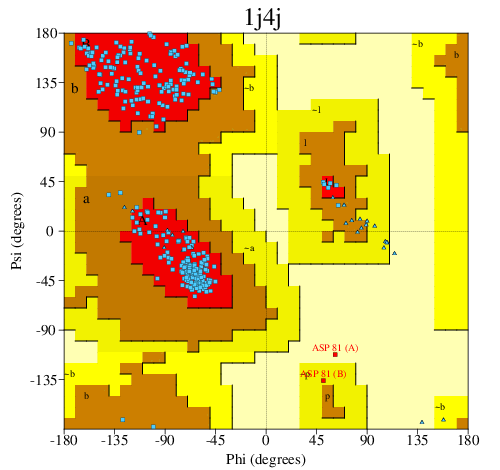
PROCHECK
|
|
|
|
|
|
Headers
|
|
|
|
References
|
|
|
|
|
|

|
|
P16966
(TTR_PSEAJ) -
Acetyltransferase from Pseudomonas amygdali pv. tabaci
|
|
|
|
Seq:
Struc:
|
|
|
|
177 a.a.
170 a.a.
|
|

|

|
|
|
|
|
|
|
|
|
|
|
|
Key: |
 |
PfamA domain |
|
|
 |
Secondary structure |
|
 |
CATH domain |
|
|
|
|
|
|
|
|
|
|
|
|
|
|
|
|
|
 |
|
|
|
|
|
|
| |
|
DOI no:
|
J Mol Biol
325:1019-1030
(2003)
|
|
PubMed id:
|
|
|
|
|
|
| |
|
Crystal structure of tabtoxin resistance protein complexed with acetyl coenzyme A reveals the mechanism for beta-lactam acetylation.
|
|
H.He,
Y.Ding,
M.Bartlam,
F.Sun,
Y.Le,
X.Qin,
H.Tang,
R.Zhang,
A.Joachimiak,
J.Liu,
N.Zhao,
Z.Rao.
|
|
|
|
|
| |
ABSTRACT
|
|
|
|
| |
|
|
Tabtoxin resistance protein (TTR) is an enzyme that renders tabtoxin-producing
pathogens, such as Pseudomonas syringae, tolerant to their own phytotoxins.
Here, we report the crystal structure of TTR complexed with its natural
cofactor, acetyl coenzyme A (AcCoA), to 1.55A resolution. The binary complex
forms a characteristic "V" shape for substrate binding and contains
the four motifs conserved in the GCN5-related N-acetyltransferase (GNAT)
superfamily, which also includes the histone acetyltransferases (HATs). A
single-step mechanism is proposed to explain the function of three conserved
residues, Glu92, Asp130 and Tyr141, in catalyzing the acetyl group transfer to
its substrate. We also report that TTR possesses HAT activity and suggest an
evolutionary relationship between TTR and other GNAT members.
|
|
|
|
|
|
| |
Selected figure(s)
|
|
|
|
| |
|
|

|
|

|
|
Figure 3.
Figure 3. AcCoA recognition and binding. (a) A stereo view
of an |F[o]| -|F[c]| difference map calculated in the absence of
AcCoA. The map is contoured at 2s. (b) The side-chain
interactions between TTR and AcCoA. Hydrogen bonds are marked by
green arrows and hydrophobic interactions are indicated in red.
|
|
Figure 4.
Figure 4. (a) A stereo view of the catalytic site showing
interactions between TTR and both AcCoA and the tightly bound
water molecule; GRASP surfaces showing the AcCoA-binding pocket
viewed from the front (b) and back (c), respectively (color
coded according to electrostatic potential: blue corresponds to
20k[B]T; white, 0k[B]T; and red, -20k[B]T). (b) The front view,
with two polar regions inside the hydrophobic-binding pocket.
The positive region indicated in blue corresponds to residue
Lys95 and the negative region in red corresponds to residues
Glu92 and Asp130. (c) The back view.
|
|
|
|
|
|
| |
The above figures are
reprinted
by permission from Elsevier:
J Mol Biol
(2003,
325,
1019-1030)
copyright 2003.
|
|
| |
Figures were
selected
by an automated process.
|
|
|
|
|
|
|
|
|
|
|
|
|
|
|
|
 |
 |
 |
|
Literature references that cite this PDB file's key reference
|
|
|
| |
PubMed id
|
|
Reference
|
|
|
|
|
|
E.Cundliffe,
and
A.L.Demain
(2010).
Avoidance of suicide in antibiotic-producing microbes.
|
| |
J Ind Microbiol Biotechnol,
37,
643-672.
|
|
|
|
|
|
|
K.Oda,
Y.Matoba,
M.Noda,
T.Kumagai,
and
M.Sugiyama
(2010).
Catalytic mechanism of bleomycin N-acetyltransferase proposed on the basis of its crystal structure.
|
| |
J Biol Chem,
285,
1446-1456.
|
|
|
PDB codes:
|
|
|
|
|
|
|
|
K.S.Makarova,
Y.I.Wolf,
and
E.V.Koonin
(2009).
Comprehensive comparative-genomic analysis of Type 2 toxin-antitoxin systems and related mobile stress response systems in prokaryotes.
|
| |
Biol Direct,
4,
19.
|
|
|
|
|
|
|
D.Shi,
V.Sagar,
Z.Jin,
X.Yu,
L.Caldovic,
H.Morizono,
N.M.Allewell,
and
M.Tuchman
(2008).
The crystal structure of N-acetyl-L-glutamate synthase from Neisseria gonorrhoeae provides insights into mechanisms of catalysis and regulation.
|
| |
J Biol Chem,
283,
7176-7184.
|
|
|
PDB codes:
|
|
|
|
|
|
|
|
M.W.Vetting,
J.C.Errey,
and
J.S.Blanchard
(2008).
Rv0802c from Mycobacterium tuberculosis: the first structure of a succinyltransferase with the GNAT fold.
|
| |
Acta Crystallogr Sect F Struct Biol Cryst Commun,
64,
978-985.
|
|
|
PDB codes:
|
|
|
|
|
|
|
|
H.Kiyota
(2006).
Synthesis of naturally derived bioactive compounds of agricultural interest.
|
| |
Biosci Biotechnol Biochem,
70,
317-324.
|
|
|
|
|
|
|
M.N.Hung,
E.Rangarajan,
C.Munger,
G.Nadeau,
T.Sulea,
and
A.Matte
(2006).
Crystal structure of TDP-fucosamine acetyltransferase (WecD) from Escherichia coli, an enzyme required for enterobacterial common antigen synthesis.
|
| |
J Bacteriol,
188,
5606-5617.
|
|
|
PDB codes:
|
|
|
|
|
|
|
|
V.Simunovic,
J.Zapp,
S.Rachid,
D.Krug,
P.Meiser,
and
R.Müller
(2006).
Myxovirescin A biosynthesis is directed by hybrid polyketide synthases/nonribosomal peptide synthetase, 3-hydroxy-3-methylglutaryl-CoA synthases, and trans-acting acyltransferases.
|
| |
Chembiochem,
7,
1206-1220.
|
|
|
|
|
|
|
G.L.Card,
N.A.Peterson,
C.A.Smith,
B.Rupp,
B.M.Schick,
and
E.N.Baker
(2005).
The crystal structure of Rv1347c, a putative antibiotic resistance protein from Mycobacterium tuberculosis, reveals a GCN5-related fold and suggests an alternative function in siderophore biosynthesis.
|
| |
J Biol Chem,
280,
13978-13986.
|
|
|
PDB code:
|
|
|
|
|
|
|
|
M.W.Vetting,
S.Magnet,
E.Nieves,
S.L.Roderick,
and
J.S.Blanchard
(2004).
A bacterial acetyltransferase capable of regioselective N-acetylation of antibiotics and histones.
|
| |
Chem Biol,
11,
565-573.
|
|
|
PDB codes:
|
|
|
|
|
|
|
|
S.Biarrotte-Sorin,
A.P.Maillard,
J.Delettré,
W.Sougakoff,
M.Arthur,
and
C.Mayer
(2004).
Crystal structures of Weissella viridescens FemX and its complex with UDP-MurNAc-pentapeptide: insights into FemABX family substrates recognition.
|
| |
Structure,
12,
257-267.
|
|
|
PDB codes:
|
|
|
|
|
|
|
|
S.Teichert,
B.Schönig,
S.Richter,
and
B.Tudzynski
(2004).
Deletion of the Gibberella fujikuroi glutamine synthetase gene has significant impact on transcriptional control of primary and secondary metabolism.
|
| |
Mol Microbiol,
53,
1661-1675.
|
|
|
|
|
|
|
Y.Ye,
and
A.Godzik
(2004).
Database searching by flexible protein structure alignment.
|
| |
Protein Sci,
13,
1841-1850.
|
|
|
|
|
|
|
M.W.Vetting,
S.L.Roderick,
M.Yu,
and
J.S.Blanchard
(2003).
Crystal structure of mycothiol synthase (Rv0819) from Mycobacterium tuberculosis shows structural homology to the GNAT family of N-acetyltransferases.
|
| |
Protein Sci,
12,
1954-1959.
|
|
|
PDB codes:
|
|
|
|
|
|
|
The most recent references are shown first.
Citation data come partly from CiteXplore and partly
from an automated harvesting procedure. Note that this is likely to be
only a partial list as not all journals are covered by
either method. However, we are continually building up the citation data
so more and more references will be included with time.
Where a reference describes a PDB structure, the PDB
codes are
shown on the right.
|
|


 Links
Links


