 |
PDBsum entry 1j2h

|
|
|
|
|
|

|

|

|

|
|

|
|

|
|
|
 |

|

|
|
|
|
|
|
|
|
|
|
|
|
|
|
|
|
|
|
|
|
|
|
|
|
|
|
|
|
|
|
|
Protein transport
|
PDB id
|
|
|
|
1j2h
|
|
|
|
|
|
|
|
|
|
|
|
|
|
|

|

|

|
|
|
|
|
|
| Superseded by: |
|
|
|
|
PDB id:
|
|
|
|
| Name: |
|
Protein transport
|
|
|
Title:
|
|
Crystal structure of human gga1 gat domain
|
|
Structure:
|
|
Adp-ribosylation factor binding protein gga1. Chain: a. Fragment: gat domain. Engineered: yes
|
|
Source:
|
|
Homo sapiens. Human. Expressed in: escherichia coli.
|
|
Resolution:
|
|
|
2.10Å
|
R-factor:
|
0.247
|
R-free:
|
0.290
|
|
|
Authors:
|
|
T.Shiba,M.Kawasaki,H.Takatsu,T.Nogi,N.Matsugaki,N.Igarashi, M.Suzuki,R.Kato,K.Nakayama,S.Wakatsuki
|
Key ref:

|
|
T.Shiba
et al.
(2003).
Molecular mechanism of membrane recruitment of GGA by ARF in lysosomal protein transport.
Nat Struct Biol,
10,
386-393.
PubMed id:
DOI:

|
|
|
Date:
|
|
|
05-Jan-03
|
Release date:
|
06-May-03
|
|
|
|
|
|
|
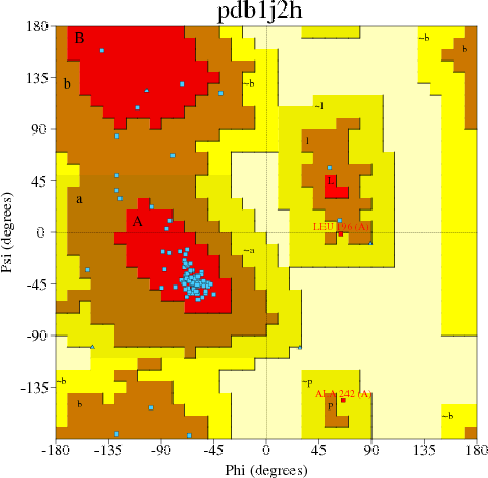
PROCHECK
|
|
|
|
|
|
Headers
|
|
|
|
References
|
|
|
|
|
|

|
|
Q9UJY5
(GGA1_HUMAN) -
ADP-ribosylation factor-binding protein GGA1 from Homo sapiens
|
|
|
|
Seq:
Struc:
|
|
|
|
639 a.a.
112 a.a.
|
|

|

|
|
|
|
|
|
|
|
|
|
|
|
Key: |
 |
PfamA domain |
|
|
 |
Secondary structure |
|
 |
CATH domain |
|
|
|
|
|
|
|
|
|
|
|
|
|
|
|
|
|
 |
|
|
|
|
|
|
| |
|
DOI no:
|
Nat Struct Biol
10:386-393
(2003)
|
|
PubMed id:
|
|
|
|
|
|
| |
|
Molecular mechanism of membrane recruitment of GGA by ARF in lysosomal protein transport.
|
|
T.Shiba,
M.Kawasaki,
H.Takatsu,
T.Nogi,
N.Matsugaki,
N.Igarashi,
M.Suzuki,
R.Kato,
K.Nakayama,
S.Wakatsuki.
|
|
|
|
|
| |
ABSTRACT
|
|
|
|
| |
|
|
GGAs are critical for trafficking soluble proteins from the trans-Golgi network
(TGN) to endosomes/lysosomes through interactions with TGN-sorting receptors,
ADP-ribosylation factor (ARF) and clathrin. ARF-GTP bound to TGN membranes
recruits its effector GGA by binding to the GAT domain, thus facilitating
recognition of GGA for cargo-loaded receptors. Here we report the X-ray crystal
structures of the human GGA1-GAT domain and the complex between ARF1-GTP and the
N-terminal region of the GAT domain. When unbound, the GAT domain forms an
elongated bundle of three a-helices with a hydrophobic core. Structurally, this
domain, combined with the preceding VHS domain, resembles CALM, an AP180 homolog
involved in endocytosis. In the complex with ARF1-GTP, a helix-loop-helix of the
N-terminal part of GGA1-GAT interacts with the switches 1 and 2 of ARF1
predominantly in a hydrophobic manner. These data reveal a molecular mechanism
underlying membrane recruitment of adaptor proteins by ARF-GTP.
|
|
|
|
|
|
| |
Selected figure(s)
|
|
|
|
| |
|
|

|
|

|
|
Figure 1.
Figure 1. Structures of the GGA1-GAT domain and its complex with
ARF1. a, Stereo diagram of the GGA1-GAT domain. The GAT
domain forms three  -helices
connected by loops of varying length. The final model is
complete except for the N-terminal 26 residues (166 -191, dotted
line) and the C-terminal 2 residues (304 -305), whose electron
density is weak. b, Stereo view of the omit F[o] -F[c] electron
density map of the GGA1 N-GAT (Leu178 -Asn194) within the ARF1
-N-GAT complex. The map was calculated to 1.6 Å resolution and
is displayed at 1.5 -helices
connected by loops of varying length. The final model is
complete except for the N-terminal 26 residues (166 -191, dotted
line) and the C-terminal 2 residues (304 -305), whose electron
density is weak. b, Stereo view of the omit F[o] -F[c] electron
density map of the GGA1 N-GAT (Leu178 -Asn194) within the ARF1
-N-GAT complex. The map was calculated to 1.6 Å resolution and
is displayed at 1.5  cutoff,
superimposed with a ball-and-stick model of the N-GAT domain. c,
Stereo view of the ARF1 -N-GAT complex. N-GAT forms a
helix-loop-helix motif facing switches 1 and 2 of ARF1-GTP. The
diagrams in (a) and (c) are shown in the same orientation, which
was chosen by the least-square minimization of the overlap of a
common helical region (199 -205, shown in red in a and c)
between the GAT domain and the ARF1 -N-GAT complex. cutoff,
superimposed with a ball-and-stick model of the N-GAT domain. c,
Stereo view of the ARF1 -N-GAT complex. N-GAT forms a
helix-loop-helix motif facing switches 1 and 2 of ARF1-GTP. The
diagrams in (a) and (c) are shown in the same orientation, which
was chosen by the least-square minimization of the overlap of a
common helical region (199 -205, shown in red in a and c)
between the GAT domain and the ARF1 -N-GAT complex.
|
|
Figure 6.
Figure 6. Domain organization of GGA and a proposed model of the
interactions with its partners at several stages of the vesicle
formation: M6PR, ARF -GTP, clathrin N-terminal propeller and an
accessory protein. The N-terminal VHS domain recognizes the
sorting signals, such as M6PR (PDB entry 1JWG). The GAT domain
interacts with a membrane-bound ARF (this study). The subsequent
hinge region interacts with clathrin (clathrin terminal domain
in complex with the clathrin-box peptide from  3-hinge
of AP-3; PDB entry 1C9I). The sequence S*LLDDELM interact with
VHS domain (autoinhibition), where S* is phosphorylated^24.
Finally, the C-terminal GGA1 GAE domain is modeled from the
structure of the ear domain of 3-hinge
of AP-3; PDB entry 1C9I). The sequence S*LLDDELM interact with
VHS domain (autoinhibition), where S* is phosphorylated^24.
Finally, the C-terminal GGA1 GAE domain is modeled from the
structure of the ear domain of  -adaptin
(PDB entry 1IU1) based on their similarity both in sequence and
function. -adaptin
(PDB entry 1IU1) based on their similarity both in sequence and
function.
|
|
|
|
|
|
| |
The above figures are
reprinted
by permission from Macmillan Publishers Ltd:
Nat Struct Biol
(2003,
10,
386-393)
copyright 2003.
|
|
| |
Figures were
selected
by an automated process.
|
|
|
|
|
|
|
|
|
|
|
|
|
|
|
|
 |
 |
 |
|
Literature references that cite this PDB file's key reference
|
|
|
| |
PubMed id
|
|
Reference
|
|
|
|
|
|
A.S.Selyunin,
S.E.Sutton,
B.A.Weigele,
L.E.Reddick,
R.C.Orchard,
S.M.Bresson,
D.R.Tomchick,
and
N.M.Alto
(2011).
The assembly of a GTPase-kinase signalling complex by a bacterial catalytic scaffold.
|
| |
Nature,
469,
107-111.
|
|
|
PDB codes:
|
|
|
|
|
|
|
|
A.F.Neuwald
(2010).
Bayesian classification of residues associated with protein functional divergence: Arf and Arf-like GTPases.
|
| |
Biol Direct,
5,
66.
|
|
|
|
|
|
|
B.Kropff,
Y.Koedel,
W.Britt,
and
M.Mach
(2010).
Optimal replication of human cytomegalovirus correlates with endocytosis of glycoprotein gpUL132.
|
| |
J Virol,
84,
7039-7052.
|
|
|
|
|
|
|
P.Chavrier,
and
J.Ménétrey
(2010).
Toward a structural understanding of arf family:effector specificity.
|
| |
Structure,
18,
1552-1558.
|
|
|
|
|
|
|
S.Kametaka,
N.Sawada,
J.S.Bonifacino,
and
S.Waguri
(2010).
Functional characterization of protein-sorting machineries at the trans-Golgi network in Drosophila melanogaster.
|
| |
J Cell Sci,
123,
460-471.
|
|
|
|
|
|
|
S.Qin,
and
H.X.Zhou
(2010).
Selection of near-native poses in CAPRI rounds 13-19.
|
| |
Proteins,
78,
3166-3173.
|
|
|
|
|
|
|
T.Wang,
N.S.Liu,
L.F.Seet,
and
W.Hong
(2010).
The emerging role of VHS domain-containing Tom1, Tom1L1 and Tom1L2 in membrane trafficking.
|
| |
Traffic,
11,
1119-1128.
|
|
|
|
|
|
|
Y.Liu,
and
J.H.Prestegard
(2010).
A device for the measurement of residual chemical shift anisotropy and residual dipolar coupling in soluble and membrane-associated proteins.
|
| |
J Biomol NMR,
47,
249-258.
|
|
|
|
|
|
|
Y.Liu,
R.A.Kahn,
and
J.H.Prestegard
(2010).
Dynamic structure of membrane-anchored Arf*GTP.
|
| |
Nat Struct Mol Biol,
17,
876-881.
|
|
|
PDB code:
|
|
|
|
|
|
|
|
T.Isabet,
G.Montagnac,
K.Regazzoni,
B.Raynal,
F.El Khadali,
P.England,
M.Franco,
P.Chavrier,
A.Houdusse,
and
J.Ménétrey
(2009).
The structural basis of Arf effector specificity: the crystal structure of ARF6 in a complex with JIP4.
|
| |
EMBO J,
28,
2835-2845.
|
|
|
PDB code:
|
|
|
|
|
|
|
|
T.J.Pucadyil,
and
S.L.Schmid
(2009).
Conserved functions of membrane active GTPases in coated vesicle formation.
|
| |
Science,
325,
1217-1220.
|
|
|
|
|
|
|
B.Hall,
M.A.McLean,
K.Davis,
J.E.Casanova,
S.G.Sligar,
and
M.A.Schwartz
(2008).
A fluorescence resonance energy transfer activation sensor for Arf6.
|
| |
Anal Biochem,
374,
243-249.
|
|
|
|
|
|
|
M.E.Abazeed,
and
R.S.Fuller
(2008).
Yeast Golgi-localized, gamma-Ear-containing, ADP-ribosylation factor-binding proteins are but adaptor protein-1 is not required for cell-free transport of membrane proteins from the trans-Golgi network to the prevacuolar compartment.
|
| |
Mol Biol Cell,
19,
4826-4836.
|
|
|
|
|
|
|
R.Beck,
Z.Sun,
F.Adolf,
C.Rutz,
J.Bassler,
K.Wild,
I.Sinning,
E.Hurt,
B.Brügger,
J.Béthune,
and
F.Wieland
(2008).
Membrane curvature induced by Arf1-GTP is essential for vesicle formation.
|
| |
Proc Natl Acad Sci U S A,
105,
11731-11736.
|
|
|
|
|
|
|
A.F.Neuwald
(2007).
Galpha Gbetagamma dissociation may be due to retraction of a buried lysine and disruption of an aromatic cluster by a GTP-sensing Arg Trp pair.
|
| |
Protein Sci,
16,
2570-2577.
|
|
|
|
|
|
|
A.Heifetz,
S.Pal,
and
G.R.Smith
(2007).
Protein-protein docking: progress in CAPRI rounds 6-12 using a combination of methods: the introduction of steered solvated molecular dynamics.
|
| |
Proteins,
69,
816-822.
|
|
|
|
|
|
|
A.K.Gillingham,
and
S.Munro
(2007).
The small G proteins of the Arf family and their regulators.
|
| |
Annu Rev Cell Dev Biol,
23,
579-611.
|
|
|
|
|
|
|
G.Prag,
H.Watson,
Y.C.Kim,
B.M.Beach,
R.Ghirlando,
G.Hummer,
J.S.Bonifacino,
and
J.H.Hurley
(2007).
The Vps27/Hse1 complex is a GAT domain-based scaffold for ubiquitin-dependent sorting.
|
| |
Dev Cell,
12,
973-986.
|
|
|
PDB code:
|
|
|
|
|
|
|
|
H.P.Price,
M.Stark,
B.Smith,
and
D.F.Smith
(2007).
TbARF1 influences lysosomal function but not endocytosis in procyclic stage Trypanosoma brucei.
|
| |
Mol Biochem Parasitol,
155,
123-127.
|
|
|
|
|
|
|
J.Ménétrey,
M.Perderiset,
J.Cicolari,
T.Dubois,
N.Elkhatib,
F.El Khadali,
M.Franco,
P.Chavrier,
and
A.Houdusse
(2007).
Structural basis for ARF1-mediated recruitment of ARHGAP21 to Golgi membranes.
|
| |
EMBO J,
26,
1953-1962.
|
|
|
PDB code:
|
|
|
|
|
|
|
|
J.Wang,
H.Q.Sun,
E.Macia,
T.Kirchhausen,
H.Watson,
J.S.Bonifacino,
and
H.L.Yin
(2007).
PI4P promotes the recruitment of the GGA adaptor proteins to the trans-Golgi network and regulates their recognition of the ubiquitin sorting signal.
|
| |
Mol Biol Cell,
18,
2646-2655.
|
|
|
|
|
|
|
S.Chaudhury,
A.Sircar,
A.Sivasubramanian,
M.Berrondo,
and
J.J.Gray
(2007).
Incorporating biochemical information and backbone flexibility in RosettaDock for CAPRI rounds 6-12.
|
| |
Proteins,
69,
793-800.
|
|
|
|
|
|
|
C.D'Souza-Schorey,
and
P.Chavrier
(2006).
ARF proteins: roles in membrane traffic and beyond.
|
| |
Nat Rev Mol Cell Biol,
7,
347-358.
|
|
|
|
|
|
|
L.Baksheev,
and
P.J.Fuller
(2006).
Gene expression in the adapting small bowel after massive small bowel resection.
|
| |
J Gastroenterol,
41,
1041-1052.
|
|
|
|
|
|
|
O.Schlenker,
A.Hendricks,
I.Sinning,
and
K.Wild
(2006).
The structure of the mammalian signal recognition particle (SRP) receptor as prototype for the interaction of small GTPases with Longin domains.
|
| |
J Biol Chem,
281,
8898-8906.
|
|
|
PDB code:
|
|
|
|
|
|
|
|
P.Beemiller,
A.D.Hoppe,
and
J.A.Swanson
(2006).
A phosphatidylinositol-3-kinase-dependent signal transition regulates ARF1 and ARF6 during Fcgamma receptor-mediated phagocytosis.
|
| |
PLoS Biol,
4,
e162.
|
|
|
|
|
|
|
V.V.Gurevich,
and
E.V.Gurevich
(2006).
The structural basis of arrestin-mediated regulation of G-protein-coupled receptors.
|
| |
Pharmacol Ther,
110,
465-502.
|
|
|
|
|
|
|
C.J.O'Neal,
M.G.Jobling,
R.K.Holmes,
and
W.G.Hol
(2005).
Structural basis for the activation of cholera toxin by human ARF6-GTP.
|
| |
Science,
309,
1093-1096.
|
|
|
PDB codes:
|
|
|
|
|
|
|
|
G.Prag,
S.Lee,
R.Mattera,
C.N.Arighi,
B.M.Beach,
J.S.Bonifacino,
and
J.H.Hurley
(2005).
Structural mechanism for ubiquitinated-cargo recognition by the Golgi-localized, gamma-ear-containing, ADP-ribosylation-factor-binding proteins.
|
| |
Proc Natl Acad Sci U S A,
102,
2334-2339.
|
|
|
PDB code:
|
|
|
|
|
|
|
|
M.Kawasaki,
T.Shiba,
Y.Shiba,
Y.Yamaguchi,
N.Matsugaki,
N.Igarashi,
M.Suzuki,
R.Kato,
K.Kato,
K.Nakayama,
and
S.Wakatsuki
(2005).
Molecular mechanism of ubiquitin recognition by GGA3 GAT domain.
|
| |
Genes Cells,
10,
639-654.
|
|
|
PDB code:
|
|
|
|
|
|
|
|
M.Wu,
T.Wang,
E.Loh,
W.Hong,
and
H.Song
(2005).
Structural basis for recruitment of RILP by small GTPase Rab7.
|
| |
EMBO J,
24,
1491-1501.
|
|
|
PDB codes:
|
|
|
|
|
|
|
|
R.L.Rich,
and
D.G.Myszka
(2005).
Survey of the year 2003 commercial optical biosensor literature.
|
| |
J Mol Recognit,
18,
1.
|
|
|
|
|
|
|
D.J.Owen,
B.M.Collins,
and
P.R.Evans
(2004).
Adaptors for clathrin coats: structure and function.
|
| |
Annu Rev Cell Dev Biol,
20,
153-191.
|
|
|
|
|
|
|
G.Zhu,
P.Zhai,
X.He,
N.Wakeham,
K.Rodgers,
G.Li,
J.Tang,
and
X.C.Zhang
(2004).
Crystal structure of human GGA1 GAT domain complexed with the GAT-binding domain of Rabaptin5.
|
| |
EMBO J,
23,
3909-3917.
|
|
|
PDB code:
|
|
|
|
|
|
|
|
M.Albrecht,
M.Golatta,
U.Wüllner,
and
T.Lengauer
(2004).
Structural and functional analysis of ataxin-2 and ataxin-3.
|
| |
Eur J Biochem,
271,
3155-3170.
|
|
|
|
|
|
|
M.M.McKay,
and
R.A.Kahn
(2004).
Multiple phosphorylation events regulate the subcellular localization of GGA1.
|
| |
Traffic,
5,
102-116.
|
|
|
|
|
|
|
M.Wu,
L.Lu,
W.Hong,
and
H.Song
(2004).
Structural basis for recruitment of GRIP domain golgin-245 by small GTPase Arl1.
|
| |
Nat Struct Mol Biol,
11,
86-94.
|
|
|
PDB code:
|
|
|
|
|
|
|
|
M.Yamakami,
and
H.Yokosawa
(2004).
Tom1 (target of Myb 1) is a novel negative regulator of interleukin-1- and tumor necrosis factor-induced signaling pathways.
|
| |
Biol Pharm Bull,
27,
564-566.
|
|
|
|
|
|
|
P.S.Bilodeau,
S.C.Winistorfer,
M.M.Allaman,
K.Surendhran,
W.R.Kearney,
A.D.Robertson,
and
R.C.Piper
(2004).
The GAT domains of clathrin-associated GGA proteins have two ubiquitin binding motifs.
|
| |
J Biol Chem,
279,
54808-54816.
|
|
|
|
|
|
|
R.Mattera,
R.Puertollano,
W.J.Smith,
and
J.S.Bonifacino
(2004).
The trihelical bundle subdomain of the GGA proteins interacts with multiple partners through overlapping but distinct sites.
|
| |
J Biol Chem,
279,
31409-31418.
|
|
|
|
|
|
|
Y.Katoh,
Y.Shiba,
H.Mitsuhashi,
Y.Yanagida,
H.Takatsu,
and
K.Nakayama
(2004).
Tollip and Tom1 form a complex and recruit ubiquitin-conjugated proteins onto early endosomes.
|
| |
J Biol Chem,
279,
24435-24443.
|
|
|
|
|
|
|
Y.Shiba,
Y.Katoh,
T.Shiba,
K.Yoshino,
H.Takatsu,
H.Kobayashi,
H.W.Shin,
S.Wakatsuki,
and
K.Nakayama
(2004).
GAT (GGA and Tom1) domain responsible for ubiquitin binding and ubiquitination.
|
| |
J Biol Chem,
279,
7105-7111.
|
|
|
|
|
|
|
B.Panic,
O.Perisic,
D.B.Veprintsev,
R.L.Williams,
and
S.Munro
(2003).
Structural basis for Arl1-dependent targeting of homodimeric GRIP domains to the Golgi apparatus.
|
| |
Mol Cell,
12,
863-874.
|
|
|
PDB code:
|
|
|
|
|
|
|
|
K.Nakayama,
and
S.Wakatsuki
(2003).
The structure and function of GGAs, the traffic controllers at the TGN sorting crossroads.
|
| |
Cell Struct Funct,
28,
431-442.
|
|
|
|
|
|
|
P.Zhai,
X.He,
J.Liu,
N.Wakeham,
G.Zhu,
G.Li,
J.Tang,
and
X.C.Zhang
(2003).
The interaction of the human GGA1 GAT domain with rabaptin-5 is mediated by residues on its three-helix bundle.
|
| |
Biochemistry,
42,
13901-13908.
|
|
|
|
|
|
The most recent references are shown first.
Citation data come partly from CiteXplore and partly
from an automated harvesting procedure. Note that this is likely to be
only a partial list as not all journals are covered by
either method. However, we are continually building up the citation data
so more and more references will be included with time.
Where a reference describes a PDB structure, the PDB
codes are
shown on the right.
|
|


 Links
Links


