 |
PDBsum entry 1i09

|
|
|
|
|
 |
Contents |
 |
|
|
|
|
|
|
|
|
|
|
|
|
* Residue conservation analysis
|
|
|
|
|
|
|
|
|
|
|
Enzyme class 1:
|
|
E.C.2.7.11.1
- non-specific serine/threonine protein kinase.
|
|
|
|
|
|
|
Reaction:
|
|
|
1.
|
L-seryl-[protein] + ATP = O-phospho-L-seryl-[protein] + ADP + H+
|
|
2.
|
L-threonyl-[protein] + ATP = O-phospho-L-threonyl-[protein] + ADP + H+
|
|
|
|
|
|
|
L-seryl-[protein]
|
+
|
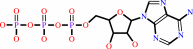 ATP
ATP
|
=
|
O-phospho-L-seryl-[protein]
|
+
|
 ADP
ADP
|
+
|
H(+)
|
|
|
|
|
|
|
L-threonyl-[protein]
|
+
|
ATP
|
=
|
O-phospho-L-threonyl-[protein]
|
+
|
ADP
|
+
|
H(+)
|
|
|
|
|
|
|
|
|
|
Enzyme class 2:
|
|
E.C.2.7.11.26
- [tau protein] kinase.
|
|
|
|
|
|
|
Reaction:
|
|
|
1.
|
L-seryl-[tau protein] + ATP = O-phospho-L-seryl-[tau protein] + ADP + H+
|
|
2.
|
L-threonyl-[tau protein] + ATP = O-phospho-L-threonyl-[tau protein] + ADP + H+
|
|
|
|
|
|
|
L-seryl-[tau protein]
|
+
|
ATP
|
=
|
O-phospho-L-seryl-[tau protein]
|
+
|
ADP
|
+
|
H(+)
|
|
|
|
|
|
|
L-threonyl-[tau protein]
|
+
|
ATP
|
=
|
O-phospho-L-threonyl-[tau protein]
|
+
|
ADP
|
+
|
H(+)
|
|
|
|
|
|
|
|
|
|
|
|
|
Note, where more than one E.C. class is given (as above), each may
correspond to a different protein domain or, in the case of polyprotein
precursors, to a different mature protein.
|
|
|
|
Molecule diagrams generated from .mol files obtained from the
KEGG ftp site
|
|
|
|
|
|
|
|
|
|
|
|
|
|
 |
|
|
|
|
|
|
| |
|
|
| |
|
DOI no:
|
Nat Struct Biol
8:593-596
(2001)
|
|
PubMed id:
|
|
|
|
|
|
| |
|
Structure of GSK3beta reveals a primed phosphorylation mechanism.
|
|
E.ter Haar,
J.T.Coll,
D.A.Austen,
H.M.Hsiao,
L.Swenson,
J.Jain.
|
|
|
|
|
| |
ABSTRACT
|
|
|
|
| |
|
|
GSK3beta was identified as the kinase that phosphorylates glycogen synthase but
is now known to be involved in multiple signaling pathways. GSK3beta prefers
prior phosphorylation of its substrates. We present the structure of
unphosphorylated GSK3beta at 2.7 A. The orientation of the two domains and
positioning of the activation loop of GSK3beta are similar to those observed in
activated kinases. A phosphate ion held by Arg 96, Arg 180 and Lys 205 occupies
the same position as the phosphate group of the phosphothreonine in activated
p38gamma, CDK2 or ERK2. A loop from a neighboring molecule in the crystal
occupies a portion of the substrate binding groove. The structure explains the
unique primed phosphorylation mechanism of GSK3beta and how GSK3beta relies on a
phosphoserine in the substrate for the alignment of the beta- and alpha-helical
domains.
|
|
|
|
|
|
| |
Selected figure(s)
|
|
|
|
| |
|
|

|
|

|
|
Figure 1.
Figure 1. Representative portion of a 2F[o] - F[c] electron
density map contoured at 1.5  . .
|
|
Figure 4.
Figure 4. The GSK3  substrate
binding groove. substrate
binding groove.
|
|
|
|
|
|
| |
The above figures are
reprinted
by permission from Macmillan Publishers Ltd:
Nat Struct Biol
(2001,
8,
593-596)
copyright 2001.
|
|
| |
Figures were
selected
by an automated process.
|
|
|
|
|
|
|
|
|
|
|
|
|
|
|
|
 |
 |
 |
|
Literature references that cite this PDB file's key reference
|
|
|
| |
PubMed id
|
|
Reference
|
|
|
|
|
|
A.Licht-Murava,
B.Plotkin,
M.Eisenstein,
and
H.Eldar-Finkelman
(2011).
Elucidating substrate and inhibitor binding sites on the surface of GSK-3β and the refinement of a competitive inhibitor.
|
| |
J Mol Biol,
408,
366-378.
|
|
|
|
|
|
|
H.Sun,
Y.J.Jiang,
Q.S.Yu,
C.C.Luo,
and
J.W.Zou
(2011).
The effect of Li(+) on GSK-3 inhibition: Molecular dynamics simulation.
|
| |
J Mol Model,
17,
377-381.
|
|
|
|
|
|
|
J.L.Johnson,
S.G.Rupasinghe,
F.Stefani,
M.A.Schuler,
and
E.Gonzalez de Mejia
(2011).
Citrus flavonoids luteolin, apigenin, and quercetin inhibit glycogen synthase kinase-3β enzymatic activity by lowering the interaction energy within the binding cavity.
|
| |
J Med Food,
14,
325-333.
|
|
|
|
|
|
|
K.Saeki,
M.Machida,
Y.Kinoshita,
R.Takasawa,
and
S.Tanuma
(2011).
Glycogen synthase kinase-3β2 has lower phosphorylation activity to tau than glycogen synthase kinase-3β1.
|
| |
Biol Pharm Bull,
34,
146-149.
|
|
|
|
|
|
|
W.Berrabah,
P.Aumercier,
P.Lefebvre,
and
B.Staels
(2011).
Control of nuclear receptor activities in metabolism by post-translational modifications.
|
| |
FEBS Lett,
585,
1640-1650.
|
|
|
|
|
|
|
I.Buch,
D.Fishelovitch,
N.London,
B.Raveh,
H.J.Wolfson,
and
R.Nussinov
(2010).
Allosteric regulation of glycogen synthase kinase 3β: a theoretical study.
|
| |
Biochemistry,
49,
10890-10901.
|
|
|
|
|
|
|
J.Avila,
F.Wandosell,
and
F.Hernández
(2010).
Role of glycogen synthase kinase-3 in Alzheimer's disease pathogenesis and glycogen synthase kinase-3 inhibitors.
|
| |
Expert Rev Neurother,
10,
703-710.
|
|
|
|
|
|
|
J.L.Buescher,
and
C.J.Phiel
(2010).
A noncatalytic domain of glycogen synthase kinase-3 (GSK-3) is essential for activity.
|
| |
J Biol Chem,
285,
7957-7963.
|
|
|
|
|
|
|
R.Ko,
H.D.Jang,
and
S.Y.Lee
(2010).
GSK3beta Inhibitor Peptide Protects Mice from LPS-induced Endotoxin Shock.
|
| |
Immune Netw,
10,
99.
|
|
|
|
|
|
|
S.L.Howng,
C.C.Hwang,
C.Y.Hsu,
M.Y.Hsu,
C.Y.Teng,
C.H.Chou,
M.F.Lee,
C.H.Wu,
S.J.Chiou,
A.S.Lieu,
J.K.Loh,
C.N.Yang,
C.S.Lin,
and
Y.R.Hong
(2010).
Involvement of the residues of GSKIP, AxinGID, and FRATtide in their binding with GSK3beta to unravel a novel C-terminal scaffold-binding region.
|
| |
Mol Cell Biochem,
339,
23-33.
|
|
|
|
|
|
|
G.V.Rayasam,
V.K.Tulasi,
R.Sodhi,
J.A.Davis,
and
A.Ray
(2009).
Glycogen synthase kinase 3: more than a namesake.
|
| |
Br J Pharmacol,
156,
885-898.
|
|
|
|
|
|
|
K.H.Kim,
I.Gaisina,
F.Gallier,
D.Holzle,
S.Y.Blond,
A.Mesecar,
and
A.P.Kozikowski
(2009).
Use of molecular modeling, docking, and 3D-QSAR studies for the determination of the binding mode of benzofuran-3-yl-(indol-3-yl)maleimides as GSK-3beta inhibitors.
|
| |
J Mol Model,
15,
1463-1479.
|
|
|
|
|
|
|
N.Zhang,
Y.Jiang,
J.Zou,
Q.Yu,
and
W.Zhao
(2009).
Structural basis for the complete loss of GSK3beta catalytic activity due to R96 mutation investigated by molecular dynamics study.
|
| |
Proteins,
75,
671-681.
|
|
|
|
|
|
|
P.Goñi-Oliver,
J.Avila,
and
F.Hernández
(2009).
Calpain-mediated truncation of GSK-3 in post-mortem brain samples.
|
| |
J Neurosci Res,
87,
1156-1161.
|
|
|
|
|
|
|
S.Prasanna,
P.R.Daga,
A.Xie,
and
R.J.Doerksen
(2009).
Glycogen synthase kinase-3 inhibition by 3-anilino-4-phenylmaleimides: insights from 3D-QSAR and docking.
|
| |
J Comput Aided Mol Des,
23,
113-127.
|
|
|
|
|
|
|
A.Kannoji,
S.Phukan,
V.Sudher Babu,
and
V.N.Balaji
(2008).
GSK3beta: a master switch and a promising target.
|
| |
Expert Opin Ther Targets,
12,
1443-1455.
|
|
|
|
|
|
|
D.Muyllaert,
A.Kremer,
T.Jaworski,
P.Borghgraef,
H.Devijver,
S.Croes,
I.Dewachter,
and
F.Van Leuven
(2008).
Glycogen synthase kinase-3beta, or a link between amyloid and tau pathology?
|
| |
Genes Brain Behav,
7,
57-66.
|
|
|
|
|
|
|
J.C.Ngo,
K.Giang,
S.Chakrabarti,
C.T.Ma,
N.Huynh,
J.C.Hagopian,
P.C.Dorrestein,
X.D.Fu,
J.A.Adams,
and
G.Ghosh
(2008).
A sliding docking interaction is essential for sequential and processive phosphorylation of an SR protein by SRPK1.
|
| |
Mol Cell,
29,
563-576.
|
|
|
PDB code:
|
|
|
|
|
|
|
|
K.Vougogiannopoulou,
Y.Ferandin,
K.Bettayeb,
V.Myrianthopoulos,
O.Lozach,
Y.Fan,
C.H.Johnson,
P.Magiatis,
A.L.Skaltsounis,
E.Mikros,
and
L.Meijer
(2008).
Soluble 3',6-substituted indirubins with enhanced selectivity toward glycogen synthase kinase -3 alter circadian period.
|
| |
J Med Chem,
51,
6421-6431.
|
|
|
|
|
|
|
S.Braconi Quintaje,
and
S.Orchard
(2008).
The annotation of both human and mouse kinomes in UniProtKB/Swiss-Prot: one small step in manual annotation, one giant leap for full comprehension of genomes.
|
| |
Mol Cell Proteomics,
7,
1409-1419.
|
|
|
|
|
|
|
G.M.Cheetham,
P.A.Charlton,
J.M.Golec,
and
J.R.Pollard
(2007).
Structural basis for potent inhibition of the Aurora kinases and a T315I multi-drug resistant mutant form of Abl kinase by VX-680.
|
| |
Cancer Lett,
251,
323-329.
|
|
|
|
|
|
|
J.Avila,
and
F.Hernández
(2007).
GSK-3 inhibitors for Alzheimer's disease.
|
| |
Expert Rev Neurother,
7,
1527-1533.
|
|
|
|
|
|
|
K.A.Burns,
and
J.P.Vanden Heuvel
(2007).
Modulation of PPAR activity via phosphorylation.
|
| |
Biochim Biophys Acta,
1771,
952-960.
|
|
|
|
|
|
|
L.Dugo,
M.Collin,
and
C.Thiemermann
(2007).
Glycogen synthase kinase 3beta as a target for the therapy of shock and inflammation.
|
| |
Shock,
27,
113-123.
|
|
|
|
|
|
|
M.Wrzaczek,
W.Rozhon,
and
C.Jonak
(2007).
A Proteasome-regulated glycogen synthase kinase-3 modulates disease response in plants.
|
| |
J Biol Chem,
282,
5249-5255.
|
|
|
|
|
|
|
P.Goñi-Oliver,
J.J.Lucas,
J.Avila,
and
F.Hernández
(2007).
N-terminal cleavage of GSK-3 by calpain: a new form of GSK-3 regulation.
|
| |
J Biol Chem,
282,
22406-22413.
|
|
|
|
|
|
|
P.Patwardhan,
and
W.T.Miller
(2007).
Processive phosphorylation: mechanism and biological importance.
|
| |
Cell Signal,
19,
2218-2226.
|
|
|
|
|
|
|
R.Kalamegham,
D.Sturgill,
E.Siegfried,
and
B.Oliver
(2007).
Drosophila mojoless, a retroposed GSK-3, has functionally diverged to acquire an essential role in male fertility.
|
| |
Mol Biol Evol,
24,
732-742.
|
|
|
|
|
|
|
P.A.Lochhead,
R.Kinstrie,
G.Sibbet,
T.Rawjee,
N.Morrice,
and
V.Cleghon
(2006).
A chaperone-dependent GSK3beta transitional intermediate mediates activation-loop autophosphorylation.
|
| |
Mol Cell,
24,
627-633.
|
|
|
|
|
|
|
R.Ilouz,
N.Kowalsman,
M.Eisenstein,
and
H.Eldar-Finkelman
(2006).
Identification of novel glycogen synthase kinase-3beta substrate-interacting residues suggests a common mechanism for substrate recognition.
|
| |
J Biol Chem,
281,
30621-30630.
|
|
|
|
|
|
|
S.Benzeno,
F.Lu,
M.Guo,
O.Barbash,
F.Zhang,
J.G.Herman,
P.S.Klein,
A.Rustgi,
and
J.A.Diehl
(2006).
Identification of mutations that disrupt phosphorylation-dependent nuclear export of cyclin D1.
|
| |
Oncogene,
25,
6291-6303.
|
|
|
|
|
|
|
D.Komander,
G.Kular,
M.Deak,
D.R.Alessi,
and
D.M.van Aalten
(2005).
Role of T-loop phosphorylation in PDK1 activation, stability, and substrate binding.
|
| |
J Biol Chem,
280,
18797-18802.
|
|
|
PDB code:
|
|
|
|
|
|
|
|
J.R.Woodgett
(2005).
Recent advances in the protein kinase B signaling pathway.
|
| |
Curr Opin Cell Biol,
17,
150-157.
|
|
|
|
|
|
|
M.D.Jacobs,
J.Black,
O.Futer,
L.Swenson,
B.Hare,
M.Fleming,
and
K.Saxena
(2005).
Pim-1 ligand-bound structures reveal the mechanism of serine/threonine kinase inhibition by LY294002.
|
| |
J Biol Chem,
280,
13728-13734.
|
|
|
PDB codes:
|
|
|
|
|
|
|
|
A.M.Aronov,
and
G.W.Bemis
(2004).
A minimalist approach to fragment-based ligand design using common rings and linkers: application to kinase inhibitors.
|
| |
Proteins,
57,
36-50.
|
|
|
|
|
|
|
A.V.Skurat,
and
A.D.Dietrich
(2004).
Phosphorylation of Ser640 in muscle glycogen synthase by DYRK family protein kinases.
|
| |
J Biol Chem,
279,
2490-2498.
|
|
|
|
|
|
|
D.Papadopoulou,
M.W.Bianchi,
and
M.Bourouis
(2004).
Functional studies of shaggy/glycogen synthase kinase 3 phosphorylation sites in Drosophila melanogaster.
|
| |
Mol Cell Biol,
24,
4909-4919.
|
|
|
|
|
|
|
L.Litovchick,
A.Chestukhin,
and
J.A.DeCaprio
(2004).
Glycogen synthase kinase 3 phosphorylates RBL2/p130 during quiescence.
|
| |
Mol Cell Biol,
24,
8970-8980.
|
|
|
|
|
|
|
L.M.Iakoucheva,
P.Radivojac,
C.J.Brown,
T.R.O'Connor,
J.G.Sikes,
Z.Obradovic,
and
A.K.Dunker
(2004).
The importance of intrinsic disorder for protein phosphorylation.
|
| |
Nucleic Acids Res,
32,
1037-1049.
|
|
|
|
|
|
|
N.Kannan,
and
A.F.Neuwald
(2004).
Evolutionary constraints associated with functional specificity of the CMGC protein kinases MAPK, CDK, GSK, SRPK, DYRK, and CK2alpha.
|
| |
Protein Sci,
13,
2059-2077.
|
|
|
|
|
|
|
R.van Amerongen,
H.van der Gulden,
F.Bleeker,
J.Jonkers,
and
A.Berns
(2004).
Characterization and functional analysis of the murine Frat2 gene.
|
| |
J Biol Chem,
279,
26967-26974.
|
|
|
|
|
|
|
T.R.Salas,
J.Kim,
F.Vakar-Lopez,
A.L.Sabichi,
P.Troncoso,
G.Jenster,
A.Kikuchi,
S.Y.Chen,
L.Shemshedini,
M.Suraokar,
C.J.Logothetis,
J.DiGiovanni,
S.M.Lippman,
and
D.G.Menter
(2004).
Glycogen synthase kinase-3 beta is involved in the phosphorylation and suppression of androgen receptor activity.
|
| |
J Biol Chem,
279,
19191-19200.
|
|
|
|
|
|
|
B.W.Doble,
and
J.R.Woodgett
(2003).
GSK-3: tricks of the trade for a multi-tasking kinase.
|
| |
J Cell Sci,
116,
1175-1186.
|
|
|
|
|
|
|
F.Zhang,
C.J.Phiel,
L.Spece,
N.Gurvich,
and
P.S.Klein
(2003).
Inhibitory phosphorylation of glycogen synthase kinase-3 (GSK-3) in response to lithium. Evidence for autoregulation of GSK-3.
|
| |
J Biol Chem,
278,
33067-33077.
|
|
|
|
|
|
|
J.H.Cho,
and
G.V.Johnson
(2003).
Glycogen synthase kinase 3beta phosphorylates tau at both primed and unprimed sites. Differential impact on microtubule binding.
|
| |
J Biol Chem,
278,
187-193.
|
|
|
|
|
|
|
K.Stankunas,
J.H.Bayle,
J.E.Gestwicki,
Y.M.Lin,
T.J.Wandless,
and
G.R.Crabtree
(2003).
Conditional protein alleles using knockin mice and a chemical inducer of dimerization.
|
| |
Mol Cell,
12,
1615-1624.
|
|
|
|
|
|
|
L.Meijer,
A.L.Skaltsounis,
P.Magiatis,
P.Polychronopoulos,
M.Knockaert,
M.Leost,
X.P.Ryan,
C.A.Vonica,
A.Brivanlou,
R.Dajani,
C.Crovace,
C.Tarricone,
A.Musacchio,
S.M.Roe,
L.Pearl,
and
P.Greengard
(2003).
GSK-3-selective inhibitors derived from Tyrian purple indirubins.
|
| |
Chem Biol,
10,
1255-1266.
|
|
|
PDB code:
|
|
|
|
|
|
|
|
M.A.Gregory,
Y.Qi,
and
S.R.Hann
(2003).
Phosphorylation by glycogen synthase kinase-3 controls c-myc proteolysis and subnuclear localization.
|
| |
J Biol Chem,
278,
51606-51612.
|
|
|
|
|
|
|
M.Welcker,
J.Singer,
K.R.Loeb,
J.Grim,
A.Bloecher,
M.Gurien-West,
B.E.Clurman,
and
J.M.Roberts
(2003).
Multisite phosphorylation by Cdk2 and GSK3 controls cyclin E degradation.
|
| |
Mol Cell,
12,
381-392.
|
|
|
|
|
|
|
O.Marin,
V.H.Bustos,
L.Cesaro,
F.Meggio,
M.A.Pagano,
M.Antonelli,
C.C.Allende,
L.A.Pinna,
and
J.E.Allende
(2003).
A noncanonical sequence phosphorylated by casein kinase 1 in beta-catenin may play a role in casein kinase 1 targeting of important signaling proteins.
|
| |
Proc Natl Acad Sci U S A,
100,
10193-10200.
|
|
|
|
|
|
|
P.M.Fischer
(2003).
CDK versus GSK-3 inhibition: a purple haze no longer?
|
| |
Chem Biol,
10,
1144-1146.
|
|
|
|
|
|
|
T.R.Salas,
S.A.Reddy,
J.L.Clifford,
R.J.Davis,
A.Kikuchi,
S.M.Lippman,
and
D.G.Menter
(2003).
Alleviating the suppression of glycogen synthase kinase-3beta by Akt leads to the phosphorylation of cAMP-response element-binding protein and its transactivation in intact cell nuclei.
|
| |
J Biol Chem,
278,
41338-41346.
|
|
|
|
|
|
|
A.Martinez,
A.Castro,
I.Dorronsoro,
and
M.Alonso
(2002).
Glycogen synthase kinase 3 (GSK-3) inhibitors as new promising drugs for diabetes, neurodegeneration, cancer, and inflammation.
|
| |
Med Res Rev,
22,
373-384.
|
|
|
|
|
|
|
B.Haefner
(2002).
NF-kappa B: arresting a major culprit in cancer.
|
| |
Drug Discov Today,
7,
653-663.
|
|
|
|
|
|
|
C.Jonak,
and
H.Hirt
(2002).
Glycogen synthase kinase 3/SHAGGY-like kinases in plants: an emerging family with novel functions.
|
| |
Trends Plant Sci,
7,
457-461.
|
|
|
|
|
|
|
C.Liu,
Y.Li,
M.Semenov,
C.Han,
G.H.Baeg,
Y.Tan,
Z.Zhang,
X.Lin,
and
X.He
(2002).
Control of beta-catenin phosphorylation/degradation by a dual-kinase mechanism.
|
| |
Cell,
108,
837-847.
|
|
|
|
|
|
|
C.M.Sheridan,
E.K.Heist,
C.R.Beals,
G.R.Crabtree,
and
P.Gardner
(2002).
Protein kinase A negatively modulates the nuclear accumulation of NF-ATc1 by priming for subsequent phosphorylation by glycogen synthase kinase-3.
|
| |
J Biol Chem,
277,
48664-48676.
|
|
|
|
|
|
|
D.M.Ferkey,
and
D.Kimelman
(2002).
Glycogen synthase kinase-3 beta mutagenesis identifies a common binding domain for GBP and Axin.
|
| |
J Biol Chem,
277,
16147-16152.
|
|
|
|
|
|
|
D.P.Brazil,
J.Park,
and
B.A.Hemmings
(2002).
PKB binding proteins. Getting in on the Akt.
|
| |
Cell,
111,
293-303.
|
|
|
|
|
|
|
F.Mukai,
K.Ishiguro,
Y.Sano,
and
S.C.Fujita
(2002).
Alternative splicing isoform of tau protein kinase I/glycogen synthase kinase 3beta.
|
| |
J Neurochem,
81,
1073-1083.
|
|
|
|
|
|
|
G.M.Cheetham,
R.M.Knegtel,
J.T.Coll,
S.B.Renwick,
L.Swenson,
P.Weber,
J.A.Lippke,
and
D.A.Austen
(2002).
Crystal structure of aurora-2, an oncogenic serine/threonine kinase.
|
| |
J Biol Chem,
277,
42419-42422.
|
|
|
PDB code:
|
|
|
|
|
|
|
|
H.Eldar-Finkelman
(2002).
Glycogen synthase kinase 3: an emerging therapeutic target.
|
| |
Trends Mol Med,
8,
126-132.
|
|
|
|
|
|
|
O.Kaidanovich,
and
H.Eldar-Finkelman
(2002).
The role of glycogen synthase kinase-3 in insulin resistance and type 2 diabetes.
|
| |
Expert Opin Ther Targets,
6,
555-561.
|
|
|
|
|
|
|
S.C.h.Papasozomenos,
and
A.Shanavas
(2002).
Testosterone prevents the heat shock-induced overactivation of glycogen synthase kinase-3 beta but not of cyclin-dependent kinase 5 and c-Jun NH2-terminal kinase and concomitantly abolishes hyperphosphorylation of tau: implications for Alzheimer's disease.
|
| |
Proc Natl Acad Sci U S A,
99,
1140-1145.
|
|
|
|
|
|
|
T.Hagen,
E.Di Daniel,
A.A.Culbert,
and
A.D.Reith
(2002).
Expression and characterization of GSK-3 mutants and their effect on beta-catenin phosphorylation in intact cells.
|
| |
J Biol Chem,
277,
23330-23335.
|
|
|
|
|
|
|
V.Stambolic
(2002).
PTEN: a new twist on beta-catenin?
|
| |
Trends Pharmacol Sci,
23,
104-106.
|
|
|
|
|
|
|
A.J.Harwood
(2001).
Regulation of GSK-3: a cellular multiprocessor.
|
| |
Cell,
105,
821-824.
|
|
|
|
|
|
|
D.Gurwitz,
and
H.Eldar-Finkelman
(2001).
Monitor and Molecules.
|
| |
Drug Discov Today,
6,
1072-1073.
|
|
|
|
|
|
|
P.Cohen
(2001).
The role of protein phosphorylation in human health and disease. The Sir Hans Krebs Medal Lecture.
|
| |
Eur J Biochem,
268,
5001-5010.
|
|
|
|
|
|
The most recent references are shown first.
Citation data come partly from CiteXplore and partly
from an automated harvesting procedure. Note that this is likely to be
only a partial list as not all journals are covered by
either method. However, we are continually building up the citation data
so more and more references will be included with time.
Where a reference describes a PDB structure, the PDB
code is
shown on the right.
|
|


 Links
Links


