 |
PDBsum entry 1h4d

|
|
|
|
|
|

|

|

|

|
|

|
|

|
|

|
|

|
|
|
 |

|

|
|
|
|
|
|
|
|
|
|
|
|
|
|
|
|
|
|
|
|
|
|
|
|
|
|
|
|
|
|
|
|
|
Molybdenum cofactor biosynthesis
|
PDB id
|
|
|
|
1h4d
|
|
|
|
|
|
|
|
|
|
|
|
|
|
|

|

|

|
|
|
|
|
|
|
|
 |
Contents |
 |
|
|
|
|
|
|
|
|
|
|
|
|
|
|
* Residue conservation analysis
|
|
|
|
|
|
|
|
|
|
|
Enzyme class:
|
|
E.C.2.7.7.77
- molybdenum cofactor guanylyltransferase.
|
|
|
|
|
|
|
Reaction:
|
|
Mo-molybdopterin + GTP + H+ = Mo-molybdopterin guanine dinucleotide + diphosphate
|
|
|
|
|
|
Mo-molybdopterin
|
+
|
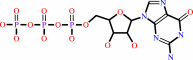 GTP
GTP
|
+
|
H(+)
|
=
|
Mo-molybdopterin guanine dinucleotide
|
+
|
 diphosphate
|
|
|
|
|
|
|
|
|
|
|
|
|
Molecule diagrams generated from .mol files obtained from the
KEGG ftp site
|
|
|
|
|
|
|
|
|
|
|
|
|
|
 |
|
|
|
|
|
|
| |
|
|
| |
|
DOI no:
|
J Biol Chem
278:25302-25307
(2003)
|
|
PubMed id:
|
|
|
|
|
|
| |
|
Biochemical and structural analysis of the molybdenum cofactor biosynthesis protein MobA.
|
|
A.Guse,
C.E.Stevenson,
J.Kuper,
G.Buchanan,
G.Schwarz,
G.Giordano,
A.Magalon,
R.R.Mendel,
D.M.Lawson,
T.Palmer.
|
|
|
|
|
| |
ABSTRACT
|
|
|
|
| |
|
|
Molybdopterin guanine dinucleotide (MGD) is the form of the molybdenum cofactor
that is required for the activity of most bacterial molybdoenzymes. MGD is
synthesized from molybdopterin (MPT) and GTP in a reaction catalyzed by the MobA
protein. Here we report that wild type MobA can be copurified along with bound
MPT and MGD, demonstrating a tight binding of both its substrate and product. To
study structure-function relationships, we have constructed a number of
site-specific mutations of the most highly conserved amino acid residues of the
MobA protein family. Variant MobA proteins were characterized for their ability
to support the synthesis of active molybdenum enzymes, to bind MPT and MGD, to
interact with the molybdenum cofactor biosynthesis proteins MobB and MoeA. They
were also characterized by x-ray structural analysis. Our results suggest an
essential role for glycine 15 of MobA, either for GTP binding and/or catalysis,
and an involvement of glycine 82 in the stabilization of the product-bound form
of the enzyme. Surprisingly, the individual and double substitution of
asparagines 180 and 182 to aspartate did not affect MPT binding, catalysis, and
product stabilization.
|
|
|
|
|
|
| |
Selected figure(s)
|
|
|
|
| |
|
|

|
|

|
|
Figure 1.
FIG. 1. Alignment of MobA amino acid sequences from
bacteria. The abbreviations used are: Eco, E. coli (17); Rsp,
Rhodobacter sphaeroides (41); Ppu, Pseudomonas putida
(GenBankTM/EBI accession number AJ2429522); Bsu, Bacillus
subtilis (GenBankTM/EBI accession number AAC24900 [GenBank]
). Conserved residues that were subjected to mutagenesis in this
study are indicated by asterisks under the sequence.
|
|
Figure 5.
FIG. 5. Structural analysis of amino acid substituted MobA
proteins. Composite figure showing the locations of the
substituted residues in MobA and their effects on the local
structure. The central picture shows a C  trace of the wild type
structure in white (Protein Data Bank accession code 1E5K [PDB]
), with the side chains (or C s for glycines) of the
substituted residues shown in black. The four circular insets
show the local changes in the structures for four of the five
variants whose structures were determined: close-ups of the wild
type (white) and variant (black) structures are superposed. The
R19A variant is not shown, since the resultant model was
virtually indistinguishable from the wild type. In fact, the
side chain of Arg 19 was not visible in the electron density
maps for any of the crystal structures of MobA (including wild
type), although it is included in the central picture for
completeness. Note the change in the conformation of the
consensus loop in the G22L variant and the loss of a salt bridge
in the D101N form of the protein. The perturbations in the N180D
and N182D structures are relatively minor. The figure was
generated using SwissPDBviewer (40) (www.expasy.ch/spdbv) and
rendered using POV-RayTM (www.povray.org). trace of the wild type
structure in white (Protein Data Bank accession code 1E5K [PDB]
), with the side chains (or C s for glycines) of the
substituted residues shown in black. The four circular insets
show the local changes in the structures for four of the five
variants whose structures were determined: close-ups of the wild
type (white) and variant (black) structures are superposed. The
R19A variant is not shown, since the resultant model was
virtually indistinguishable from the wild type. In fact, the
side chain of Arg 19 was not visible in the electron density
maps for any of the crystal structures of MobA (including wild
type), although it is included in the central picture for
completeness. Note the change in the conformation of the
consensus loop in the G22L variant and the loss of a salt bridge
in the D101N form of the protein. The perturbations in the N180D
and N182D structures are relatively minor. The figure was
generated using SwissPDBviewer (40) (www.expasy.ch/spdbv) and
rendered using POV-RayTM (www.povray.org).
|
|
|
|
|
|
| |
The above figures are
reprinted
by permission from the ASBMB:
J Biol Chem
(2003,
278,
25302-25307)
copyright 2003.
|
|
| |
Figures were
selected
by an automated process.
|
|
|
|
|
|
|
|
|
|
|
|
|
|
|
|
 |
 |
 |
|
Literature references that cite this PDB file's key reference
|
|
|
| |
PubMed id
|
|
Reference
|
|
|
|
|
|
M.Neumann,
G.Mittelstädt,
F.Seduk,
C.Iobbi-Nivol,
and
S.Leimkühler
(2009).
MocA is a specific cytidylyltransferase involved in molybdopterin cytosine dinucleotide biosynthesis in Escherichia coli.
|
| |
J Biol Chem,
284,
21891-21898.
|
|
|
|
|
|
|
P.Sachelaru,
E.Schiltz,
and
R.Brandsch
(2006).
A functional mobA gene for molybdopterin cytosine dinucleotide cofactor biosynthesis is required for activity and holoenzyme assembly of the heterotrimeric nicotine dehydrogenases of Arthrobacter nicotinovorans.
|
| |
Appl Environ Microbiol,
72,
5126-5131.
|
|
|
|
|
|
|
N.Xiao,
G.Du,
and
M.A.Frohman
(2005).
Peroxiredoxin II functions as a signal terminator for H2O2-activated phospholipase D1.
|
| |
FEBS J,
272,
3929-3937.
|
|
|
|
|
|
|
J.Kuper,
A.Llamas,
H.J.Hecht,
R.R.Mendel,
and
G.Schwarz
(2004).
Structure of the molybdopterin-bound Cnx1G domain links molybdenum and copper metabolism.
|
| |
Nature,
430,
803-806.
|
|
|
PDB codes:
|
|
|
|
|
|
|
The most recent references are shown first.
Citation data come partly from CiteXplore and partly
from an automated harvesting procedure. Note that this is likely to be
only a partial list as not all journals are covered by
either method. However, we are continually building up the citation data
so more and more references will be included with time.
Where a reference describes a PDB structure, the PDB
codes are
shown on the right.
|
|


 Links
Links


