|
PDBsum entry 1gmi

|
|
|
|
|
 |
Contents |
 |
|
|
|
|
|
|
|
|
|
|
|
|
* Residue conservation analysis
|
|
|
|
|
|
|
|
|
|
|
Enzyme class:
|
|
E.C.2.7.11.13
- protein kinase C.
|
|
|
|
|
|
|
Reaction:
|
|
|
1.
|
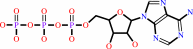
L-seryl-[protein] + ATP = O-phospho-L-seryl-[protein] + ADP + H+
|
|
2.
|
L-threonyl-[protein] + ATP = O-phospho-L-threonyl-[protein] + ADP + H+
|
|
|
|
|
|
|
L-seryl-[protein]
|
+
|
 ATP
ATP
|
=
|
O-phospho-L-seryl-[protein]
|
+
|
 ADP
ADP
|
+
|
H(+)
|
|
|
|
|
|
|
L-threonyl-[protein]
|
+
|
ATP
|
=
|
O-phospho-L-threonyl-[protein]
|
+
|
ADP
|
+
|
H(+)
|
|
|
|
|
|
|
|
|
|
|
|
|
Molecule diagrams generated from .mol files obtained from the
KEGG ftp site
|
|
|
|
|
|
|
|
|
|
|
|
|
|
 |
|
|
|
|
|
|
| |
|
|
| |
|
DOI no:
|
J Mol Biol
311:837-849
(2001)
|
|
PubMed id:
|
|
|
|
|
|
| |
|
Structure of the C2 domain from novel protein kinase Cepsilon. A membrane binding model for Ca(2+)-independent C2 domains.
|
|
W.F.Ochoa,
J.Garcia-Garcia,
I.Fita,
S.Corbalan-Garcia,
N.Verdaguer,
J.C.Gomez-Fernandez.
|
|
|
|
|
| |
ABSTRACT
|
|
|
|
| |
|
|
Protein kinase Cepsilon (PKCepsilon) is a member of the novel PKCs which are
activated by acidic phospholipids, diacylglycerol and phorbol esters, but lack
the calcium dependence of classical PKC isotypes. The crystal structures of the
C2 domain of PKCepsilon, crystallized both in the absence and in the presence of
the two acidic phospholipids, 1,2-dicaproyl-sn-phosphatidyl-l-serine (DCPS) and
1,2-dicaproyl-sn-phosphatidic acid (DCPA), have now been determined at 2.1, 1.7
and 2.8 A resolution, respectively. The central feature of the PKCepsilon-C2
domain structure is an eight-stranded, antiparallel, beta-sandwich with a type
II topology similar to that of the C2 domains from phospholipase C and from
novel PKCdelta. Despite the similar topology, important differences are found
between the structures of C2 domains from PKCs delta and epsilon, suggesting
they be considered as different PKC subclasses. Site-directed mutagenesis
experiments and structural changes in the PKCepsilon-C2 domain from crystals
with DCPS or DCPA indicate, though phospholipids were not visible in these
structures, that loops joining strands beta1-beta2 and beta5-beta6 participate
in the binding to anionic membranes. The different behavior in membrane-binding
and activation between PKCepsilon and classical PKCs appears to originate in
localized structural changes, which include a major reorganization of the region
corresponding to the calcium binding pocket in classical PKCs. A mechanism is
proposed for the interaction of the PKCepsilon-C2 domain with model membranes
that retains basic features of the docking of C2 domains from classical,
calcium-dependent, PKCs.
|
|
|
|
|
|
| |
Selected figure(s)
|
|
|
|
| |
|
|

|
|

|
|
Figure 4.
Figure 4. Top region of the C2-domain b-sandwich from PKCe.
(a) Superimposition of loops 1 and 3 from PKCe (magenta) with
the structurally equivalents loops CBR1 and CBR3 from the
Ca^2+-dependent C2 domain of PKCa (cyan). The two Ca ions
identified in the crystal structure of the C2 domain of PKCa are
depicted as green spheres. Three of the five aspartate residues
conserved in classical PKCs were replaced in PKCe by residues
Pro33, His85 and Ala87. The imidazole ring of His85 occupies the
position corresponding to the active Ca ion. (b) Superimposition
of loop 1 and loop 3 of PKCe onto the equivalent loops in PKCd.
The relative disposition of the loops and the orientation of the
side-chains within the pocket differs markedly between the two
novel PKCs.
|
|
Figure 6.
Figure 6. (a) The docking of the PKCa-C2-Ca^2+-DCPS ternary
complex onto a model membrane and (b) the superimposition of the
structures from the PKCs C2 domains a and e suggest (c) a
docking mechanism for PKCe-C2. In this model only loop 3 appears
to penetrate into the lipid bilayer, though loop 1 would also be
in close contact with the membrane. In the model bulky
side-chains of Trp23, Ile89 and Tyr91 (explicitly depicted)
could reach the inner membrane while conserved basic residues
(particularly Arg26, Arg32, Arg50 and probably also His85) would
interact with the phospholipid charged heads (c). The
coordination of the Mg2+ might also facilitate the interaction
with the membrane (see the text). In this model the carboxy end
of the C2 domain, to be continued by the pseudo-substrate and
the C1 domain in the intact PKC, appears situated apart from the
membrane.
|
|
|
|
|
|
| |
The above figures are
reprinted
by permission from Elsevier:
J Mol Biol
(2001,
311,
837-849)
copyright 2001.
|
|
| |
Figures were
selected
by an automated process.
|
|
|
|
|
|
|
|
|
|
|
|
|
|
|
|
 |
 |
 |
|
Literature references that cite this PDB file's key reference
|
|
|
| |
PubMed id
|
|
Reference
|
|
|
|
|
|
G.Ankem,
S.Mitra,
F.Sun,
A.C.Moreno,
B.Chutvirasakul,
H.F.Azurmendi,
L.Li,
and
D.G.Capelluto
(2011).
The C2 domain of Tollip, a Toll-like receptor signalling regulator, exhibits broad preference for phosphoinositides.
|
| |
Biochem J,
435,
597-608.
|
|
|
|
|
|
|
T.A.Leonard,
B.Różycki,
L.F.Saidi,
G.Hummer,
and
J.H.Hurley
(2011).
Crystal structure and allosteric activation of protein kinase C βII.
|
| |
Cell,
144,
55-66.
|
|
|
PDB code:
|
|
|
|
|
|
|
|
Y.Gu,
N.Kaplinsky,
M.Bringmann,
A.Cobb,
A.Carroll,
A.Sampathkumar,
T.I.Baskin,
S.Persson,
and
C.R.Somerville
(2010).
Identification of a cellulose synthase-associated protein required for cellulose biosynthesis.
|
| |
Proc Natl Acad Sci U S A,
107,
12866-12871.
|
|
|
|
|
|
|
E.N.Churchill,
N.Qvit,
and
D.Mochly-Rosen
(2009).
Rationally designed peptide regulators of protein kinase C.
|
| |
Trends Endocrinol Metab,
20,
25-33.
|
|
|
|
|
|
|
M.D.Smith,
C.G.Sudhahar,
D.Gong,
R.V.Stahelin,
and
M.D.Best
(2009).
Modular synthesis of biologically active phosphatidic acid probes using click chemistry.
|
| |
Mol Biosyst,
5,
962-972.
|
|
|
|
|
|
|
C.A.Farah,
I.Nagakura,
D.Weatherill,
X.Fan,
and
W.S.Sossin
(2008).
Physiological role for phosphatidic acid in the translocation of the novel protein kinase C Apl II in Aplysia neurons.
|
| |
Mol Cell Biol,
28,
4719-4733.
|
|
|
|
|
|
|
S.F.Steinberg
(2008).
Structural basis of protein kinase C isoform function.
|
| |
Physiol Rev,
88,
1341-1378.
|
|
|
|
|
|
|
T.M.Mittelmeier,
P.Berthold,
A.Danon,
M.R.Lamb,
A.Levitan,
M.E.Rice,
and
C.L.Dieckmann
(2008).
C2 domain protein MIN1 promotes eyespot organization in Chlamydomonas reinhardtii.
|
| |
Eukaryot Cell,
7,
2100-2112.
|
|
|
|
|
|
|
H.Al-Ali,
T.J.Ragan,
X.Gao,
and
T.K.Harris
(2007).
Reconstitution of modular PDK1 functions on trans-splicing of the regulatory PH and catalytic kinase domains.
|
| |
Bioconjug Chem,
18,
1294-1302.
|
|
|
|
|
|
|
J.L.Jiménez,
and
B.Davletov
(2007).
Beta-strand recombination in tricalbin evolution and the origin of synaptotagmin-like C2 domains.
|
| |
Proteins,
68,
770-778.
|
|
|
|
|
|
|
R.Brandman,
M.H.Disatnik,
E.Churchill,
and
D.Mochly-Rosen
(2007).
Peptides derived from the C2 domain of protein kinase C epsilon (epsilon PKC) modulate epsilon PKC activity and identify potential protein-protein interaction surfaces.
|
| |
J Biol Chem,
282,
4113-4123.
|
|
|
|
|
|
|
B.Z.Guo,
G.Xu,
Y.G.Cao,
C.C.Holbrook,
and
R.E.Lynch
(2006).
Identification and characterization of phospholipase D and its association with drought susceptibilities in peanut (Arachis hypogaea).
|
| |
Planta,
223,
512-520.
|
|
|
|
|
|
|
J.R.Giorgione,
J.H.Lin,
J.A.McCammon,
and
A.C.Newton
(2006).
Increased membrane affinity of the C1 domain of protein kinase Cdelta compensates for the lack of involvement of its C2 domain in membrane recruitment.
|
| |
J Biol Chem,
281,
1660-1669.
|
|
|
|
|
|
|
N.Bhardwaj,
R.V.Stahelin,
R.E.Langlois,
W.Cho,
and
H.Lu
(2006).
Structural bioinformatics prediction of membrane-binding proteins.
|
| |
J Mol Biol,
359,
486-495.
|
|
|
|
|
|
|
P.Conesa-Zamora,
F.Mollinedo,
S.Corbalán-García,
and
J.C.Gómez-Fernández
(2005).
A comparative study of the effect of the antineoplastic ether lipid 1-O-octadecyl-2-O-methyl-glycero-3-phosphocholine and some homologous compounds on PKC alpha and PKC epsilon.
|
| |
Biochim Biophys Acta,
1687,
110-119.
|
|
|
|
|
|
|
R.Roepman,
S.J.Letteboer,
H.H.Arts,
S.E.van Beersum,
X.Lu,
E.Krieger,
P.A.Ferreira,
and
F.P.Cremers
(2005).
Interaction of nephrocystin-4 and RPGRIP1 is disrupted by nephronophthisis or Leber congenital amaurosis-associated mutations.
|
| |
Proc Natl Acad Sci U S A,
102,
18520-18525.
|
|
|
|
|
|
|
R.V.Stahelin,
M.A.Digman,
M.Medkova,
B.Ananthanarayanan,
H.R.Melowic,
J.D.Rafter,
and
W.Cho
(2005).
Diacylglycerol-induced membrane targeting and activation of protein kinase Cepsilon: mechanistic differences between protein kinases Cdelta and Cepsilon.
|
| |
J Biol Chem,
280,
19784-19793.
|
|
|
|
|
|
|
D.Schechtman,
M.L.Craske,
V.Kheifets,
T.Meyer,
J.Schechtman,
and
D.Mochly-Rosen
(2004).
A critical intramolecular interaction for protein kinase Cepsilon translocation.
|
| |
J Biol Chem,
279,
15831-15840.
|
|
|
|
|
|
|
R.V.Stahelin,
M.A.Digman,
M.Medkova,
B.Ananthanarayanan,
J.D.Rafter,
H.R.Melowic,
and
W.Cho
(2004).
Mechanism of diacylglycerol-induced membrane targeting and activation of protein kinase Cdelta.
|
| |
J Biol Chem,
279,
29501-29512.
|
|
|
|
|
|
|
M.Jose Lopez-Andreo,
J.C.Gomez-Fernandez,
and
S.Corbalan-Garcia
(2003).
The simultaneous production of phosphatidic acid and diacylglycerol is essential for the translocation of protein kinase Cepsilon to the plasma membrane in RBL-2H3 cells.
|
| |
Mol Biol Cell,
14,
4885-4895.
|
|
|
|
|
|
|
S.Corbalán-Garcia,
S.Sánchez-Carrillo,
J.García-García,
and
J.C.Gómez-Fernández
(2003).
Characterization of the membrane binding mode of the C2 domain of PKC epsilon.
|
| |
Biochemistry,
42,
11661-11668.
|
|
|
|
|
|
|
A.S.Solodukhin,
H.L.Caldwell,
J.J.Sando,
and
R.H.Kretsinger
(2002).
Two-dimensional crystal structures of protein kinase C-delta, its regulatory domain, and the enzyme complexed with myelin basic protein.
|
| |
Biophys J,
82,
2700-2708.
|
|
|
|
|
|
|
C.Suzuki,
G.Murakami,
M.Fukuchi,
T.Shimanuki,
Y.Shikauchi,
T.Imamura,
and
K.Miyazono
(2002).
Smurf1 regulates the inhibitory activity of Smad7 by targeting Smad7 to the plasma membrane.
|
| |
J Biol Chem,
277,
39919-39925.
|
|
|
|
|
|
|
C.W.Arendt,
B.Albrecht,
T.J.Soos,
and
D.R.Littman
(2002).
Protein kinase C-theta;: signaling from the center of the T-cell synapse.
|
| |
Curr Opin Immunol,
14,
323-330.
|
|
|
|
|
|
|
Y.Kawasaki,
A.Nakagawa,
K.Nagaosa,
A.Shiratsuchi,
and
Y.Nakanishi
(2002).
Phosphatidylserine binding of class B scavenger receptor type I, a phagocytosis receptor of testicular sertoli cells.
|
| |
J Biol Chem,
277,
27559-27566.
|
|
|
|
|
|
The most recent references are shown first.
Citation data come partly from CiteXplore and partly
from an automated harvesting procedure. Note that this is likely to be
only a partial list as not all journals are covered by
either method. However, we are continually building up the citation data
so more and more references will be included with time.
Where a reference describes a PDB structure, the PDB
code is
shown on the right.
|
|


 Links
Links