 |
PDBsum entry 1gjs

|
|
|
|
|
|

|

|

|

|
|

|
|

|
|
|
 |

|

|
|
|
|
|
|
|
|
|
|
|
|
|
|
|
|
|
|
|
|
|
|
|
|
|
|
|
|
|
|
|
Immunoglobulin-binding protein
|
PDB id
|
|
|
|
1gjs
|
|
|
|
|
|
|
|
|
|
|
|
|
|
|

|

|

|
|
|
|
|
|
|
|
 |
Contents |
 |
|
|
|
|
|
|
|
|
* Residue conservation analysis
|
|
|
|
|
|
PDB id:
|
|
|
|
| Name: |
|
Immunoglobulin-binding protein
|
|
|
Title:
|
|
Solution structure of the albumin binding domain of streptococcal protein g
|
|
Structure:
|
|
Immunoglobulin g binding protein g. Chain: a. Fragment: albumin-binding domain residues 254-299. Synonym: abd, albumin-binding domain of protein g, igg binding protein g. Engineered: yes
|
|
Source:
|
|
Streptococcus sp.. Group g streptococci. Organism_taxid: 1306. Expressed in: escherichia coli. Expression_system_taxid: 562
|
|
NMR struc:
|
|
30 models
|
|
|
Authors:
|
|
M.U.Johansson,I.M.Frick,H.Nilsson,P.J.Kraulis,S.Hober,P.Jonasson, A.P.Nygren,M.Uhlen,L.Bjorck,T.Drakenberg,S.Forsen,M.Wikstrom
|
Key ref:

|
|
M.U.Johansson
et al.
(2002).
Structure, specificity, and mode of interaction for bacterial albumin-binding modules.
J Biol Chem,
277,
8114-8120.
PubMed id:
DOI:

|
|
|
Date:
|
|
|
02-Aug-01
|
Release date:
|
09-Aug-01
|
|
|
|
|
|
|
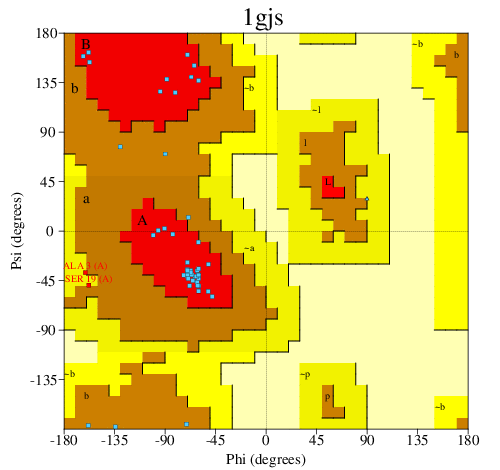
PROCHECK
|
|
|
|
|
|
Headers
|
|
|
|
References
|
|
|
|
|
|

|
|
P19909
(SPG2_STRSG) -
Immunoglobulin G-binding protein G from Streptococcus sp. group G
|
|
|
|
Seq:
Struc:
|
|
|
|
593 a.a.
65 a.a.*
|
|

|

|
|
|
|
|
|
|
|
|
|
|
|
Key: |
 |
PfamA domain |
|
|
 |
Secondary structure |
|
 |
CATH domain |
|
|
*
PDB and UniProt seqs differ
at 18 residue positions (black
crosses)
|
|
|
|
|
|
|
|
|
|
|
|
|
|
|
|
|
 |
|
|
|
|
|
|
| |
|
DOI no:
|
J Biol Chem
277:8114-8120
(2002)
|
|
PubMed id:
|
|
|
|
|
|
| |
|
Structure, specificity, and mode of interaction for bacterial albumin-binding modules.
|
|
M.U.Johansson,
I.M.Frick,
H.Nilsson,
P.J.Kraulis,
S.Hober,
P.Jonasson,
M.Linhult,
P.A.Nygren,
M.Uhlén,
L.Björck,
T.Drakenberg,
S.Forsén,
M.Wikström.
|
|
|
|
|
| |
ABSTRACT
|
|
|
|
| |
|
|
We have determined the solution structure of an albumin binding domain of
protein G, a surface protein of group C and G streptococci. We find that it
folds into a left handed three-helix bundle similar to the albumin binding
domain of protein PAB from Peptostreptococcus magnus. The two domains share 59%
sequence identity, are thermally very stable, and bind to the same site on human
serum albumin. The albumin binding site, the first determined for this
structural motif known as the GA module, comprises residues spanning the first
loop to the beginning of the third helix and includes the most conserved region
of GA modules. The two GA modules have different affinities for albumin from
different species, and their albumin binding patterns correspond directly to the
host specificity of C/G streptococci and P. magnus, respectively. These studies
of the evolution, structure, and binding properties of the GA module emphasize
the power of bacterial adaptation and underline ecological and medical problems
connected with the use of antibiotics.
|
|
|
|
|
|
| |
Selected figure(s)
|
|
|
|
| |
|
|

|
|

|
|
Figure 2.
Fig. 2. Structural features of GA modules. Panel A,
stereo representation of 30 G148-GA3 NMR solution structures
superimposed onto their unminimized average coordinates by
minimizing the r.m.s. deviations for the backbone atoms of
helices. Panel B, ribbon representation of the structure closest
to the mean of the 30 structures representing G148-GA3. Panel C,
ribbon representation of the structure closest to the mean of
the 20 structures (the atomic coordinates are available in the
Research Collaboratory for Structural Bioinformatics Protein
Data Bank under PDB 1GAB (13)). The whole protein fragment of
ALB8-GA (53 residues) is shown, and the corresponding residues
of G148-GA3 are shown in panel B, although not all residues
belong to the intact protein G sequence. Panel D, tube
representation of ALB8-GA (light gray) and G148-GA3 (dark gray)
with backbone atoms of helical regions superimposed. Residue
Thr-18 in ALB8-GA is indicated with an arrow, and at the
corresponding position in G148-GA3 there is a deletion.
Structures (all oriented with their N terminus upward) in panels
A-D were visualized using MOLMOL (40). Panel E, graphical DDM
comparing the two GA modules in this study. The average distance
differences between C^  and C^
in the
30 conformers of G148-GA3 and the 20 structures of ALB8-GA (PDB
1GAB (13) were calculated to generate the DDM (29). Only
residues belonging to the defined GA module sequence were
analyzed. Residue Thr-18 in ALB8-GA was excluded because there
is a deletion at the corresponding position in the G148-GA3
sequence, and these locations are marked by arrows. The lower
right half of the matrix shows the average distance differences
for all residue pairs; the upper left part shows only the
average distance differences that are larger than 2 S.D. The
distance differences are coded using a gradient from white to
black with gray representing interatomic distances that are the
same in both ensembles. Interatomic distances that become larger
in G148-GA3 tend toward white, whereas distances that become
smaller tend toward black. and C^
in the
30 conformers of G148-GA3 and the 20 structures of ALB8-GA (PDB
1GAB (13) were calculated to generate the DDM (29). Only
residues belonging to the defined GA module sequence were
analyzed. Residue Thr-18 in ALB8-GA was excluded because there
is a deletion at the corresponding position in the G148-GA3
sequence, and these locations are marked by arrows. The lower
right half of the matrix shows the average distance differences
for all residue pairs; the upper left part shows only the
average distance differences that are larger than 2 S.D. The
distance differences are coded using a gradient from white to
black with gray representing interatomic distances that are the
same in both ensembles. Interatomic distances that become larger
in G148-GA3 tend toward white, whereas distances that become
smaller tend toward black.
|
|
Figure 3.
Fig. 3. Albumin binding site of ALB8-GA and G148-GA3.
Panel A, chemical shift perturbations upon addition of 0.6 eq of
rabbit serum albumin to ALB8-GA at 37 °C. Panel B, same as
panel A but for G148-GA3. The chemical shift change was
calculated from the chemical shift of the backbone 15N and 1H
resonances using the following formula:   = (( (1H))2 +
(0.2 (15N))2)1/2
and is indicated with a filled bar at the corresponding residue.
Each residue for which the cross-peak is broadened beyond
detection upon the addition of albumin is indicated by a green
bar at the value of 0.14 ppm (corresponding to the maximum
chemical shift change of residues with nonbroadened
cross-peaks). Residues that were too weak to give any reliable
information, overlapped, or were not detected at all are
indicated with outlined circles at a value of 0 ppm. The helices
are indicated by boxes at the top. Panel C, overlay of a region
of 15N-1H HSQC spectra of 2 mM ALB8-GA at 47 °C in the
absence (blue) and in the presence (red) of 1 eq of rabbit serum
albumin with the residue numbers indicated. For details, see
"Results and Discussion." Panels D and E, contact surfaces
displaying the effects of albumin binding shown in two different
views differing by a 180° rotation along the y axis. The
orientation of the views to the left is the same as in the
ribbon representations in Fig. 2, panels C and B, respectively.
The 18 (ALB8-GA, panel D) and 20 (G148-GA3, panel E)
significantly perturbed residues are indicated in red. Residues
that were too weak to give any reliable information, overlapped,
or were not detected at all are shown in magenta. The remaining
residues are colored blue. To clarify the presentation, only
residues belonging to the defined GA module sequence are shown.
The contact surfaces in panels D and E were prepared using
MOLMOL (40). = (( (1H))2 +
(0.2 (15N))2)1/2
and is indicated with a filled bar at the corresponding residue.
Each residue for which the cross-peak is broadened beyond
detection upon the addition of albumin is indicated by a green
bar at the value of 0.14 ppm (corresponding to the maximum
chemical shift change of residues with nonbroadened
cross-peaks). Residues that were too weak to give any reliable
information, overlapped, or were not detected at all are
indicated with outlined circles at a value of 0 ppm. The helices
are indicated by boxes at the top. Panel C, overlay of a region
of 15N-1H HSQC spectra of 2 mM ALB8-GA at 47 °C in the
absence (blue) and in the presence (red) of 1 eq of rabbit serum
albumin with the residue numbers indicated. For details, see
"Results and Discussion." Panels D and E, contact surfaces
displaying the effects of albumin binding shown in two different
views differing by a 180° rotation along the y axis. The
orientation of the views to the left is the same as in the
ribbon representations in Fig. 2, panels C and B, respectively.
The 18 (ALB8-GA, panel D) and 20 (G148-GA3, panel E)
significantly perturbed residues are indicated in red. Residues
that were too weak to give any reliable information, overlapped,
or were not detected at all are shown in magenta. The remaining
residues are colored blue. To clarify the presentation, only
residues belonging to the defined GA module sequence are shown.
The contact surfaces in panels D and E were prepared using
MOLMOL (40).
|
|
|
|
|
|
| |
The above figures are
reprinted
by permission from the ASBMB:
J Biol Chem
(2002,
277,
8114-8120)
copyright 2002.
|
|
| |
Figures were
selected
by an automated process.
|
|
|
|
|
|
|
|
|
|
|
|
|
|
|
|
 |
 |
 |
|
Literature references that cite this PDB file's key reference
|
|
|
| |
PubMed id
|
|
Reference
|
|
|
|
|
|
A.Constantinou,
C.Chen,
and
M.P.Deonarain
(2010).
Modulating the pharmacokinetics of therapeutic antibodies.
|
| |
Biotechnol Lett,
32,
609-622.
|
|
|
|
|
|
|
J.Hopp,
N.Hornig,
K.A.Zettlitz,
A.Schwarz,
N.Fuss,
D.Müller,
and
R.E.Kontermann
(2010).
The effects of affinity and valency of an albumin-binding domain (ABD) on the half-life of a single-chain diabody-ABD fusion protein.
|
| |
Protein Eng Des Sel,
23,
827-834.
|
|
|
|
|
|
|
T.Alm,
L.Yderland,
J.Nilvebrant,
A.Halldin,
and
S.Hober
(2010).
A small bispecific protein selected for orthogonal affinity purification.
|
| |
Biotechnol J,
5,
605-617.
|
|
|
|
|
|
|
R.E.Kontermann
(2009).
Strategies to extend plasma half-lives of recombinant antibodies.
|
| |
BioDrugs,
23,
93.
|
|
|
|
|
|
|
R.Stork,
E.Campigna,
B.Robert,
D.Müller,
and
R.E.Kontermann
(2009).
Biodistribution of a bispecific single-chain diabody and its half-life extended derivatives.
|
| |
J Biol Chem,
284,
25612-25619.
|
|
|
|
|
|
|
S.Lejon,
J.F.Cramer,
and
P.Nordberg
(2008).
Structural basis for the binding of naproxen to human serum albumin in the presence of fatty acids and the GA module.
|
| |
Acta Crystallogr Sect F Struct Biol Cryst Commun,
64,
64-69.
|
|
|
PDB code:
|
|
|
|
|
|
|
|
T.Goto,
A.Yamashita,
H.Hirakawa,
M.Matsutani,
K.Todo,
K.Ohshima,
H.Toh,
K.Miyamoto,
S.Kuhara,
M.Hattori,
T.Shimizu,
and
S.Akimoto
(2008).
Complete genome sequence of Finegoldia magna, an anaerobic opportunistic pathogen.
|
| |
DNA Res,
15,
39-47.
|
|
|
|
|
|
|
Y.He,
Y.Chen,
D.A.Rozak,
P.N.Bryan,
and
J.Orban
(2007).
An artificially evolved albumin binding module facilitates chemical shift epitope mapping of GA domain interactions with phylogenetically diverse albumins.
|
| |
Protein Sci,
16,
1490-1494.
|
|
|
|
|
|
|
T.Baussant,
L.Bougueleret,
A.Johnson,
J.Rogers,
L.Menin,
M.Hall,
P.M.Aberg,
and
K.Rose
(2005).
Effective depletion of albumin using a new peptide-based affinity medium.
|
| |
Proteomics,
5,
973-977.
|
|
|
|
|
|
The most recent references are shown first.
Citation data come partly from CiteXplore and partly
from an automated harvesting procedure. Note that this is likely to be
only a partial list as not all journals are covered by
either method. However, we are continually building up the citation data
so more and more references will be included with time.
Where a reference describes a PDB structure, the PDB
code is
shown on the right.
|
|


 Links
Links


