|
PDBsum entry 1e3e

|
|
|
|
|
|

|

|

|

|
|

|
|

|
|

|
|

|
|

|
|

|
|

|
|
|
 |

|

|
|
|
|
|
|
|
|
|
|
|
|
|
|
|
|
|
|
|
|
|
|
|
|
|
|
|
|
|
|
|
|
|
|
|
|
Oxidoreductase
|
PDB id
|
|
|
|
1e3e
|
|
|
|
|
|
|
|
|
|
|
|
|
|
|

|

|

|
|
|
|
|
|
|
|
 |
Contents |
 |
|
|
|
|
|
|
|
|
|
|
|
|
|
|
* Residue conservation analysis
|
|
|
|
|
|
|
|
|
|
|
Enzyme class:
|
|
E.C.1.1.1.105
- all-trans-retinol dehydrogenase (NAD(+)).
|
|
|
|
|
|
|
Reaction:
|
|
all-trans-retinol--[retinol-binding protein] + NAD+ = all-trans- retinal--[retinol-binding protein] + NADH + H+
|
|
|
|
|
|
all-trans-retinol--[retinol-binding protein]
|
+
|
NAD(+)
Bound ligand (Het Group name = )
corresponds exactly
|
=
|
all-trans- retinal--[retinol-binding protein]
|
+
|
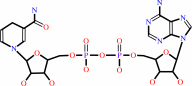 NADH
NADH
|
+
|
H(+)
|
|
|
|
|
|
|
|
|
|
|
|
|
Molecule diagrams generated from .mol files obtained from the
KEGG ftp site
|
|
|
|
|
|
|
|
|
|
|
|
|
|
 |
|
|
|
|
|
|
| |
|
|
| |
|
DOI no:
|
J Mol Biol
302:441-453
(2000)
|
|
PubMed id:
|
|
|
|
|
|
| |
|
Crystal structures of mouse class II alcohol dehydrogenase reveal determinants of substrate specificity and catalytic efficiency.
|
|
S.Svensson,
J.O.Höög,
G.Schneider,
T.Sandalova.
|
|
|
|
|
| |
ABSTRACT
|
|
|
|
| |
|
|
The structure of mouse class II alcohol dehydrogenase (ADH2) has been determined
in a binary complex with the coenzyme NADH and in a ternary complex with both
NADH and the inhibitor N-cyclohexylformamide to 2.2 A and 2.1 A resolution,
respectively. The ADH2 dimer is asymmetric in the crystal with different
orientations of the catalytic domains relative to the coenzyme-binding domains
in the two subunits, resulting in a slightly different closure of the
active-site cleft. Both conformations are about half way between the open apo
structure and the closed holo structure of horse ADH1, thus resembling that of
ADH3. The semi-open conformation and structural differences around the
active-site cleft contribute to a substantially different substrate-binding
pocket architecture as compared to other classes of alcohol dehydrogenase, and
provide the structural basis for recognition and selectivity of alcohols and
quinones. The active-site cleft is more voluminous than that of ADH1 but not as
open and funnel-shaped as that of ADH3. The loop with residues 296-301 from the
coenzyme-binding domain is short, thus opening up the pocket towards the
coenzyme. On the opposite side, the loop with residues 114-121 stretches out
over the inter-domain cleft. A cavity is formed below this loop and adds an
appendix to the substrate-binding pocket. Asp301 is positioned at the entrance
of the pocket and may control the binding of omega-hydroxy fatty acids, which
act as inhibitors rather than substrates. Mouse ADH2 is known as an inefficient
ADH with a slow hydrogen-transfer step. By replacing Pro47 with His, the alcohol
dehydrogenase activity is restored. Here, the structure of this P47H mutant was
determined in complex with NADH to 2.5 A resolution. His47 is suitably
positioned to act as a catalytic base in the deprotonation of the substrate.
Moreover, in the more closed subunit, the coenzyme is allowed a position closer
to the catalytic zinc. This is consistent with hydrogen transfer from an
alcoholate intermediate where the Pro/His replacement focuses on the function of
the enzyme.
|
|
|
|
|
|
| |
Selected figure(s)
|
|
|
|
| |
|
|

|
|

|
|
Figure 2.
Figure 2. Comparison of mouse ADH2 subunit A (orange) with
horse liver ADH1 apo (green) and holo (blue) subunits. C^a
chains of the individual coenzyme-binding domains are
superpositioned. Coenzyme-binding domains are to the left and
the catalytic domains to the right. Zinc atoms and NADH are
depicted in purple and brown, respectively. The three structural
segments with insertions, deletions and high rms deviations as
compared to other ADH structures are colored red and denoted
V1-V3 (V1, residues 55-61; V2, residues 114-121; V3, residues
294-307). The mouse ADH2 A-subunit is semi-open about half way
between the open apo and the closed holo form of horse liver
ADH1.
|
|
Figure 3.
Figure 3. Stereo diagrams of the active site of mouse ADH2
complexed with NADH and N-cyclohexylformamide (CXF). (a), The
alternative proton relay via Thr48 and Asn51 is indicated with
broken lines and distances are given in Å (red). The 2F[o]
-F[c] electron density map (blue) is contoured at 1s and the
annealed omit F[o] -F[c] electron density map for CXF is
contoured at 2.5s (red). Two of the four zinc ligands are
depicted with the coordination to the zinc indicated with dashed
lines. (b) Stereo diagram showing all residues lining the
substrate pocket.
|
|
|
|
|
|
| |
The above figures are
reprinted
by permission from Elsevier:
J Mol Biol
(2000,
302,
441-453)
copyright 2000.
|
|
| |
Figures were
selected
by an automated process.
|
|
|
|
|
|
|
|
|
|
|
|
|
|
|
|
 |
 |
 |
|
Literature references that cite this PDB file's key reference
|
|
|
| |
PubMed id
|
|
Reference
|
|
|
|
|
|
P.Aryal,
H.Dvir,
S.Choe,
and
P.A.Slesinger
(2009).
A discrete alcohol pocket involved in GIRK channel activation.
|
| |
Nat Neurosci,
12,
988-995.
|
|
|
|
|
|
|
R.A.Harris,
J.R.Trudell,
and
S.J.Mihic
(2008).
Ethanol's molecular targets.
|
| |
Sci Signal,
1,
re7.
|
|
|
|
|
|
|
R.Gonzàlez-Duarte,
and
R.Albalat
(2005).
Merging protein, gene and genomic data: the evolution of the MDR-ADH family.
|
| |
Heredity,
95,
184-197.
|
|
|
|
|
|
|
S.Watanabe,
T.Kodaki,
and
K.Makino
(2005).
Complete reversal of coenzyme specificity of xylitol dehydrogenase and increase of thermostability by the introduction of structural zinc.
|
| |
J Biol Chem,
280,
10340-10349.
|
|
|
|
|
|
|
I.Levin,
G.Meiri,
M.Peretz,
Y.Burstein,
and
F.Frolow
(2004).
The ternary complex of Pseudomonas aeruginosa alcohol dehydrogenase with NADH and ethylene glycol.
|
| |
Protein Sci,
13,
1547-1556.
|
|
|
PDB code:
|
|
|
|
|
|
|
|
A.Rosell,
E.Valencia,
W.F.Ochoa,
I.Fita,
X.Parés,
and
J.Farrés
(2003).
Complete reversal of coenzyme specificity by concerted mutation of three consecutive residues in alcohol dehydrogenase.
|
| |
J Biol Chem,
278,
40573-40580.
|
|
|
|
|
|
|
E.Valencia,
A.Rosell,
C.Larroy,
J.Farrés,
J.A.Biosca,
I.Fita,
X.Parés,
and
W.F.Ochoa
(2003).
Crystallization and preliminary X-ray analysis of NADP(H)-dependent alcohol dehydrogenases from Saccharomyces cerevisiae and Rana perezi.
|
| |
Acta Crystallogr D Biol Crystallogr,
59,
334-337.
|
|
|
|
|
|
|
H.L.Liu,
Y.Ho,
and
C.M.Hsu
(2003).
The effect of metal ions on the binding of ethanol to human alcohol dehydrogenase beta2beta2.
|
| |
J Biomed Sci,
10,
302-312.
|
|
|
|
|
|
|
L.Esposito,
I.Bruno,
F.Sica,
C.A.Raia,
A.Giordano,
M.Rossi,
L.Mazzarella,
and
A.Zagari
(2003).
Crystal structure of a ternary complex of the alcohol dehydrogenase from Sulfolobus solfataricus.
|
| |
Biochemistry,
42,
14397-14407.
|
|
|
PDB code:
|
|
|
|
|
|
|
|
J.O.Höög,
J.J.Hedberg,
P.Strömberg,
and
S.Svensson
(2001).
Mammalian alcohol dehydrogenase - functional and structural implications.
|
| |
J Biomed Sci,
8,
71-76.
|
|
|
|
|
|
The most recent references are shown first.
Citation data come partly from CiteXplore and partly
from an automated harvesting procedure. Note that this is likely to be
only a partial list as not all journals are covered by
either method. However, we are continually building up the citation data
so more and more references will be included with time.
Where a reference describes a PDB structure, the PDB
code is
shown on the right.
|
|


 Links
Links