 |
PDBsum entry 1e2a

|
|
|
|
|
 |
Contents |
 |
|
|
|
|
|
|
|
|
|
|
|
|
* Residue conservation analysis
|
|
|
|
|
|
|
|
|
|
|
Enzyme class:
|
|
E.C.2.7.1.69
- Transferred entry: 2.7.1.191, 2.7.1.192, 2.7.1.193, 2.7.1.194, 2.7.1.195,
|
|
|
|
|
|
|
Reaction:
|
|
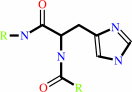
Protein EIIB N(pi)-phospho-L-histidine/cysteine + sugar = protein EIIB + sugar phosphate
|
|
|
|
|
|
|
+
|
|
=
|
|
+
|
|
|
|
|
|
|
|
|
|
|
|
|
|
Molecule diagrams generated from .mol files obtained from the
KEGG ftp site
|
|
|
|
|
|
|
|
|
|
|
|
|
|
 |
|
|
|
|
|
|
| |
|
|
| |
|
DOI no:
|
Structure
5:775-788
(1997)
|
|
PubMed id:
|
|
|
|
|
|
| |
|
The structure of enzyme IIAlactose from Lactococcus lactis reveals a new fold and points to possible interactions of a multicomponent system.
|
|
P.Sliz,
R.Engelmann,
W.Hengstenberg,
E.F.Pai.
|
|
|
|
|
| |
ABSTRACT
|
|
|
|
| |
|
|
BACKGROUND: The bacterial phosphoenolpyruvate: sugar phosphotransferase system
(PTS) is responsible for the binding, transmembrane transport and
phosphorylation of numerous sugar substrates. The system is also involved in the
regulation of a variety of metabolic and transcriptional processes. The PTS
consists of two non-specific energy coupling components, enzyme I and a heat
stable phosphocarrier protein (HPr), as well as several sugar-specific
multiprotein permeases known as enzymes II. In most cases, enzymes IIA and IIB
are located in the cytoplasm, while enzyme IIC acts as a membrane channel.
Enzyme IIAlactose belongs to the lactose/cellobiose-specific family of enzymes
II, one of four functionally and structurally distinct groups. The protein,
which normally functions as a trimer, is believed to separate into its subunits
after phosphorylation. RESULTS: The crystal structure of the trimeric enzyme
IIAlactose from Lactococcus lactis has been determined at 2.3 A resolution. The
subunits of the enzyme, related to each other by the inherent threefold
rotational symmetry, possess interesting structural features such as
coiled-coil-like packing and a methionine cluster. The subunits each comprise
three helices (I, II and III) and pack against each other forming a nine-helix
bundle. This helical bundle is stabilized by a centrally located metal ion and
also encloses a hydrophobic cavity. The three phosphorylation sites (His78 on
each monomer) are located in helices III and their sidechains protrude into a
large groove between helices I and II of the neighbouring subunits. A model of
the complex between phosphorylated HPr and enzyme IIAlactose has been
constructed. CONCLUSIONS: Enzyme IIAlactose is the first representative of the
family of lactose/cellobiose-specific enzymes IIA for which a three-dimensional
structure has been determined. Some of its structural features, like the
presence of two histidine residues at the active site, seem to be common to all
enzymes no overall structural homology is observed to any PTS proteins or to any
other proteins in the Protein Data Bank. Enzyme IIAlactose shows surface
complementarity to the phosphorylated form of HPr and several energetically
favourable interactions between the two molecules can be predicted.
|
|
|
|
|
|
| |
Selected figure(s)
|
|
|
|
| |
|
|

|
|
Figure 8.
Figure 8. Stereo view representation of a modelled enzyme
IIA-HPr complex. With knowledge of the phosphorylation site, the
family of NMR structures of P-HPr (PDB code 1PFH coloured in
red) was docked into the crystallographic model of enzyme IIA.
The P-HPr ensemble of structures was rotated around the apical
axis (red line) to minimize clashes and short contacts between
the two proteins. Residues possibly involved in electrostatic
interaction are Glu64[IIA] and Arg17[HPr]. Sidechains of
His78[IIA], His82[IIA] and P-His15[HPr] are displayed and
coloured by atom type.
|
|
|
|
|
|
| |
The above figure is
reprinted
by permission from Cell Press:
Structure
(1997,
5,
775-788)
copyright 1997.
|
|
| |
Figure was
selected
by the author.
|
|
|
|
|
|
|
|
|
|
|
|
|
|
|
|
 |
 |
 |
|
Literature references that cite this PDB file's key reference
|
|
|
| |
PubMed id
|
|
Reference
|
|
|
|
|
|
Y.S.Jung,
M.Cai,
and
G.M.Clore
(2010).
Solution structure of the IIAChitobiose-IIBChitobiose complex of the N,N'-diacetylchitobiose branch of the Escherichia coli phosphotransferase system.
|
| |
J Biol Chem,
285,
4173-4184.
|
|
|
PDB codes:
|
|
|
|
|
|
|
|
J.Deutscher,
C.Francke,
and
P.W.Postma
(2006).
How phosphotransferase system-related protein phosphorylation regulates carbohydrate metabolism in bacteria.
|
| |
Microbiol Mol Biol Rev,
70,
939.
|
|
|
|
|
|
|
J.Y.Suh,
M.Cai,
D.C.Williams,
and
G.M.Clore
(2006).
Solution structure of a post-transition state analog of the phosphotransfer reaction between the A and B cytoplasmic domains of the mannitol transporter IIMannitol of the Escherichia coli phosphotransferase system.
|
| |
J Biol Chem,
281,
8939-8949.
|
|
|
PDB code:
|
|
|
|
|
|
|
|
C.Tang,
D.C.Williams,
R.Ghirlando,
and
G.M.Clore
(2005).
Solution structure of enzyme IIA(Chitobiose) from the N,N'-diacetylchitobiose branch of the Escherichia coli phosphotransferase system.
|
| |
J Biol Chem,
280,
11770-11780.
|
|
|
PDB code:
|
|
|
|
|
|
|
|
P.M.Legler,
M.Cai,
A.Peterkofsky,
and
G.M.Clore
(2004).
Three-dimensional solution structure of the cytoplasmic B domain of the mannitol transporter IImannitol of the Escherichia coli phosphotransferase system.
|
| |
J Biol Chem,
279,
39115-39121.
|
|
|
PDB code:
|
|
|
|
|
|
|
|
W.R.Silverman,
J.P.Bannister,
and
D.M.Papazian
(2004).
Binding site in eag voltage sensor accommodates a variety of ions and is accessible in closed channel.
|
| |
Biophys J,
87,
3110-3121.
|
|
|
|
|
|
|
G.Cornilescu,
B.R.Lee,
C.C.Cornilescu,
G.Wang,
A.Peterkofsky,
and
G.M.Clore
(2002).
Solution structure of the phosphoryl transfer complex between the cytoplasmic A domain of the mannitol transporter IIMannitol and HPr of the Escherichia coli phosphotransferase system.
|
| |
J Biol Chem,
277,
42289-42298.
|
|
|
PDB code:
|
|
|
|
|
|
|
|
M.Witty,
C.Sanz,
A.Shah,
J.G.Grossmann,
K.Mizuguchi,
R.N.Perham,
and
B.Luisi
(2002).
Structure of the periplasmic domain of Pseudomonas aeruginosa TolA: evidence for an evolutionary relationship with the TonB transporter protein.
|
| |
EMBO J,
21,
4207-4218.
|
|
|
PDB code:
|
|
|
|
|
|
|
|
G.Wang,
J.M.Louis,
M.Sondej,
Y.J.Seok,
A.Peterkofsky,
and
G.M.Clore
(2000).
Solution structure of the phosphoryl transfer complex between the signal transducing proteins HPr and IIA(glucose) of the Escherichia coli phosphoenolpyruvate:sugar phosphotransferase system.
|
| |
EMBO J,
19,
5635-5649.
|
|
|
PDB code:
|
|
|
|
|
|
|
|
W.R.Silverman,
C.Y.Tang,
A.F.Mock,
K.B.Huh,
and
D.M.Papazian
(2000).
Mg(2+) modulates voltage-dependent activation in ether-à-go-go potassium channels by binding between transmembrane segments S2 and S3.
|
| |
J Gen Physiol,
116,
663-678.
|
|
|
|
|
|
|
A.Mattevi,
G.Tedeschi,
L.Bacchella,
A.Coda,
A.Negri,
and
S.Ronchi
(1999).
Structure of L-aspartate oxidase: implications for the succinate dehydrogenase/fumarate reductase oxidoreductase family.
|
| |
Structure,
7,
745-756.
|
|
|
PDB code:
|
|
|
|
|
|
|
|
G.T.Robillard,
and
J.Broos
(1999).
Structure/function studies on the bacterial carbohydrate transporters, enzymes II, of the phosphoenolpyruvate-dependent phosphotransferase system.
|
| |
Biochim Biophys Acta,
1422,
73.
|
|
|
|
|
|
|
R.Gutknecht,
K.Flükiger,
R.Lanz,
and
B.Erni
(1999).
Mechanism of phosphoryl transfer in the dimeric IIABMan subunit of the Escherichia coli mannose transporter.
|
| |
J Biol Chem,
274,
6091-6096.
|
|
|
|
|
|
|
J.P.Schneider,
A.Lombardi,
and
W.F.DeGrado
(1998).
Analysis and design of three-stranded coiled coils and three-helix bundles.
|
| |
Fold Des,
3,
R29-R40.
|
|
|
|
|
|
|
J.W.Bryson,
J.R.Desjarlais,
T.M.Handel,
and
W.F.DeGrado
(1998).
From coiled coils to small globular proteins: design of a native-like three-helix bundle.
|
| |
Protein Sci,
7,
1404-1414.
|
|
|
|
|
|
|
R.L.van Montfort,
T.Pijning,
K.H.Kalk,
I.Hangyi,
M.L.Kouwijzer,
G.T.Robillard,
and
B.W.Dijkstra
(1998).
The structure of the Escherichia coli phosphotransferase IIAmannitol reveals a novel fold with two conformations of the active site.
|
| |
Structure,
6,
377-388.
|
|
|
PDB code:
|
|
|
|
|
|
|
|
M.M.McEvoy,
and
F.W.Dahlquist
(1997).
Phosphohistidines in bacterial signaling.
|
| |
Curr Opin Struct Biol,
7,
793-797.
|
|
|
|
|
|
The most recent references are shown first.
Citation data come partly from CiteXplore and partly
from an automated harvesting procedure. Note that this is likely to be
only a partial list as not all journals are covered by
either method. However, we are continually building up the citation data
so more and more references will be included with time.
Where a reference describes a PDB structure, the PDB
codes are
shown on the right.
|
|


 Links
Links


