 |
PDBsum entry 1dpf

|
|
|
|
|
|

|

|

|

|
|

|
|

|
|

|
|

|
|

|
|
|
 |

|

|
|
|
|
|
|
|
|
|
|
|
|
|
|
|
|
|
|
|
|
|
|
|
|
|
|
|
|
|
|
|
|
|
|
Gene regulation/signaling protein
|
PDB id
|
|
|
|
1dpf
|
|
|
|
|
|
|
|
|
|
|
|
|
|
|

|

|

|
|
|
|
|
|
|
|
 |
Contents |
 |
|
|
|
|
|
|
|
|
|
|
|
|
* Residue conservation analysis
|
|
|
|
|
|
|
|
|
|
|
Enzyme class:
|
|
E.C.3.6.5.2
- small monomeric GTPase.
|
|
|
|
|
|
|
Reaction:
|
|
GTP + H2O = GDP + phosphate + H+
|
|
|
|
|
|
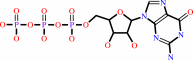 GTP
GTP
|
+
|
H2O
|
=
|
GDP
Bound ligand (Het Group name = )
corresponds exactly
|
+
|
 phosphate
|
+
|
H(+)
|
|
|
|
|
|
|
|
|
|
|
|
|
Molecule diagrams generated from .mol files obtained from the
KEGG ftp site
|
|
|
|
|
|
|
|
|
|
|
|
|
|
 |
|
|
|
|
|
|
| |
|
|
| |
|
DOI no:
|
J Biol Chem
275:18311-18317
(2000)
|
|
PubMed id:
|
|
|
|
|
|
| |
|
An open conformation of switch I revealed by the crystal structure of a Mg2+-free form of RHOA complexed with GDP. Implications for the GDP/GTP exchange mechanism.
|
|
T.Shimizu,
K.Ihara,
R.Maesaki,
S.Kuroda,
K.Kaibuchi,
T.Hakoshima.
|
|
|
|
|
| |
ABSTRACT
|
|
|
|
| |
|
|
Mg(2+) ions are essential for guanosine triphosphatase (GTPase) activity and
play key roles in guanine nucleotide binding and preserving the structural
integrity of GTP-binding proteins. We determined the crystal structure of a
small GTPase RHOA complexed with GDP in the absence of Mg(2+) at 2.0-A
resolution. Elimination of a Mg(2+) ion induces significant conformational
changes in the switch I region that opens up the nucleotide-binding site.
Similar structural changes have been observed in the switch regions of Ha-Ras
bound to its guanine nucleotide exchange factor, Sos. This RHOA-GDP structure
reveals an important regulatory role for Mg(2+) and suggests that guanine
nucleotide exchange factor may utilize this feature of switch I to produce an
open conformation in GDP/GTP exchange.
|
|
|
|
|
|
| |
Selected figure(s)
|
|
|
|
| |
|
|

|
|

|
|
Figure 5.
Fig. 5. A diagram showing the coordination of GDP in the
RHOA Mg2+-free form. All dashed lines correspond to hydrogen
bonding interactions (distance less than 3.5 Å), and the
corresponding distances are indicated. The hydrogen bonds
observed in the current structure but not in the GDP/Mg2+-bound
form are highlighted in red.
|
|
Figure 6.
Fig. 6. Summary of contacts of the RHOA Mg2+-free form
around the switch I region. Thin and thick dashed lines
correspond to hydrogen bonding and van der Waals interactions,
respectively.
|
|
|
|
|
|
| |
The above figures are
reprinted
by permission from the ASBMB:
J Biol Chem
(2000,
275,
18311-18317)
copyright 2000.
|
|
| |
Figures were
selected
by an automated process.
|
|
|
|
|
|
|
|
|
|
|
|
|
|
|
|
 |
 |
 |
|
Literature references that cite this PDB file's key reference
|
|
|
| |
PubMed id
|
|
Reference
|
|
|
|
|
|
J.H.Lebbink,
A.Fish,
A.Reumer,
G.Natrajan,
H.H.Winterwerp,
and
T.K.Sixma
(2010).
Magnesium coordination controls the molecular switch function of DNA mismatch repair protein MutS.
|
| |
J Biol Chem,
285,
13131-13141.
|
|
|
PDB codes:
|
|
|
|
|
|
|
|
M.Della Peruta,
C.Giagulli,
C.Laudanna,
A.Scarpa,
and
C.Sorio
(2010).
RHOA and PRKCZ control different aspects of cell motility in pancreatic cancer metastatic clones.
|
| |
Mol Cancer,
9,
61.
|
|
|
|
|
|
|
N.Nassar,
K.Singh,
and
M.Garcia-Diaz
(2010).
Structure of the dominant negative S17N mutant of Ras.
|
| |
Biochemistry,
49,
1970-1974.
|
|
|
PDB code:
|
|
|
|
|
|
|
|
S.Rimmele,
P.Gierschik,
T.O.Joos,
and
N.Schneiderhan-Marra
(2010).
Bead-based protein-protein interaction assays for the analysis of Rho GTPase signaling.
|
| |
J Mol Recognit,
23,
543-550.
|
|
|
|
|
|
|
Y.Chen,
Z.Yang,
M.Meng,
Y.Zhao,
N.Dong,
H.Yan,
L.Liu,
M.Ding,
H.B.Peng,
and
F.Shao
(2009).
Cullin mediates degradation of RhoA through evolutionarily conserved BTB adaptors to control actin cytoskeleton structure and cell movement.
|
| |
Mol Cell,
35,
841-855.
|
|
|
|
|
|
|
M.Soundararajan,
A.Turnbull,
O.Fedorov,
C.Johansson,
and
D.A.Doyle
(2008).
RhoB can adopt a Mg2+ free conformation prior to GEF binding.
|
| |
Proteins,
72,
498-505.
|
|
|
|
|
|
|
C.Thomas,
I.Fricke,
A.Scrima,
A.Berken,
and
A.Wittinghofer
(2007).
Structural evidence for a common intermediate in small G protein-GEF reactions.
|
| |
Mol Cell,
25,
141-149.
|
|
|
PDB codes:
|
|
|
|
|
|
|
|
Y.W.Huang,
M.C.Surka,
D.Reynaud,
C.Pace-Asciak,
and
W.S.Trimble
(2006).
GTP binding and hydrolysis kinetics of human septin 2.
|
| |
FEBS J,
273,
3248-3260.
|
|
|
|
|
|
|
K.L.Rossman,
C.J.Der,
and
J.Sondek
(2005).
GEF means go: turning on RHO GTPases with guanine nucleotide-exchange factors.
|
| |
Nat Rev Mol Cell Biol,
6,
167-180.
|
|
|
|
|
|
|
R.Rose,
M.Weyand,
M.Lammers,
T.Ishizaki,
M.R.Ahmadian,
and
A.Wittinghofer
(2005).
Structural and mechanistic insights into the interaction between Rho and mammalian Dia.
|
| |
Nature,
435,
513-518.
|
|
|
PDB codes:
|
|
|
|
|
|
|
|
J.Korlach,
D.W.Baird,
A.A.Heikal,
K.R.Gee,
G.R.Hoffman,
and
W.W.Webb
(2004).
Spontaneous nucleotide exchange in low molecular weight GTPases by fluorescently labeled gamma-phosphate-linked GTP analogs.
|
| |
Proc Natl Acad Sci U S A,
101,
2800-2805.
|
|
|
|
|
|
|
P.J.Budge,
J.Lebowitz,
and
B.S.Graham
(2003).
Antiviral activity of RhoA-derived peptides against respiratory syncytial virus is dependent on formation of peptide dimers.
|
| |
Antimicrob Agents Chemother,
47,
3470-3477.
|
|
|
|
|
|
|
G.Buchwald,
A.Friebel,
J.E.Galán,
W.D.Hardt,
A.Wittinghofer,
and
K.Scheffzek
(2002).
Structural basis for the reversible activation of a Rho protein by the bacterial toxin SopE.
|
| |
EMBO J,
21,
3286-3295.
|
|
|
PDB code:
|
|
|
|
|
|
|
|
H.Garavini,
K.Riento,
J.P.Phelan,
M.S.McAlister,
A.J.Ridley,
and
N.H.Keep
(2002).
Crystal structure of the core domain of RhoE/Rnd3: a constitutively activated small G protein.
|
| |
Biochemistry,
41,
6303-6310.
|
|
|
PDB code:
|
|
|
|
|
|
|
The most recent references are shown first.
Citation data come partly from CiteXplore and partly
from an automated harvesting procedure. Note that this is likely to be
only a partial list as not all journals are covered by
either method. However, we are continually building up the citation data
so more and more references will be included with time.
Where a reference describes a PDB structure, the PDB
codes are
shown on the right.
|
|


 Links
Links


