 |
PDBsum entry 1deh

|
|
|
|
|
|

|

|

|

|
|

|
|

|
|

|
|

|
|

|
|

|
|

|
|
|
 |

|

|
|
|
|
|
|
|
|
|
|
|
|
|
|
|
|
|
|
|
|
|
|
|
|
|
|
|
|
|
|
|
|
|
|
|
|
Oxidoreductase
|
PDB id
|
|
|
|
1deh
|
|
|
|
|
|
|
|
|
|
|
|
|
|
|

|

|

|
|
|
|
|
|
|
|
 |
Contents |
 |
|
|
|
|
|
|
|
|
|
|
|
|
|
|
* Residue conservation analysis
|
|
|
|
|
|
|
|
|
|
|
Enzyme class:
|
|
E.C.1.1.1.105
- all-trans-retinol dehydrogenase (NAD(+)).
|
|
|
|
|
|
|
Reaction:
|
|
all-trans-retinol--[retinol-binding protein] + NAD+ = all-trans- retinal--[retinol-binding protein] + NADH + H+
|
|
|
|
|
|
all-trans-retinol--[retinol-binding protein]
|
+
|
NAD(+)
Bound ligand (Het Group name = )
corresponds exactly
|
=
|
all-trans- retinal--[retinol-binding protein]
|
+
|
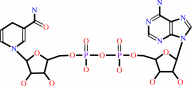 NADH
NADH
|
+
|
H(+)
|
|
|
|
|
|
|
|
|
|
|
|
|
Molecule diagrams generated from .mol files obtained from the
KEGG ftp site
|
|
|
|
|
|
|
|
|
|
|
|
|
|
 |
|
|
|
|
|
|
| |
|
|
| |
|
DOI no:
|
J Biol Chem
271:17057-17061
(1996)
|
|
PubMed id:
|
|
|
|
|
|
| |
|
X-ray structure of human beta3beta3 alcohol dehydrogenase. The contribution of ionic interactions to coenzyme binding.
|
|
G.J.Davis,
W.F.Bosron,
C.L.Stone,
K.Owusu-Dekyi,
T.D.Hurley.
|
|
|
|
|
| |
ABSTRACT
|
|
|
|
| |
|
|
The three-dimensional structure of the human beta3beta3 dimeric alcohol
dehydrogenase (beta3) was determined to 2.4-A resolution. beta3 was crystallized
as a ternary complex with the coenzyme NAD+ and the competitive inhibitor
4-iodopyrazole. beta3 is a polymorphic variant at ADH2 that differs from beta1
by a single amino acid substitution of Arg-369 --> Cys. The available x-ray
structures of mammalian alcohol dehydrogenases show that the side chain of
Arg-369 forms an ion pair with the NAD(H) pyrophosphate to stabilize the
E.NAD(H) complex. The Cys-369 side chain of beta3 cannot form this interaction.
The three-dimensional structures of beta3 and beta1 are virtually identical,
with the exception that Cys-369 and two water molecules in beta3 occupy the
position of Arg-369 in beta1. The two waters occupy the same positions as two
guanidino nitrogens of Arg-369. Hence, the number of hydrogen bonding
interactions between the enzyme and NAD(H) are the same for both isoenzymes.
However, beta3 differs from beta1 by the loss of the electrostatic interaction
between the NAD(H) pyrophosphate and the Arg-369 side chain. The equilibrium
dissociation constants of beta3 for NAD+ and NADH are 350-fold and 4000-fold
higher, respectively, than those for beta1. These changes correspond to binding
free energy differences of 3.5 kcal/mol for NAD+ and 4.9 kcal/mol for NADH.
Thus, the Arg-369 --> Cys substitution of beta3 isoenzyme destabilizes the
interaction between coenzyme and beta3 alcohol dehydrogenase.
|
|
|
|
|
|
| |
Selected figure(s)
|
|
|
|
| |
|
|

|
|

|
|
Figure 1.
Fig. 1. Electron density in the vicinity of residue 369. Omit
2F[o]  F[c]
electron density maps for (A) F[c]
electron density maps for (A)  [3] ADH and
(B) [1] ADH.
Waters which occur between the amino acid at position 369 and
coenzyme molecule are also displayed. The electron density maps
were calculated after first removing those atoms displayed in
the figure from the structure factor calculation. The maps are
contoured at 1 S.D. of their respective electron density. [3] ADH and
(B) [1] ADH.
Waters which occur between the amino acid at position 369 and
coenzyme molecule are also displayed. The electron density maps
were calculated after first removing those atoms displayed in
the figure from the structure factor calculation. The maps are
contoured at 1 S.D. of their respective electron density.
|
|
Figure 2.
Fig. 2. Aligned active sites of human [1] and [3] ADH. A
stereo diagram of human [3] (thick
lines) and [1] (thin
lines) structures in the vicinity of amino acid 369. The
structures were aligned by superposition of all their respective
C  atoms.
R.m.s differences for alignment of [3] to [1] are 0.25
Å for all C atoms.
Alignments of individual subunits or domains yielded r.m.s
values of 0.19 Å for the C atoms
within subunit A, 0.17 Å for the C atoms
within the coenzyme domain, and 0.20 Å for the catalytic
domain of the A subunits; the corresponding values for alignment
of the B subunits are 0.25, 0.19, and 0.24 Å. atoms.
R.m.s differences for alignment of [3] to [1] are 0.25
Å for all C atoms.
Alignments of individual subunits or domains yielded r.m.s
values of 0.19 Å for the C atoms
within subunit A, 0.17 Å for the C atoms
within the coenzyme domain, and 0.20 Å for the catalytic
domain of the A subunits; the corresponding values for alignment
of the B subunits are 0.25, 0.19, and 0.24 Å.
|
|
|
|
|
|
| |
The above figures are
reprinted
by permission from the ASBMB:
J Biol Chem
(1996,
271,
17057-17061)
copyright 1996.
|
|
|
|
|
|
|
|
|
|
|
|
|
|
 |
 |
 |
|
Literature references that cite this PDB file's key reference
|
|
|
| |
PubMed id
|
|
Reference
|
|
|
|
|
|
S.L.Lee,
J.O.Höög,
and
S.J.Yin
(2004).
Functionality of allelic variations in human alcohol dehydrogenase gene family: assessment of a functional window for protection against alcoholism.
|
| |
Pharmacogenetics,
14,
725-732.
|
|
|
|
|
|
|
M.S.Niederhut,
B.J.Gibbons,
S.Perez-Miller,
and
T.D.Hurley
(2001).
Three-dimensional structures of the three human class I alcohol dehydrogenases.
|
| |
Protein Sci,
10,
697-706.
|
|
|
PDB codes:
|
|
|
|
|
|
|
|
C.Darmanin,
and
O.El-Kabbani
(2000).
Modelling studies on the binding of substrate and inhibitor to the active site of human sorbitol dehydrogenase.
|
| |
Bioorg Med Chem Lett,
10,
1101-1104.
|
|
|
|
|
|
|
S.Martinović,
Pasa-Tolíc,
C.Masselon,
P.K.Jensen,
C.L.Stone,
and
R.D.Smith
(2000).
Characterization of human alcohol dehydrogenase isoenzymes by capillary isoelectric focusing-mass spectrometry.
|
| |
Electrophoresis,
21,
2368-2375.
|
|
|
|
|
|
|
C.L.Stone,
M.B.Jipping,
K.Owusu-Dekyi,
T.D.Hurley,
T.K.Li,
and
W.F.Bosron
(1999).
The pH-dependent binding of NADH and subsequent enzyme isomerization of human liver beta 3 beta 3 alcohol dehydrogenase.
|
| |
Biochemistry,
38,
5829-5835.
|
|
|
|
|
|
|
C.Li,
J.Heatwole,
S.Soelaiman,
and
M.Shoham
(1999).
Crystal structure of a thermophilic alcohol dehydrogenase substrate complex suggests determinants of substrate specificity and thermostability.
|
| |
Proteins,
37,
619-627.
|
|
|
PDB code:
|
|
|
|
|
|
|
|
P.T.Xie,
and
T.D.Hurley
(1999).
Methionine-141 directly influences the binding of 4-methylpyrazole in human sigma sigma alcohol dehydrogenase.
|
| |
Protein Sci,
8,
2639-2644.
|
|
|
PDB codes:
|
|
|
|
|
|
|
|
S.R.Piersma,
A.J.Visser,
S.de Vries,
and
J.A.Duine
(1998).
Optical spectroscopy of nicotinoprotein alcohol dehydrogenase from Amycolatopsis methanolica: a comparison with horse liver alcohol dehydrogenase and UDP-galactose epimerase.
|
| |
Biochemistry,
37,
3068-3077.
|
|
|
|
|
|
|
W.E.Lands
(1998).
A review of alcohol clearance in humans.
|
| |
Alcohol,
15,
147-160.
|
|
|
|
|
|
The most recent references are shown first.
Citation data come partly from CiteXplore and partly
from an automated harvesting procedure. Note that this is likely to be
only a partial list as not all journals are covered by
either method. However, we are continually building up the citation data
so more and more references will be included with time.
Where a reference describes a PDB structure, the PDB
codes are
shown on the right.
|
|


 Links
Links


