
|
|
|
|
|
 |
Contents |
 |
|
|
|
|
|
|
|
|
|
|
|


 272 a.a.
|
|
|
|
|
|
|
|
|
|
|


 99 a.a.
|
|
|
|
|
|
|
|
|
|
|


 635 a.a.
|
|
|
|
|
|
|
|
|
|
|
|
|
* Residue conservation analysis
|
|
|
|
|
|
PDB id:
|
|
|
|
| Name: |
|
Metal transport inhibitor/receptor
|
|
|
Title:
|
|
Hemochromatosis protein hfe complexed with transferrin receptor
|
|
Structure:
|
|
Hemochromatosis protein. Chain: a, d, g. Fragment: ectodomain. Synonym: hfe. Engineered: yes. Beta-2-microglobulin. Chain: b, e, h. Engineered: yes. Transferrin receptor.
|
|
Source:
|
|
Homo sapiens. Human. Organism_taxid: 9606. Expressed in: cricetulus griseus. Expression_system_taxid: 10029. Expression_system_cell: ovary cells. Expressed in: trichoplusia ni. Expression_system_taxid: 7111. Expression_system_cell: high 5 insect cells.
|
|
Biol. unit:
|
|
 Hexamer (from PDB file)
|
|
Resolution:
|
|
|
2.80Å
|
R-factor:
|
0.231
|
R-free:
|
0.265
|
|
|
Authors:
|
|
M.J.Bennett,J.A.Lebron,P.J.Bjorkman
|
Key ref:

|
|
M.J.Bennett
et al.
(2000).
Crystal structure of the hereditary haemochromatosis protein HFE complexed with transferrin receptor.
Nature,
403,
46-53.
PubMed id:
DOI:

|
|
|
Date:
|
|
|
12-Nov-99
|
Release date:
|
19-Jan-00
|
|
|
|
|
|
|
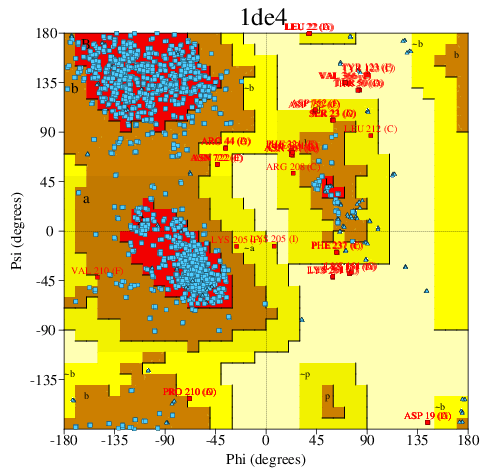
PROCHECK
|
|
|
|
|
|
Headers
|
|
|
|
References
|
|
|
|
|
|

|
|
Q30201
(HFE_HUMAN) -
Hereditary hemochromatosis protein from Homo sapiens
|
|
|
|
Seq:
Struc:
|
|
|
|
348 a.a.
272 a.a.
|
|

|

|

|
|
|
|
|
|
|
|
|
|
|
|
|
|
|
|
|
|
|
|
|
 |
|
|
|
|
|
|
| |
|
DOI no:
|
Nature
403:46-53
(2000)
|
|
PubMed id:
|
|
|
|
|
|
| |
|
Crystal structure of the hereditary haemochromatosis protein HFE complexed with transferrin receptor.
|
|
M.J.Bennett,
J.A.Lebrón,
P.J.Bjorkman.
|
|
|
|
|
| |
ABSTRACT
|
|
|
|
| |
|
|
HFE is related to major histocompatibility complex (MHC) class I proteins and is
mutated in the iron-overload disease hereditary haemochromatosis. HFE binds to
the transferrin receptor (TfR), a receptor by which cells acquire iron-loaded
transferrin. The 2.8 A crystal structure of a complex between the extracellular
portions of HFE and TfR shows two HFE molecules which grasp each side of a
twofold symmetric TfR dimer. On a cell membrane containing both proteins, HFE
would 'lie down' parallel to the membrane, such that the HFE helices that
delineate the counterpart of the MHC peptide-binding groove make extensive
contacts with helices in the TfR dimerization domain. The structures of TfR
alone and complexed with HFE differ in their domain arrangement and dimer
interfaces, providing a mechanism for communicating binding events between TfR
chains. The HFE-TfR complex suggests a binding site for transferrin on TfR and
sheds light upon the function of HFE in regulating iron homeostasis.
|
|
|
|
|
|
| |
Selected figure(s)
|
|
|
|
| |
|
|

|
|

|
|
Figure 1.
Figure 1: Ribbon diagrams of HFE, TfR and HFE-TfR structures.
a, HFE^5 (PDB code 1A6Z). Residues substituted in HH mutations
(Cys 260 and His 41)3 and a cluster of histidines (residues 87,
89, 94 and 123) are highlighted. An arrow indicates the inward
displacement of  1
domain helix as compared with the analogous class I MHC helix.
b, TfR monomer from homodimer structure^15 (made using
coordinates provided by C. M. Lawrence and S. C. Harrison). A,
apical loop (residues 312-328); PL, protease-like loop (residues
469-476); C tail, C-terminal tail (residues 750-760). c, Two
views of the HFE-TfR structure related by a 90° rotation about
the vertical axis. Chain termini nearest the predicted
transmembrane region (C terminus for HFE heavy chain; N terminus
for TfR) are labelled (left). The membrane bilayer is
represented by a grey box (right). 1
domain helix as compared with the analogous class I MHC helix.
b, TfR monomer from homodimer structure^15 (made using
coordinates provided by C. M. Lawrence and S. C. Harrison). A,
apical loop (residues 312-328); PL, protease-like loop (residues
469-476); C tail, C-terminal tail (residues 750-760). c, Two
views of the HFE-TfR structure related by a 90° rotation about
the vertical axis. Chain termini nearest the predicted
transmembrane region (C terminus for HFE heavy chain; N terminus
for TfR) are labelled (left). The membrane bilayer is
represented by a grey box (right).
|
|
Figure 2.
Figure 2: The HFE-TfR interface. Cut away views of a TfR
monomer (a) and the HFE platform (b) from the HFE-TfR structure
are shown with regions containing residues that form contacts
highlighted in gold (HFE) and aqua (TfR). Side chains of
residues identified by site-directed mutagenesis to affect
ligand binding are highlighted on TfR in cyan (Fe-Tf binding28)
and on HFE in red (TfR binding12). c, Representation of HFE-TfR
interface showing the three-helix bundle and kinked portion of
the HFE 2
helix. d, TCR footprint (pink box) on the structure of a class I
MHC molecule. Arrows indicate the 'high points' on the 1
and 2
helices (Based on Fig. 5 in ref. 4).
|
|
|
|
|
|
| |
The above figures are
reprinted
by permission from Macmillan Publishers Ltd:
Nature
(2000,
403,
46-53)
copyright 2000.
|
|
| |
Figures were
selected
by an automated process.
|
|
|
|
|
|
|
|
|
|
|
|
|
|
|
|
 |
 |
 |
|
Literature references that cite this PDB file's key reference
|
|
|
| |
PubMed id
|
|
Reference
|
|
|
|
|
|
P.C.Santos,
R.D.Cançado,
A.C.Pereira,
I.T.Schettert,
R.A.Soares,
R.A.Pagliusi,
R.D.Hirata,
M.H.Hirata,
A.C.Teixeira,
M.S.Figueiredo,
C.S.Chiattone,
J.E.Krieger,
and
E.M.Guerra-Shinohara
(2011).
Hereditary hemochromatosis: mutations in genes involved in iron homeostasis in Brazilian patients.
|
| |
Blood Cells Mol Dis,
46,
302-307.
|
|
|
|
|
|
|
C.S.Hee,
S.Gao,
B.Loll,
M.M.Miller,
B.Uchanska-Ziegler,
O.Daumke,
and
A.Ziegler
(2010).
Structure of a classical MHC class I molecule that binds "non-classical" ligands.
|
| |
PLoS Biol,
8,
e1000557.
|
|
|
PDB codes:
|
|
|
|
|
|
|
|
G.Weiss
(2010).
Genetic mechanisms and modifying factors in hereditary hemochromatosis.
|
| |
Nat Rev Gastroenterol Hepatol,
7,
50-58.
|
|
|
|
|
|
|
H.Li,
and
Y.Z.Ginzburg
(2010).
Crosstalk between Iron Metabolism and Erythropoiesis.
|
| |
Adv Hematol,
2010,
605435.
|
|
|
|
|
|
|
J.Abraham,
K.D.Corbett,
M.Farzan,
H.Choe,
and
S.C.Harrison
(2010).
Structural basis for receptor recognition by New World hemorrhagic fever arenaviruses.
|
| |
Nat Struct Mol Biol,
17,
438-444.
|
|
|
PDB code:
|
|
|
|
|
|
|
|
J.Gao,
J.Chen,
I.De Domenico,
D.M.Koeller,
C.O.Harding,
R.E.Fleming,
D.D.Koeberl,
and
C.A.Enns
(2010).
Hepatocyte-targeted HFE and TFR2 control hepcidin expression in mice.
|
| |
Blood,
115,
3374-3381.
|
|
|
|
|
|
|
J.L.Babitt,
and
H.Y.Lin
(2010).
Molecular mechanisms of hepcidin regulation: implications for the anemia of CKD.
|
| |
Am J Kidney Dis,
55,
726-741.
|
|
|
|
|
|
|
J.Rochette,
G.Le Gac,
K.Lassoued,
C.Férec,
and
K.J.Robson
(2010).
Factors influencing disease phenotype and penetrance in HFE haemochromatosis.
|
| |
Hum Genet,
128,
233-248.
|
|
|
|
|
|
|
L.B.Goodman,
S.M.Lyi,
N.C.Johnson,
J.O.Cifuente,
S.L.Hafenstein,
and
C.R.Parrish
(2010).
Binding site on the transferrin receptor for the parvovirus capsid and effects of altered affinity on cell uptake and infection.
|
| |
J Virol,
84,
4969-4978.
|
|
|
|
|
|
|
L.Bhatt,
C.Murphy,
L.S.O'Driscoll,
M.Carmo-Fonseca,
M.W.McCaffrey,
and
J.V.Fleming
(2010).
N-glycosylation is important for the correct intracellular localization of HFE and its ability to decrease cell surface transferrin binding.
|
| |
FEBS J,
277,
3219-3234.
|
|
|
|
|
|
|
M.A.Wouters,
S.W.Fan,
and
N.L.Haworth
(2010).
Disulfides as redox switches: from molecular mechanisms to functional significance.
|
| |
Antioxid Redox Signal,
12,
53-91.
|
|
|
|
|
|
|
M.Chloupková,
A.S.Zhang,
and
C.A.Enns
(2010).
Stoichiometries of transferrin receptors 1 and 2 in human liver.
|
| |
Blood Cells Mol Dis,
44,
28-33.
|
|
|
|
|
|
|
M.D.Knutson
(2010).
Iron-sensing proteins that regulate hepcidin and enteric iron absorption.
|
| |
Annu Rev Nutr,
30,
149-171.
|
|
|
|
|
|
|
A.I.Mendes,
A.Ferro,
R.Martins,
I.Picanço,
S.Gomes,
R.Cerqueira,
M.Correia,
A.R.Nunes,
J.Esteves,
R.Fleming,
and
P.Faustino
(2009).
Non-classical hereditary hemochromatosis in Portugal: novel mutations identified in iron metabolism-related genes.
|
| |
Ann Hematol,
88,
229-234.
|
|
|
|
|
|
|
C.E.Harbison,
S.M.Lyi,
W.S.Weichert,
and
C.R.Parrish
(2009).
Early steps in cell infection by parvoviruses: host-specific differences in cell receptor binding but similar endosomal trafficking.
|
| |
J Virol,
83,
10504-10514.
|
|
|
|
|
|
|
C.J.Shatz
(2009).
MHC class I: an unexpected role in neuronal plasticity.
|
| |
Neuron,
64,
40-45.
|
|
|
|
|
|
|
E.Corradini,
C.Garuti,
G.Montosi,
P.Ventura,
B.Andriopoulos,
H.Y.Lin,
A.Pietrangelo,
and
J.L.Babitt
(2009).
Bone morphogenetic protein signaling is impaired in an HFE knockout mouse model of hemochromatosis.
|
| |
Gastroenterology,
137,
1489-1497.
|
|
|
|
|
|
|
J.Gao,
J.Chen,
M.Kramer,
H.Tsukamoto,
A.S.Zhang,
and
C.A.Enns
(2009).
Interaction of the hereditary hemochromatosis protein HFE with transferrin receptor 2 is required for transferrin-induced hepcidin expression.
|
| |
Cell Metab,
9,
217-227.
|
|
|
|
|
|
|
L.Kautz,
D.Meynard,
C.Besson-Fournier,
V.Darnaud,
T.Al Saati,
H.Coppin,
and
M.P.Roth
(2009).
BMP/Smad signaling is not enhanced in Hfe-deficient mice despite increased Bmp6 expression.
|
| |
Blood,
114,
2515-2520.
|
|
|
|
|
|
|
N.G.James,
S.L.Byrne,
and
A.B.Mason
(2009).
Incorporation of 5-hydroxytryptophan into transferrin and its receptor allows assignment of the pH induced changes in intrinsic fluorescence when iron is released.
|
| |
Biochim Biophys Acta,
1794,
532-540.
|
|
|
|
|
|
|
B.A.Rabinovich,
R.R.Ketchem,
M.Wolfson,
L.Goldstein,
M.Skelly,
and
D.Cosman
(2008).
A role for the MHC class I-like Mill molecules in nutrient metabolism and wound healing.
|
| |
Immunol Cell Biol,
86,
489-496.
|
|
|
|
|
|
|
K.Pantopoulos
(2008).
Function of the hemochromatosis protein HFE: Lessons from animal models.
|
| |
World J Gastroenterol,
14,
6893-6901.
|
|
|
|
|
|
|
M.U.Muckenthaler,
B.Galy,
and
M.W.Hentze
(2008).
Systemic iron homeostasis and the iron-responsive element/iron-regulatory protein (IRE/IRP) regulatory network.
|
| |
Annu Rev Nutr,
28,
197-213.
|
|
|
|
|
|
|
N.C.Andrews
(2008).
Forging a field: the golden age of iron biology.
|
| |
Blood,
112,
219-230.
|
|
|
|
|
|
|
P.J.Schmidt,
P.T.Toran,
A.M.Giannetti,
P.J.Bjorkman,
and
N.C.Andrews
(2008).
The transferrin receptor modulates Hfe-dependent regulation of hepcidin expression.
|
| |
Cell Metab,
7,
205-214.
|
|
|
|
|
|
|
S.R.Radoshitzky,
J.H.Kuhn,
C.F.Spiropoulou,
C.G.Albariño,
D.P.Nguyen,
J.Salazar-Bravo,
T.Dorfman,
A.S.Lee,
E.Wang,
S.R.Ross,
H.Choe,
and
M.Farzan
(2008).
Receptor determinants of zoonotic transmission of New World hemorrhagic fever arenaviruses.
|
| |
Proc Natl Acad Sci U S A,
105,
2664-2669.
|
|
|
|
|
|
|
W.Held,
and
R.A.Mariuzza
(2008).
Cis interactions of immunoreceptors with MHC and non-MHC ligands.
|
| |
Nat Rev Immunol,
8,
269-278.
|
|
|
|
|
|
|
F.A.Arosa,
S.G.Santos,
and
S.J.Powis
(2007).
Open conformers: the hidden face of MHC-I molecules.
|
| |
Trends Immunol,
28,
115-123.
|
|
|
|
|
|
|
J.Chen,
M.Chloupková,
J.Gao,
T.L.Chapman-Arvedson,
and
C.A.Enns
(2007).
HFE Modulates Transferrin Receptor 2 Levels in Hepatoma Cells via Interactions That Differ from Transferrin Receptor 1-HFE Interactions.
|
| |
J Biol Chem,
282,
36862-36870.
|
|
|
|
|
|
|
J.Holoshitz,
and
S.Ling
(2007).
Nitric oxide signaling triggered by the rheumatoid arthritis shared epitope: a new paradigm for MHC disease association?
|
| |
Ann N Y Acad Sci,
1110,
73-83.
|
|
|
|
|
|
|
L.A.Lambert,
and
S.L.Mitchell
(2007).
Molecular evolution of the transferrin receptor/glutamate carboxypeptidase II family.
|
| |
J Mol Evol,
64,
113-128.
|
|
|
|
|
|
|
M.Cukjati,
S.Koren,
V.Curin Serbec,
B.Vidan-Jeras,
and
R.Rupreht
(2007).
A novel homozygous frameshift deletion c.471del of HFE associated with hemochromatosis.
|
| |
Clin Genet,
71,
350-353.
|
|
|
|
|
|
|
M.G.Rossmann,
F.Arisaka,
A.J.Battisti,
V.D.Bowman,
P.R.Chipman,
A.Fokine,
S.Hafenstein,
S.Kanamaru,
V.A.Kostyuchenko,
V.V.Mesyanzhinov,
M.M.Shneider,
M.C.Morais,
P.G.Leiman,
L.M.Palermo,
C.R.Parrish,
and
C.Xiao
(2007).
From structure of the complex to understanding of the biology.
|
| |
Acta Crystallogr D Biol Crystallogr,
63,
9.
|
|
|
|
|
|
|
P.S.Oates,
and
U.Ahmed
(2007).
Molecular regulation of hepatic expression of iron regulatory hormone hepcidin.
|
| |
J Gastroenterol Hepatol,
22,
1378-1387.
|
|
|
|
|
|
|
S.Hafenstein,
L.M.Palermo,
V.A.Kostyuchenko,
C.Xiao,
M.C.Morais,
C.D.Nelson,
V.D.Bowman,
A.J.Battisti,
P.R.Chipman,
C.R.Parrish,
and
M.G.Rossmann
(2007).
Asymmetric binding of transferrin receptor to parvovirus capsids.
|
| |
Proc Natl Acad Sci U S A,
104,
6585-6589.
|
|
|
PDB code:
|
|
|
|
|
|
|
|
D.Berg,
H.Hochstrasser,
K.J.Schweitzer,
and
O.Riess
(2006).
Disturbance of iron metabolism in Parkinson's disease -- ultrasonography as a biomarker.
|
| |
Neurotox Res,
9,
1.
|
|
|
|
|
|
|
E.Wang,
L.Albritton,
and
S.R.Ross
(2006).
Identification of the segments of the mouse transferrin receptor 1 required for mouse mammary tumor virus infection.
|
| |
J Biol Chem,
281,
10243-10249.
|
|
|
|
|
|
|
J.R.Mesters,
C.Barinka,
W.Li,
T.Tsukamoto,
P.Majer,
B.S.Slusher,
J.Konvalinka,
and
R.Hilgenfeld
(2006).
Structure of glutamate carboxypeptidase II, a drug target in neuronal damage and prostate cancer.
|
| |
EMBO J,
25,
1375-1384.
|
|
|
PDB codes:
|
|
|
|
|
|
|
|
J.Wally,
P.J.Halbrooks,
C.Vonrhein,
M.A.Rould,
S.J.Everse,
A.B.Mason,
and
S.K.Buchanan
(2006).
The crystal structure of iron-free human serum transferrin provides insight into inter-lobe communication and receptor binding.
|
| |
J Biol Chem,
281,
24934-24944.
|
|
|
PDB codes:
|
|
|
|
|
|
|
|
L.M.Palermo,
S.L.Hafenstein,
and
C.R.Parrish
(2006).
Purified feline and canine transferrin receptors reveal complex interactions with the capsids of canine and feline parvoviruses that correspond to their host ranges.
|
| |
J Virol,
80,
8482-8492.
|
|
|
|
|
|
|
S.Ling,
A.Lai,
O.Borschukova,
P.Pumpens,
and
J.Holoshitz
(2006).
Activation of nitric oxide signaling by the rheumatoid arthritis shared epitope.
|
| |
Arthritis Rheum,
54,
3423-3432.
|
|
|
|
|
|
|
T.Goswami,
and
N.C.Andrews
(2006).
Hereditary hemochromatosis protein, HFE, interaction with transferrin receptor 2 suggests a molecular mechanism for mammalian iron sensing.
|
| |
J Biol Chem,
281,
28494-28498.
|
|
|
|
|
|
|
A.M.Giannetti,
P.J.Halbrooks,
A.B.Mason,
T.M.Vogt,
C.A.Enns,
and
P.J.Björkman
(2005).
The molecular mechanism for receptor-stimulated iron release from the plasma iron transport protein transferrin.
|
| |
Structure,
13,
1613-1623.
|
|
|
|
|
|
|
E.M.Teh,
J.Hewitt,
K.C.Ung,
T.A.Griffiths,
V.Nguyen,
S.K.Briggs,
A.B.Mason,
and
R.T.MacGillivray
(2005).
Identification of the epitope of a monoclonal antibody that disrupts binding of human transferrin to the human transferrin receptor.
|
| |
FEBS J,
272,
6344-6353.
|
|
|
|
|
|
|
J.W.Yewdell,
and
H.D.Hickman-Miller
(2005).
Back to the fold: T cell recognition of HFE, a MHC class Ib molecule that regulates iron metabolism.
|
| |
Proc Natl Acad Sci U S A,
102,
12649-12650.
|
|
|
|
|
|
|
M.I.Davis,
M.J.Bennett,
L.M.Thomas,
and
P.J.Bjorkman
(2005).
Crystal structure of prostate-specific membrane antigen, a tumor marker and peptidase.
|
| |
Proc Natl Acad Sci U S A,
102,
5981-5986.
|
|
|
PDB code:
|
|
|
|
|
|
|
|
P.S.Rohrlich,
N.Fazilleau,
F.Ginhoux,
H.Firat,
F.Michel,
M.Cochet,
N.Laham,
M.P.Roth,
S.Pascolo,
F.Nato,
H.Coppin,
P.Charneau,
O.Danos,
O.Acuto,
R.Ehrlich,
J.Kanellopoulos,
and
F.A.Lemonnier
(2005).
Direct recognition by alphabeta cytolytic T cells of Hfe, a MHC class Ib molecule without antigen-presenting function.
|
| |
Proc Natl Acad Sci U S A,
102,
12855-12860.
|
|
|
|
|
|
|
S.Huang,
S.Gilfillan,
M.Cella,
M.J.Miley,
O.Lantz,
L.Lybarger,
D.H.Fremont,
and
T.H.Hansen
(2005).
Evidence for MR1 antigen presentation to mucosal-associated invariant T cells.
|
| |
J Biol Chem,
280,
21183-21193.
|
|
|
|
|
|
|
S.Kasibhatla,
K.A.Jessen,
S.Maliartchouk,
J.Y.Wang,
N.M.English,
J.Drewe,
L.Qiu,
S.P.Archer,
A.E.Ponce,
N.Sirisoma,
S.Jiang,
H.Z.Zhang,
K.R.Gehlsen,
S.X.Cai,
D.R.Green,
and
B.Tseng
(2005).
A role for transferrin receptor in triggering apoptosis when targeted with gambogic acid.
|
| |
Proc Natl Acad Sci U S A,
102,
12095-12100.
|
|
|
|
|
|
|
S.Ludwiczek,
I.Theurl,
S.Bahram,
K.Schümann,
and
G.Weiss
(2005).
Regulatory networks for the control of body iron homeostasis and their dysregulation in HFE mediated hemochromatosis.
|
| |
J Cell Physiol,
204,
489-499.
|
|
|
|
|
|
|
A.M.Giannetti,
and
P.J.Björkman
(2004).
HFE and transferrin directly compete for transferrin receptor in solution and at the cell surface.
|
| |
J Biol Chem,
279,
25866-25875.
|
|
|
|
|
|
|
H.Kawabata,
X.Tong,
T.Kawanami,
Y.Wano,
Y.Hirose,
S.Sugai,
and
H.P.Koeffler
(2004).
Analyses for binding of the transferrin family of proteins to the transferrin receptor 2.
|
| |
Br J Haematol,
127,
464-473.
|
|
|
|
|
|
|
K.Hueffer,
L.M.Palermo,
and
C.R.Parrish
(2004).
Parvovirus infection of cells by using variants of the feline transferrin receptor altering clathrin-mediated endocytosis, membrane domain localization, and capsid-binding domains.
|
| |
J Virol,
78,
5601-5611.
|
|
|
|
|
|
|
K.J.Livesey,
V.L.Wimhurst,
K.Carter,
M.Worwood,
E.Cadet,
J.Rochette,
A.G.Roberts,
J.J.Pointon,
A.T.Merryweather-Clarke,
M.L.Bassett,
A.M.Jouanolle,
A.Mosser,
V.David,
J.Poulton,
and
K.J.Robson
(2004).
The 16189 variant of mitochondrial DNA occurs more frequently in C282Y homozygotes with haemochromatosis than those without iron loading.
|
| |
J Med Genet,
41,
6.
|
|
|
|
|
|
|
M.W.Hentze,
M.U.Muckenthaler,
and
N.C.Andrews
(2004).
Balancing acts: molecular control of mammalian iron metabolism.
|
| |
Cell,
117,
285-297.
|
|
|
|
|
|
|
N.Laham,
R.Rotem-Yehudar,
C.Shechter,
J.E.Coligan,
and
R.Ehrlich
(2004).
Transferrin [corrected] receptor association and endosomal localization of soluble HFE are not sufficient for regulation of cellular iron homeostasis.
|
| |
J Cell Biochem,
91,
1130-1145.
|
|
|
|
|
|
|
P.Aisen
(2004).
Transferrin receptor 1.
|
| |
Int J Biochem Cell Biol,
36,
2137-2143.
|
|
|
|
|
|
|
U.E.Schaible,
and
S.H.Kaufmann
(2004).
Iron and microbial infection.
|
| |
Nat Rev Microbiol,
2,
946-953.
|
|
|
|
|
|
|
Y.Cheng,
O.Zak,
P.Aisen,
S.C.Harrison,
and
T.Walz
(2004).
Structure of the human transferrin receptor-transferrin complex.
|
| |
Cell,
116,
565-576.
|
|
|
PDB code:
|
|
|
|
|
|
|
|
A.Kumánovics,
T.Takada,
and
K.F.Lindahl
(2003).
Genomic organization of the mammalian MHC.
|
| |
Annu Rev Immunol,
21,
629-657.
|
|
|
|
|
|
|
A.M.Giannetti,
P.M.Snow,
O.Zak,
and
P.J.Björkman
(2003).
Mechanism for multiple ligand recognition by the human transferrin receptor.
|
| |
PLoS Biol,
1,
E51.
|
|
|
|
|
|
|
A.Pietrangelo
(2003).
Haemochromatosis.
|
| |
Gut,
52,
ii23-ii30.
|
|
|
|
|
|
|
A.Pietrangelo
(2003).
Hemochromatosis gene modifies course of hepatitis C viral infection.
|
| |
Gastroenterology,
124,
1509-1523.
|
|
|
|
|
|
|
A.Widera,
F.Norouziyan,
and
W.C.Shen
(2003).
Mechanisms of TfR-mediated transcytosis and sorting in epithelial cells and applications toward drug delivery.
|
| |
Adv Drug Deliv Rev,
55,
1439-1466.
|
|
|
|
|
|
|
J.Loconto,
F.Papes,
E.Chang,
L.Stowers,
E.P.Jones,
T.Takada,
A.Kumánovics,
K.Fischer Lindahl,
and
C.Dulac
(2003).
Functional expression of murine V2R pheromone receptors involves selective association with the M10 and M1 families of MHC class Ib molecules.
|
| |
Cell,
112,
607-618.
|
|
|
|
|
|
|
K.Hueffer,
J.S.Parker,
W.S.Weichert,
R.E.Geisel,
J.Y.Sgro,
and
C.R.Parrish
(2003).
The natural host range shift and subsequent evolution of canine parvovirus resulted from virus-specific binding to the canine transferrin receptor.
|
| |
J Virol,
77,
1718-1726.
|
|
|
|
|
|
|
L.Govindasamy,
K.Hueffer,
C.R.Parrish,
and
M.Agbandje-McKenna
(2003).
Structures of host range-controlling regions of the capsids of canine and feline parvoviruses and mutants.
|
| |
J Virol,
77,
12211-12221.
|
|
|
PDB codes:
|
|
|
|
|
|
|
|
L.M.Palermo,
K.Hueffer,
and
C.R.Parrish
(2003).
Residues in the apical domain of the feline and canine transferrin receptors control host-specific binding and cell infection of canine and feline parvoviruses.
|
| |
J Virol,
77,
8915-8923.
|
|
|
|
|
|
|
M.J.Chorney,
Y.Yoshida,
P.N.Meyer,
M.Yoshida,
and
G.S.Gerhard
(2003).
The enigmatic role of the hemochromatosis protein (HFE) in iron absorption.
|
| |
Trends Mol Med,
9,
118-125.
|
|
|
|
|
|
|
R.Liu,
J.Q.Guan,
O.Zak,
P.Aisen,
and
M.R.Chance
(2003).
Structural reorganization of the transferrin C-lobe and transferrin receptor upon complex formation: the C-lobe binds to the receptor helical domain.
|
| |
Biochemistry,
42,
12447-12454.
|
|
|
|
|
|
|
S.Kotamraju,
Y.Tampo,
A.Keszler,
C.R.Chitambar,
J.Joseph,
A.L.Haas,
and
B.Kalyanaraman
(2003).
Nitric oxide inhibits H2O2-induced transferrin receptor-dependent apoptosis in endothelial cells: Role of ubiquitin-proteasome pathway.
|
| |
Proc Natl Acad Sci U S A,
100,
10653-10658.
|
|
|
|
|
|
|
T.A.Rouault
(2003).
How mammals acquire and distribute iron needed for oxygen-based metabolism.
|
| |
PLoS Biol,
1,
E79.
|
|
|
|
|
|
|
A.Bomford
(2002).
Genetics of haemochromatosis.
|
| |
Lancet,
360,
1673-1681.
|
|
|
|
|
|
|
A.Waheed,
J.H.Grubb,
X.Y.Zhou,
S.Tomatsu,
R.E.Fleming,
M.E.Costaldi,
R.S.Britton,
B.R.Bacon,
and
W.S.Sly
(2002).
Regulation of transferrin-mediated iron uptake by HFE, the protein defective in hereditary hemochromatosis.
|
| |
Proc Natl Acad Sci U S A,
99,
3117-3122.
|
|
|
|
|
|
|
C.N.Roy,
K.P.Blemings,
K.M.Deck,
P.S.Davies,
E.L.Anderson,
R.S.Eisenstein,
and
C.A.Enns
(2002).
Increased IRP1 and IRP2 RNA binding activity accompanies a reduction of the labile iron pool in HFE-expressing cells.
|
| |
J Cell Physiol,
190,
218-226.
|
|
|
|
|
|
|
H.Drakesmith,
E.Sweetland,
L.Schimanski,
J.Edwards,
D.Cowley,
M.Ashraf,
J.Bastin,
and
A.R.Townsend
(2002).
The hemochromatosis protein HFE inhibits iron export from macrophages.
|
| |
Proc Natl Acad Sci U S A,
99,
15602-15607.
|
|
|
|
|
|
|
H.Li,
and
Z.M.Qian
(2002).
Transferrin/transferrin receptor-mediated drug delivery.
|
| |
Med Res Rev,
22,
225-250.
|
|
|
|
|
|
|
M.T.Dorak,
A.K.Burnett,
and
M.Worwood
(2002).
Hemochromatosis gene in leukemia and lymphoma.
|
| |
Leuk Lymphoma,
43,
467-477.
|
|
|
|
|
|
|
N.C.Andrews
(2002).
Metal transporters and disease.
|
| |
Curr Opin Chem Biol,
6,
181-186.
|
|
|
|
|
|
|
R.E.Fleming,
and
W.S.Sly
(2002).
Mechanisms of iron accumulation in hereditary hemochromatosis.
|
| |
Annu Rev Physiol,
64,
663-680.
|
|
|
|
|
|
|
Y.Kohgo,
Y.Torimoto,
and
J.Kato
(2002).
Transferrin receptor in tissue and serum: updated clinical significance of soluble receptor.
|
| |
Int J Hematol,
76,
213-218.
|
|
|
|
|
|
|
A.P.West,
L.L.Llamas,
P.M.Snow,
S.Benzer,
and
P.J.Bjorkman
(2001).
Crystal structure of the ectodomain of Methuselah, a Drosophila G protein-coupled receptor associated with extended lifespan.
|
| |
Proc Natl Acad Sci U S A,
98,
3744-3749.
|
|
|
PDB code:
|
|
|
|
|
|
|
|
C.A.Enns
(2001).
Pumping iron: the strange partnership of the hemochromatosis protein, a class I MHC homolog, with the transferrin receptor.
|
| |
Traffic,
2,
167-174.
|
|
|
|
|
|
|
D.Barisani,
A.Parafioriti,
E.Armiraglio,
R.Meneveri,
and
D.Conte
(2001).
Duodenal expression of a putative stimulator of Fe transport and transferrin receptor in anemia and hemochromatosis.
|
| |
Gastroenterology,
120,
1404-1411.
|
|
|
|
|
|
|
P.T.Lieu,
M.Heiskala,
P.A.Peterson,
and
Y.Yang
(2001).
The roles of iron in health and disease.
|
| |
Mol Aspects Med,
22,
1.
|
|
|
|
|
|
|
S.Radaev,
B.Rostro,
A.G.Brooks,
M.Colonna,
and
P.D.Sun
(2001).
Conformational plasticity revealed by the cocrystal structure of NKG2D and its class I MHC-like ligand ULBP3.
|
| |
Immunity,
15,
1039-1049.
|
|
|
PDB code:
|
|
|
|
|
|
|
|
W.J.Griffiths,
W.S.Sly,
and
T.M.Cox
(2001).
Intestinal iron uptake determined by divalent metal transporter is enhanced in HFE-deficient mice with hemochromatosis.
|
| |
Gastroenterology,
120,
1420-1429.
|
|
|
|
|
|
|
W.L.Martin,
A.P.West,
L.Gan,
and
P.J.Bjorkman
(2001).
Crystal structure at 2.8 A of an FcRn/heterodimeric Fc complex: mechanism of pH-dependent binding.
|
| |
Mol Cell,
7,
867-877.
|
|
|
PDB codes:
|
|
|
|
|
|
|
|
W.Zhong,
W.P.Lafuse,
and
B.S.Zwilling
(2001).
Infection with Mycobacterium avium differentially regulates the expression of iron transport protein mRNA in murine peritoneal macrophages.
|
| |
Infect Immun,
69,
6618-6624.
|
|
|
|
|
|
|
B.D.Schneider,
and
E.A.Leibold
(2000).
Regulation of mammalian iron homeostasis.
|
| |
Curr Opin Clin Nutr Metab Care,
3,
267-273.
|
|
|
|
|
|
|
H.Drakesmith,
and
A.Townsend
(2000).
The structure and function of HFE.
|
| |
Bioessays,
22,
595-598.
|
|
|
|
|
|
|
J.E.Levy,
L.K.Montross,
and
N.C.Andrews
(2000).
Genes that modify the hemochromatosis phenotype in mice.
|
| |
J Clin Invest,
105,
1209-1216.
|
|
|
|
|
|
|
J.J.Pointon,
D.Wallace,
A.T.Merryweather-Clarke,
and
K.J.Robson
(2000).
Uncommon mutations and polymorphisms in the hemochromatosis gene.
|
| |
Genet Test,
4,
151-161.
|
|
|
|
|
|
|
M.C.Deller,
and
E.Yvonne Jones
(2000).
Cell surface receptors.
|
| |
Curr Opin Struct Biol,
10,
213-219.
|
|
|
|
|
|
|
M.Hirose
(2000).
The structural mechanism for iron uptake and release by transferrins.
|
| |
Biosci Biotechnol Biochem,
64,
1328-1336.
|
|
|
|
|
|
|
N.C.Andrews
(2000).
Inherited iron overload disorders.
|
| |
Curr Opin Pediatr,
12,
596-602.
|
|
|
|
|
|
|
R.Ehrlich,
and
F.A.Lemonnier
(2000).
HFE--a novel nonclassical class I molecule that is involved in iron metabolism.
|
| |
Immunity,
13,
585-588.
|
|
|
|
|
|
The most recent references are shown first.
Citation data come partly from CiteXplore and partly
from an automated harvesting procedure. Note that this is likely to be
only a partial list as not all journals are covered by
either method. However, we are continually building up the citation data
so more and more references will be included with time.
Where a reference describes a PDB structure, the PDB
codes are
shown on the right.
|
 |
|


 Links
Links


