 |
PDBsum entry 1d7h

|
|
|
|
|
 |
Contents |
 |
|
|
|
|
|
|
|
|
|
|
|
|
* Residue conservation analysis
|
|
|
|
|
|
|
|
|
|
|
Enzyme class:
|
|
E.C.5.2.1.8
- peptidylprolyl isomerase.
|
|
|
|
|
|
|
Reaction:
|
|
[protein]-peptidylproline (omega=180) = [protein]-peptidylproline (omega=0)
|
|
|
|
|
|
 Peptidylproline (omega=180)
|
=
|
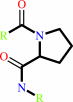 peptidylproline (omega=0)
|
|
|
|
|
|
|
|
|
|
|
|
|
Molecule diagrams generated from .mol files obtained from the
KEGG ftp site
|
|
|
|
|
|
|
|
|
|
|
|
|
|
 |
|
|
|
|
|
|
| |
|
|
| |
|
DOI no:
|
J Mol Biol
295:953-962
(2000)
|
|
PubMed id:
|
|
|
|
|
|
| |
|
X-ray structures of small ligand-FKBP complexes provide an estimate for hydrophobic interaction energies.
|
|
P.Burkhard,
P.Taylor,
M.D.Walkinshaw.
|
|
|
|
|
| |
ABSTRACT
|
|
|
|
| |
|
|
A new crystal form of native FK506 binding protein (FKBP) has been obtained
which has proved useful in ligand binding studies. Three different small
molecule ligand complexes and the native enzyme have been determined at higher
resolution than 2.0 A. Dissociation constants of the related small molecule
ligands vary from 20 mM for dimethylsulphoxide to 200 microM for
tetrahydrothiophene 1-oxide. Comparison of the four available crystal structures
shows that the protein structures are identical to within experimental error,
but there are differences in the water structure in the active site. Analysis of
the calculated buried surface areas of these related ligands provides an
estimated van der Waals contribution to the binding energy of -0.5 kJ/A(2) for
non-polar interactions between ligand and protein.
|
|
|
|
|
|
| |
Selected figure(s)
|
|
|
|
| |
|
|

|
|

|
|
Figure 1.
Figure 1. View along the 2-fold axis. One potein molecule
is shown in white with its symmetry-related molecule in yellow.
On top, His87 forms a hydrogen bond accross the 2-fold axis to
the very same histidine of the symmetry-related molecule. The
ammonium ion (middle) and the sulphate ion (bottom) are involved
in a hydrogen bonding network between the two symmetry-related
molecules.
|
|
Figure 3.
Figure 3. Superposition of the structures of the native
enzyme (cyan) and the FKBP-FK506 complex (yellow). (a) Global
view; (b) close-up view. The interatomic distances of the native
enzyme are displayed in orange. Distances in the FK506 complex
are in light blue. The active site cleft accommodates the
structure of the inhibitor FK506 and is wider but shorter in the
FK506 complex compared to the native enzyme.
|
|
|
|
|
|
| |
The above figures are
reprinted
by permission from Elsevier:
J Mol Biol
(2000,
295,
953-962)
copyright 2000.
|
|
| |
Figures were
selected
by an automated process.
|
|
|
|
|
|
|
|
|
|
|
|
|
|
|
|
 |
 |
 |
|
Literature references that cite this PDB file's key reference
|
|
|
| |
PubMed id
|
|
Reference
|
|
|
|
|
|
C.Shyu,
and
F.M.Ytreberg
(2011).
Accurate estimation of solvation free energy using polynomial fitting techniques.
|
| |
J Comput Chem,
32,
134-141.
|
|
|
|
|
|
|
F.M.Ytreberg
(2009).
Absolute FKBP binding affinities obtained via nonequilibrium unbinding simulations.
|
| |
J Chem Phys,
130,
164906.
|
|
|
|
|
|
|
S.Szep,
S.Park,
E.T.Boder,
G.D.Van Duyne,
and
J.G.Saven
(2009).
Structural coupling between FKBP12 and buried water.
|
| |
Proteins,
74,
603-611.
|
|
|
PDB codes:
|
|
|
|
|
|
|
|
C.H.Röhrig,
C.Loch,
J.Y.Guan,
G.Siegal,
and
M.Overhand
(2007).
Fragment-Based Synthesis and SAR of Modified FKBP Ligands: Influence of Different Linking on Binding Affinity.
|
| |
ChemMedChem,
2,
1054-1070.
|
|
|
|
|
|
|
M.S.Lee,
and
M.A.Olson
(2006).
Calculation of absolute protein-ligand binding affinity using path and endpoint approaches.
|
| |
Biophys J,
90,
864-877.
|
|
|
|
|
|
|
S.Park,
and
J.G.Saven
(2005).
Statistical and molecular dynamics studies of buried waters in globular proteins.
|
| |
Proteins,
60,
450-463.
|
|
|
|
|
|
|
G.Kontopidis,
P.Taylor,
and
M.D.Walkinshaw
(2004).
Enzymatic and structural characterization of non-peptide ligand-cyclophilin complexes.
|
| |
Acta Crystallogr D Biol Crystallogr,
60,
479-485.
|
|
|
PDB codes:
|
|
|
|
|
|
|
|
J.M.Swanson,
R.H.Henchman,
and
J.A.McCammon
(2004).
Revisiting free energy calculations: a theoretical connection to MM/PBSA and direct calculation of the association free energy.
|
| |
Biophys J,
86,
67-74.
|
|
|
|
|
|
|
J.H.Lin,
A.L.Perryman,
J.R.Schames,
and
J.A.McCammon
(2003).
The relaxed complex method: Accommodating receptor flexibility for drug design with an improved scoring scheme.
|
| |
Biopolymers,
68,
47-62.
|
|
|
|
|
|
|
N.R.Zaccai,
K.Maenaka,
T.Maenaka,
P.R.Crocker,
R.Brossmer,
S.Kelm,
and
E.Y.Jones
(2003).
Structure-guided design of sialic acid-based Siglec inhibitors and crystallographic analysis in complex with sialoadhesin.
|
| |
Structure,
11,
557-567.
|
|
|
PDB codes:
|
|
|
|
|
|
|
|
P.J.Pereira,
M.C.Vega,
E.González-Rey,
R.Fernández-Carazo,
S.Macedo-Ribeiro,
F.X.Gomis-Rüth,
A.González,
and
M.Coll
(2002).
Trypanosoma cruzi macrophage infectivity potentiator has a rotamase core and a highly exposed alpha-helix.
|
| |
EMBO Rep,
3,
88-94.
|
|
|
PDB code:
|
|
|
|
|
|
|
|
B.G.Gold
(2000).
Neuroimmunophilin ligands: evaluation of their therapeutic potential for the treatment of neurological disorders.
|
| |
Expert Opin Investig Drugs,
9,
2331-2342.
|
|
|
|
|
|
The most recent references are shown first.
Citation data come partly from CiteXplore and partly
from an automated harvesting procedure. Note that this is likely to be
only a partial list as not all journals are covered by
either method. However, we are continually building up the citation data
so more and more references will be included with time.
Where a reference describes a PDB structure, the PDB
codes are
shown on the right.
|
|


 Links
Links


