 |
PDBsum entry 1d2g

|
|
|
|
|
 |
Contents |
 |
|
|
|
|
|
|
|
|
|
|
* Residue conservation analysis
|
|
|
|
|
|
|
|
|
|
|
Enzyme class:
|
|
E.C.2.1.1.20
- glycine N-methyltransferase.
|
|
|
|
|
|
|
Reaction:
|
|
glycine + S-adenosyl-L-methionine = sarcosine + S-adenosyl-L-homocysteine + H+
|
|
|
|
|
|
 glycine
|
+
|
 S-adenosyl-L-methionine
|
=
|
 sarcosine
|
+
|
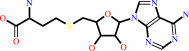 S-adenosyl-L-homocysteine
|
+
|
H(+)
|
|
|
|
|
|
|
|
|
|
|
|
|
Molecule diagrams generated from .mol files obtained from the
KEGG ftp site
|
|
|
|
|
|
|
|
|
|
|
|
|
|
 |
|
|
|
|
|
|
| |
|
|
| |
|
DOI no:
|
J Mol Biol
298:149-162
(2000)
|
|
PubMed id:
|
|
|
|
|
|
| |
|
Mechanisms for auto-inhibition and forced product release in glycine N-methyltransferase: crystal structures of wild-type, mutant R175K and S-adenosylhomocysteine-bound R175K enzymes.
|
|
Y.Huang,
J.Komoto,
K.Konishi,
Y.Takata,
H.Ogawa,
T.Gomi,
M.Fujioka,
F.Takusagawa.
|
|
|
|
|
| |
ABSTRACT
|
|
|
|
| |
|
|
Glycine N-methyltransferase (S-adenosyl-l-methionine: glycine methyltransferase,
EC 2.1.1.20; GNMT) catalyzes the AdoMet-dependent methylation of glycine to form
sarcosine (N-methylglycine). Unlike most methyltransferases, GNMT is a
tetrameric protein showing a positive cooperativity in AdoMet binding and weak
inhibition by S-adenosylhomocysteine (AdoHcy). The first crystal structure of
GNMT complexed with AdoMet showed a unique "closed" molecular basket
structure, in which the N-terminal section penetrates and corks the entrance of
the adjacent subunit. Thus, the apparent entrance or exit of the active site is
not recognizable in the subunit structure, suggesting that the enzyme must
possess a second, enzymatically active, "open" structural
conformation. A new crystalline form of the R175K enzyme has been grown in the
presence of an excess of AdoHcy, and its crystal structure has been determined
at 3.0 A resolution. In this structure, the N-terminal domain (40 amino acid
residues) of each subunit has moved out of the active site of the adjacent
subunit, and the entrances of the active sites are now opened widely. An AdoHcy
molecule has entered the site occupied in the "closed" structure by
Glu15 and Gly16 of the N-terminal domain of the adjacent subunit. An AdoHcy
binds to the consensus AdoMet binding site observed in the other
methyltransferase. This AdoHcy binding site supports the glycine binding site
(Arg175) deduced from a chemical modification study and site-directed
mutagenesis (R175K). The crystal structures of WT and R175K enzymes were also
determined at 2.5 A resolution. These enzyme structures have a closed molecular
basket structure and are isomorphous to the previously determined AdoMet-GNMT
structure. By comparing the open structure to the closed structure, mechanisms
for auto-inhibition and for the forced release of the product AdoHcy have been
revealed in the GNMT structure. The N-terminal section of the adjacent subunit
occupies the AdoMet binding site and thus inhibits the methyltransfer reaction,
whereas the same N-terminal section forces the departure of the potentially
potent inhibitor AdoHcy from the active site and thus facilitates the
methyltransfer reaction. Consequently GNMT is less active at a low level of
AdoMet concentration, and is only weakly inhibited by AdoHcy. These properties
of GNMT are particularly suited for regulation of the cellular AdoMet/AdoHcy
ratio.
|
|
|
|
|
|
| |
Selected figure(s)
|
|
|
|
| |
|
|

|
|

|
|
Figure 2.
Figure 2. Subunit structures in (a) R175K closed structure
and (b) AdoHcy-R175K open structure. The N-terminal domain,
C-terminal domain and S-domain are illustrated by red, cyan and
green, respectively. The U-loop of the adjacent subunit is shown
by thick magenta coil. In the open structure, the N-terminal
domain is invisible and an AdoHcy molecule (red) binds to the
consensus AdoMet-binding site.
|
|
Figure 7.
Figure 7. Schematic diagrams of interaction of AdoHcy in
the active site. It is noted that Trp117 stacks with the adenine
ring.
|
|
|
|
|
|
| |
The above figures are
reprinted
by permission from Elsevier:
J Mol Biol
(2000,
298,
149-162)
copyright 2000.
|
|
| |
Figures were
selected
by an automated process.
|
|
|
|
|
|
|
|
|
|
|
|
|
|
|
|
 |
 |
 |
|
Literature references that cite this PDB file's key reference
|
|
|
| |
PubMed id
|
|
Reference
|
|
|
|
|
|
K.Rutherford,
and
V.Daggett
(2010).
Polymorphisms and disease: hotspots of inactivation in methyltransferases.
|
| |
Trends Biochem Sci,
35,
531-538.
|
|
|
|
|
|
|
Z.Luka,
S.H.Mudd,
and
C.Wagner
(2009).
Glycine N-methyltransferase and regulation of S-adenosylmethionine levels.
|
| |
J Biol Chem,
284,
22507-22511.
|
|
|
|
|
|
|
M.A.Grillo,
and
S.Colombatto
(2008).
S-adenosylmethionine and its products.
|
| |
Amino Acids,
34,
187-193.
|
|
|
|
|
|
|
Z.Luka,
S.Pakhomova,
L.V.Loukachevitch,
M.Egli,
M.E.Newcomer,
and
C.Wagner
(2007).
5-methyltetrahydrofolate is bound in intersubunit areas of rat liver folate-binding protein glycine N-methyltransferase.
|
| |
J Biol Chem,
282,
4069-4075.
|
|
|
PDB codes:
|
|
|
|
|
|
|
|
Z.Luka,
S.Pakhomova,
Y.Luka,
M.E.Newcomer,
and
C.Wagner
(2007).
Destabilization of human glycine N-methyltransferase by H176N mutation.
|
| |
Protein Sci,
16,
1957-1964.
|
|
|
PDB code:
|
|
|
|
|
|
|
|
S.Pakhomova,
Z.Luka,
S.Grohmann,
C.Wagner,
and
M.E.Newcomer
(2004).
Glycine N-methyltransferases: a comparison of the crystal structures and kinetic properties of recombinant human, mouse and rat enzymes.
|
| |
Proteins,
57,
331-337.
|
|
|
PDB codes:
|
|
|
|
|
|
|
|
H.L.Schubert,
R.M.Blumenthal,
and
X.Cheng
(2003).
Many paths to methyltransfer: a chronicle of convergence.
|
| |
Trends Biochem Sci,
28,
329-335.
|
|
|
|
|
|
|
R.Waditee,
Y.Tanaka,
K.Aoki,
T.Hibino,
H.Jikuya,
J.Takano,
T.Takabe,
and
T.Takabe
(2003).
Isolation and functional characterization of N-methyltransferases that catalyze betaine synthesis from glycine in a halotolerant photosynthetic organism Aphanothece halophytica.
|
| |
J Biol Chem,
278,
4932-4942.
|
|
|
|
|
|
|
C.D.Smith,
M.Carson,
A.M.Friedman,
M.M.Skinner,
L.Delucas,
L.Chantalat,
L.Weise,
T.Shirasawa,
and
D.Chattopadhyay
(2002).
Crystal structure of human L-isoaspartyl-O-methyl-transferase with S-adenosyl homocysteine at 1.6-A resolution and modeling of an isoaspartyl-containing peptide at the active site.
|
| |
Protein Sci,
11,
625-635.
|
|
|
PDB code:
|
|
|
|
|
|
|
|
J.M.Bujnicki,
M.Feder,
M.Radlinska,
and
L.Rychlewski
(2001).
mRNA:guanine-N7 cap methyltransferases: identification of novel members of the family, evolutionary analysis, homology modeling, and analysis of sequence-structure-function relationships.
|
| |
BMC Bioinformatics,
2,
2.
|
|
|
PDB code:
|
|
|
|
|
|
|
|
X.Cheng,
and
R.J.Roberts
(2001).
AdoMet-dependent methylation, DNA methyltransferases and base flipping.
|
| |
Nucleic Acids Res,
29,
3784-3795.
|
|
|
|
|
|
|
M.M.Skinner,
J.M.Puvathingal,
R.L.Walter,
and
A.M.Friedman
(2000).
Crystal structure of protein isoaspartyl methyltransferase: a catalyst for protein repair.
|
| |
Structure,
8,
1189-1201.
|
|
|
PDB code:
|
|
|
|
|
|
|
The most recent references are shown first.
Citation data come partly from CiteXplore and partly
from an automated harvesting procedure. Note that this is likely to be
only a partial list as not all journals are covered by
either method. However, we are continually building up the citation data
so more and more references will be included with time.
Where a reference describes a PDB structure, the PDB
codes are
shown on the right.
|
|


 Links
Links


