 |
PDBsum entry 1ce9

|
|
|
|
|
|

|

|

|

|
|

|
|

|
|

|
|
|
 |

|

|
|
|
|
|
|
|
|
|
|
|
|
|
|
|
|
|
|
|
|
|
|
|
|
|
|
|
|
|
|
|
|
Helix capping
|
PDB id
|
|
|
|
1ce9
|
|
|
|
|
|
|
|
|
|
|
|
|
|
|

|

|

|
|
|
|
|
|
|
PDB id:
|
|
|
|
| Name: |
|
Helix capping
|
|
|
Title:
|
|
Helix capping in the gcn4 leucine zipper
|
|
Structure:
|
|
Protein (gcn4-pmse). Chain: a, b, c, d. Engineered: yes. Mutation: yes
|
|
Source:
|
|
Synthetic: yes
|
|
Biol. unit:
|
|
Tetramer (from
)
|
|
Resolution:
|
|
|
1.80Å
|
R-factor:
|
0.214
|
R-free:
|
0.283
|
|
|
Authors:
|
|
M.Lu,W.Shu,H.Ji,E.Spek,L.-Y.Wang,N.R.Kallenbach
|
Key ref:

|
|
M.Lu
et al.
(1999).
Helix capping in the GCN4 leucine zipper.
J Mol Biol,
288,
743-752.
PubMed id:
DOI:

|
|
|
Date:
|
|
|
18-Mar-99
|
Release date:
|
25-Mar-99
|
|
|
|
|
|
|
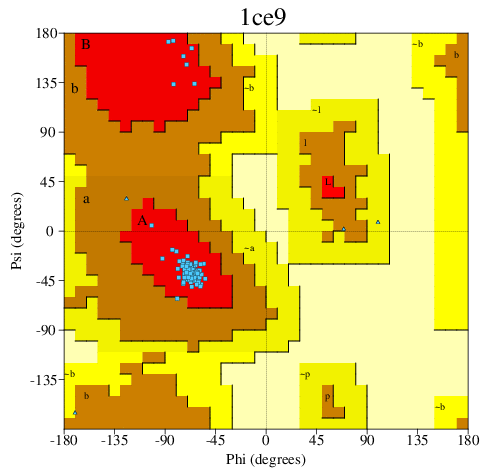
PROCHECK
|
|
|
|
|
|
Headers
|
|
|
|
References
|
|
|
|
|
|

|
|
P03069
(GCN4_YEAST) -
General control transcription factor GCN4 from Saccharomyces cerevisiae (strain ATCC 204508 / S288c)
|
|
|
|
Seq:
Struc:
|
|
|
|
281 a.a.
34 a.a.*
|
|

|

|

|
|
|
|
|
|
|
|
|
|
|
Key: |
 |
PfamA domain |
|
|
 |
Secondary structure |
|
|
*
PDB and UniProt seqs differ
at 4 residue positions (black
crosses)
|
|
|
|
|
|
|
|
|
|
|
|
|
|
|
|
|
 |
|
|
|
|
|
|
| |
|
DOI no:
|
J Mol Biol
288:743-752
(1999)
|
|
PubMed id:
|
|
|
|
|
|
| |
|
Helix capping in the GCN4 leucine zipper.
|
|
M.Lu,
W.Shu,
H.Ji,
E.Spek,
L.Wang,
N.R.Kallenbach.
|
|
|
|
|
| |
ABSTRACT
|
|
|
|
| |
|
|
Capping interactions associated with specific sequences at or near the ends of
alpha-helices are important determinants of the stability of protein secondary
and tertiary structure. We investigate here the role of the helix-capping motif
Ser-X-X-Glu, a sequence that occurs frequently at the N termini of alpha helices
in proteins, on the conformation and stability of the GCN4 leucine zipper. The
1.8 A resolution crystal structure of the capped molecule reveals distinct
conformations, packing geometries and hydrogen-bonding networks at the amino
terminus of the two helices in the leucine zipper dimer. The free energy of
helix stabilization associated with the hydrogen-bonding and hydrophobic
interactions in this capping structure is -1.2 kcal/mol, evaluated from thermal
unfolding experiments. A single cap thus contributes appreciably to stabilizing
the terminated helix and thereby the native state. These results suggest that
helix capping plays a further role in protein folding, providing a sensitive
connector linking alpha-helix formation to the developing tertiary structure of
a protein.
|
|
|
|
|
|
| |
Selected figure(s)
|
|
|
|
| |
|
|

|
|

|
|
Figure 2.
Figure 2. Folding of the GCN4 leucine zipper mutant
peptides as a-helical dimers. (a) CD spectra of GCN4-
pMSE (open circles), GCN4-pSE (open squares), and
GCN4-pAA (open triangles) at 0 ° C in PBS (pH 7.0) and
10 mM peptide. (b) Temperature-dependence of the CD
signal at 222 nm for GCN4-pMSE (open circles), GCN4-
pSE (open squares), and GCN4-pAA (open triangles) in
PBS (pH 7.0) and 10 mM peptide. (c) Representative
sedimentation equilibrium data (35 krpm) for GCN4-
pMSE collected at 20 °C and
~300
mM peptide. The ran-
dom distribution of the residuals indicates that the data
fit well to an ideal single-species model.
|
|
Figure 3.
Figure 3. Stereo view of the crystal structure of the
GCN4-pMSE dimer. An axial view of the two a-helical
coiled-coil dimers of the unit cell. Water molecules are
indicated with blue dots. The view is from the amino
terminus down the superhelix axis of the coiled-coil
dimer, colored yellow, and the carboxyl terminus of the
coiled-coil dimer, colored green. The Figure was pre-
pared using the program SETOR (Evans, 1993).
|
|
|
|
|
|
| |
The above figures are
reprinted
by permission from Elsevier:
J Mol Biol
(1999,
288,
743-752)
copyright 1999.
|
|
| |
Figures were
selected
by an automated process.
|
|
|
|
|
|
|
|
|
|
|
|
|
|
|
|
 |
 |
 |
|
Literature references that cite this PDB file's key reference
|
|
|
| |
PubMed id
|
|
Reference
|
|
|
|
|
|
D.P.Leader,
and
E.J.Milner-White
(2011).
The structure of the ends of α-helices in globular proteins: Effect of additional hydrogen bonds and implications for helix formation.
|
| |
Proteins,
79,
1010-1019.
|
|
|
|
|
|
|
R.S.Hodges,
J.Mills,
S.McReynolds,
J.P.Kirwan,
B.Tripet,
and
D.Osguthorpe
(2009).
Identification of a unique "stability control region" that controls protein stability of tropomyosin: A two-stranded alpha-helical coiled-coil.
|
| |
J Mol Biol,
392,
747-762.
|
|
|
|
|
|
|
J.J.Dwyer,
K.L.Wilson,
D.K.Davison,
S.A.Freel,
J.E.Seedorff,
S.A.Wring,
N.A.Tvermoes,
T.J.Matthews,
M.L.Greenberg,
and
M.K.Delmedico
(2007).
Design of helical, oligomeric HIV-1 fusion inhibitor peptides with potent activity against enfuvirtide-resistant virus.
|
| |
Proc Natl Acad Sci U S A,
104,
12772-12777.
|
|
|
|
|
|
|
Y.Deng,
Q.Zheng,
J.Liu,
C.S.Cheng,
N.R.Kallenbach,
and
M.Lu
(2007).
Self-assembly of coiled-coil tetramers in the 1.40 A structure of a leucine-zipper mutant.
|
| |
Protein Sci,
16,
323-328.
|
|
|
PDB code:
|
|
|
|
|
|
|
|
L.Domínguez-Ramírez,
A.Gómez-Puyou,
and
M.T.de Gómez-Puyou
(2006).
A hinge of the endogeneous ATP synthase inhibitor protein: the link between inhibitory and anchoring domains.
|
| |
Proteins,
65,
999.
|
|
|
|
|
|
|
M.K.Yadav,
L.J.Leman,
D.J.Price,
C.L.Brooks,
C.D.Stout,
and
M.R.Ghadiri
(2006).
Coiled coils at the edge of configurational heterogeneity. Structural analyses of parallel and antiparallel homotetrameric coiled coils reveal configurational sensitivity to a single solvent-exposed amino acid substitution.
|
| |
Biochemistry,
45,
4463-4473.
|
|
|
PDB codes:
|
|
|
|
|
|
|
|
K.Jacobsen,
S.Oga,
W.L.Hubbell,
and
T.Risse
(2005).
Determination of the orientation of T4 lysozyme vectorially bound to a planar-supported lipid bilayer using site-directed spin labeling.
|
| |
Biophys J,
88,
4351-4365.
|
|
|
|
|
|
|
S.C.Kwok,
and
R.S.Hodges
(2004).
Stabilizing and destabilizing clusters in the hydrophobic core of long two-stranded alpha-helical coiled-coils.
|
| |
J Biol Chem,
279,
21576-21588.
|
|
|
|
|
|
|
J.J.Havranek,
and
P.B.Harbury
(2003).
Automated design of specificity in molecular recognition.
|
| |
Nat Struct Biol,
10,
45-52.
|
|
|
|
|
|
|
W.K.Low,
Q.Lin,
and
C.L.Hew
(2003).
The role of N and C termini in the antifreeze activity of winter flounder (Pleuronectes americanus) antifreeze proteins.
|
| |
J Biol Chem,
278,
10334-10343.
|
|
|
|
|
|
|
S.C.Kwok,
C.T.Mant,
and
R.S.Hodges
(2002).
Importance of secondary structural specificity determinants in protein folding: insertion of a native beta-sheet sequence into an alpha-helical coiled-coil.
|
| |
Protein Sci,
11,
1519-1531.
|
|
|
|
|
|
|
M.D.Lanigan,
J.E.Tudor,
M.W.Pennington,
and
R.S.Norton
(2001).
A helical capping motif in ShK toxin and its role in helix stabilization.
|
| |
Biopolymers,
58,
422-436.
|
|
|
|
|
|
|
P.Burkhard,
M.Meier,
and
A.Lustig
(2000).
Design of a minimal protein oligomerization domain by a structural approach.
|
| |
Protein Sci,
9,
2294-2301.
|
|
|
PDB code:
|
|
|
|
|
|
|
The most recent references are shown first.
Citation data come partly from CiteXplore and partly
from an automated harvesting procedure. Note that this is likely to be
only a partial list as not all journals are covered by
either method. However, we are continually building up the citation data
so more and more references will be included with time.
Where a reference describes a PDB structure, the PDB
code is
shown on the right.
|
|


 Links
Links


