 |
PDBsum entry 1cbk

|
|
|
|
|
 |
Contents |
 |
|
|
|
|
|
|
|
|
|
|
|
|
* Residue conservation analysis
|
|
|
|
|
|
|
|
|
|
|
Enzyme class:
|
|
E.C.2.7.6.3
- 2-amino-4-hydroxy-6-hydroxymethyldihydropteridine diphosphokinase.
|
|
|
|
|
|
|
Pathway:
|
|
Folate Biosynthesis (late stages)
|
|
|
|
|
|
Reaction:
|
|
6-hydroxymethyl-7,8-dihydropterin + ATP = (7,8-dihydropterin-6-yl)methyl diphosphate + AMP + H+
|
|
|
|
|
|
6-hydroxymethyl-7,8-dihydropterin
|
+
|
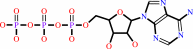 ATP
ATP
|
=
|
(7,8-dihydropterin-6-yl)methyl diphosphate
|
+
|
AMP
Bound ligand (Het Group name = )
matches with 40.74% similarity
|
+
|
H(+)
|
|
|
|
|
|
|
|
|
|
Cofactor:
|
|
Mg(2+)
|
|
|
|
|
|
|
|
|
Molecule diagrams generated from .mol files obtained from the
KEGG ftp site
|
|
|
|
|
|
|
|
|
|
|
|
|
|
 |
|
|
|
|
|
|
| |
|
|
| |
|
DOI no:
|
J Mol Biol
287:211-219
(1999)
|
|
PubMed id:
|
|
|
|
|
|
| |
|
The structure and function of the 6-hydroxymethyl-7,8-dihydropterin pyrophosphokinase from Haemophilus influenzae.
|
|
M.Hennig,
G.E.Dale,
A.D'arcy,
F.Danel,
S.Fischer,
C.P.Gray,
S.Jolidon,
F.Müller,
M.G.Page,
P.Pattison,
C.Oefner.
|
|
|
|
|
| |
ABSTRACT
|
|
|
|
| |
|
|
The gene encoding the 6-hydroxymethyl-7,8-dihydropterin pyrophosphokinase of
Haemophilus influenzae has been cloned and expressed in Escherichia coli. A
complex of the purified protein with a substrate analog has been crystallized
and its structure solved by multiple anomalous dispersion using phase
information obtained from a single crystal of selenomethione-labeled protein.
The enzyme folds into a four-stranded antiparallel beta-sheet flanked on one
side by two alpha-helices and on the other by three consecutive alpha-helices,
giving a novel beta1alpha1beta2beta3alpha2beta4alpha3alpha4alpha5 polypeptide
topology. The three-dimensional structure of a binary complex has been refined
at 2.1 A resolution. The location of the substrate analog and a sulfate ion
gives important insight into the molecular mechanism of the enzyme.
|
|
|
|
|
|
| |
Selected figure(s)
|
|
|
|
| |
|
|

|
|

|
|
Figure 5.
Figure 5. Structure of the HPPK monomer. (a) In the overall
view β-strands are presented as arrows and α-helices are shown
as ribbons. The inhibitor in the active site is represented by
the ball-and-stick model in green. (b) The molecular surface of
the enzyme in the absence of compound [II] depicts the position
of the conserved charged amino acid residues in the proximity of
the pterin binding site. The surface is colored red and blue for
negative and positive char respectively. The Figure was produced
using the programs MOLSCRIPT [Kraulis 1991] and RASTER3D [Merrit
and Bacon 1997]. The surface was generated and displayed with
the program GRASP [Nicholls and Honig 1992].
|
|
Figure 6.
Figure 6. Refined structure of the active site region of HPPK
superimposed with the MAD electron density at 2.6 Å
resolution contoured at (a) 1.5σ and (b) the final 2 F[o] −
F[c] map at 2.1 Å contoured at 1σ. The protein, inhibitor
and sulfate ion is represented in red, green or blue,
respectively. Water molecules are shown by small spheres. The
Figure was produces with the program MOLOC [Gerber 1992].
|
|
|
|
|
|
| |
The above figures are
reprinted
by permission from Elsevier:
J Mol Biol
(1999,
287,
211-219)
copyright 1999.
|
|
| |
Figures were
selected
by an automated process.
|
|
|
|
|
|
|
|
|
|
|
|
|
|
|
|
 |
 |
 |
|
Literature references that cite this PDB file's key reference
|
|
|
| |
PubMed id
|
|
Reference
|
|
|
|
|
|
C.W.Pemble,
P.K.Mehta,
S.Mehra,
Z.Li,
A.Nourse,
R.E.Lee,
and
S.W.White
(2010).
Crystal structure of the 6-hydroxymethyl-7,8-dihydropterin pyrophosphokinase•dihydropteroate synthase bifunctional enzyme from Francisella tularensis.
|
| |
PLoS One,
5,
e14165.
|
|
|
PDB codes:
|
|
|
|
|
|
|
|
J.Blaszczyk,
Y.Li,
S.Cherry,
J.Alexandratos,
Y.Wu,
G.Shaw,
J.E.Tropea,
D.S.Waugh,
H.Yan,
and
X.Ji
(2007).
Structure and activity of Yersinia pestis 6-hydroxymethyl-7,8-dihydropterin pyrophosphokinase as a novel target for the development of antiplague therapeutics.
|
| |
Acta Crystallogr D Biol Crystallogr,
63,
1169-1177.
|
|
|
PDB code:
|
|
|
|
|
|
|
|
A.Nzila
(2006).
Inhibitors of de novo folate enzymes in Plasmodium falciparum.
|
| |
Drug Discov Today,
11,
939-944.
|
|
|
|
|
|
|
J.Y.Liu,
D.E.Timm,
and
T.D.Hurley
(2006).
Pyrithiamine as a substrate for thiamine pyrophosphokinase.
|
| |
J Biol Chem,
281,
6601-6607.
|
|
|
PDB code:
|
|
|
|
|
|
|
|
J.Ko,
L.F.Murga,
P.André,
H.Yang,
M.J.Ondrechen,
R.J.Williams,
A.Agunwamba,
and
D.E.Budil
(2005).
Statistical criteria for the identification of protein active sites using Theoretical Microscopic Titration Curves.
|
| |
Proteins,
59,
183-195.
|
|
|
|
|
|
|
R.Yang,
M.C.Lee,
H.Yan,
and
Y.Duan
(2005).
Loop conformation and dynamics of the Escherichia coli HPPK apo-enzyme and its binary complex with MgATP.
|
| |
Biophys J,
89,
95.
|
|
|
|
|
|
|
W.Huber
(2005).
A new strategy for improved secondary screening and lead optimization using high-resolution SPR characterization of compound-target interactions.
|
| |
J Mol Recognit,
18,
273-281.
|
|
|
|
|
|
|
A.Bermingham,
and
J.P.Derrick
(2002).
The folic acid biosynthesis pathway in bacteria: evaluation of potential for antibacterial drug discovery.
|
| |
Bioessays,
24,
637-648.
|
|
|
|
|
|
|
B.Xiao,
G.Shi,
J.Gao,
J.Blaszczyk,
Q.Liu,
X.Ji,
and
H.Yan
(2001).
Unusual conformational changes in 6-hydroxymethyl-7,8-dihydropterin pyrophosphokinase as revealed by X-ray crystallography and NMR.
|
| |
J Biol Chem,
276,
40274-40281.
|
|
|
PDB codes:
|
|
|
|
|
|
|
|
L.J.Baker,
J.A.Dorocke,
R.A.Harris,
and
D.E.Timm
(2001).
The crystal structure of yeast thiamin pyrophosphokinase.
|
| |
Structure,
9,
539-546.
|
|
|
PDB code:
|
|
|
|
|
|
|
|
S.A.Teichmann,
A.G.Murzin,
and
C.Chothia
(2001).
Determination of protein function, evolution and interactions by structural genomics.
|
| |
Curr Opin Struct Biol,
11,
354-363.
|
|
|
|
|
|
|
J.Blaszczyk,
G.Shi,
H.Yan,
and
X.Ji
(2000).
Catalytic center assembly of HPPK as revealed by the crystal structure of a ternary complex at 1.25 A resolution.
|
| |
Structure,
8,
1049-1058.
|
|
|
PDB codes:
|
|
|
|
|
|
|
The most recent references are shown first.
Citation data come partly from CiteXplore and partly
from an automated harvesting procedure. Note that this is likely to be
only a partial list as not all journals are covered by
either method. However, we are continually building up the citation data
so more and more references will be included with time.
Where a reference describes a PDB structure, the PDB
codes are
shown on the right.
|
|


 Links
Links


