|
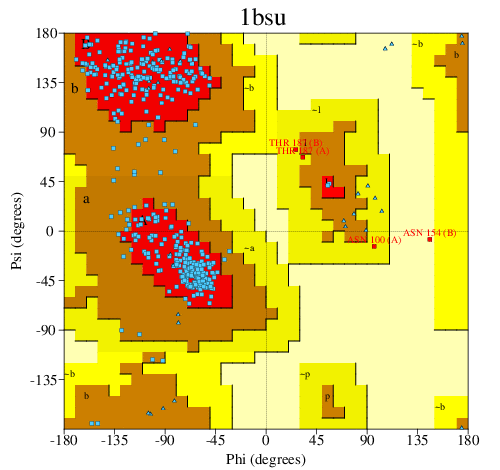
PDBsum entry 1bsu

|
|
|
|
|
|

|

|

|

|
|

|
|

|
|

|
|

|
|

|
|

|
|

|
|
|
 |

|

|
|
|
|
|
|
|
|
|
|
|
|
|
|
|
|
|
|
|
|
|
|
|
|
|
|
|
|
|
|
|
|
|
|
|
|
Hydrolase/DNA
|
PDB id
|
|
|
|
1bsu
|
|
|
|
|
|
|
|
|
|
|
|
|
|
|

|

|

|
|
|
|
|
|
|
|
|
Enzyme class:
|
|
E.C.3.1.21.4
- type Ii site-specific deoxyribonuclease.
|
|
|
|
|
|
|
Reaction:
|
|
Endonucleolytic cleavage of DNA to give specific double-stranded fragments with terminal 5'-phosphates.
|
|
|
|
|
|
Cofactor:
|
|
Mg(2+)
|
|
|
|
|
|
|
|
|
|
|
|
|
|
|
|
|
|
 |
|
|
|
|
|
|
| |
|
DOI no:
|
Nat Struct Biol
6:269-277
(1999)
|
|
PubMed id:
|
|
|
|
|
|
| |
|
Structural and energetic origins of indirect readout in site-specific DNA cleavage by a restriction endonuclease.
|
|
A.M.Martin,
M.D.Sam,
N.O.Reich,
J.J.Perona.
|
|
|
|
|
| |
ABSTRACT
|
|
|
|
| |
|
|
Specific recognition by EcoRV endonuclease of its cognate, sharply bent GATATC
site at the center TA step occurs solely via hydrophobic interaction with
thymine methyl groups. Mechanistic kinetic analyses of base analog-substituted
DNAs at this position reveal that direct readout provides 5 kcal mol(-1) toward
specificity, with an additional 6-10 kcal mol(-1) arising from indirect readout.
Crystal structures of several base analog complexes show that the major-groove
hydrophobic contacts are crucial to forming required divalent metal-binding
sites, and that indirect readout operates in part through the sequence-dependent
free-energy cost of unstacking the center base-pair step of the DNA.
|
|
|
|
|
|
| |
Selected figure(s)
|
|
|
|
| |
|
|

|
|

|
|
Figure 1.
Figure 1. a, Ribbon representation of the EcoRV dimer showing
the dimerization domain at bottom (orange), the
DNA-binding/catalytic domains in yellow and the four flexible
linkers I−IV in each subunit^13. The major-groove binding
R-loops (red, residues 182−188 of each subunit) present all of
the primary determinants for direct readout of base-pair
functional groups in the GATATC target. The scissile phosphorus
atoms are shown by the pink spheres. The Gln-rich Q-loops that
bind in the minor groove are shown in blue. b, View of the bent
DNA conformation as seen in the complex of EcoRV with specific
DNA^13. The center TA step and the R-loops are drawn in purple
and blue, respectively. Van der Waals contacts of the Thr 186
side-chain methyl groups (red) with functional groups in the
major groove are shown. c, Hydrogen-bonding (dotted lines) and
van der Waals/electrostatic contacts (hatched lines) at the
center TA step in the wild-type EcoRV−DNA complex. Distances
in Å between nonhydrogen atoms are from the ternary
complex structure with Ca^2+ (ref. 15). The contacts between Thr
186 and the thymine O4/adenine N6 groups may contribute binding
energy but are considered to be nonspecific. The Watson−Crick
hydrogen bonds are designated WC. The distance between the Thr
186 and Thr 186' methyl groups from the two separate subunits is
4.2 Å.
|
|
Figure 4.
Figure 4. a, Superposition of the structures of EcoRV bound to
the wild-type site in the presence of Ca^2+ (green), and bound
to CI (red). The subunit II active site is shown, and the
superposition is carried out over all backbone atoms in the core
portion of this subunit^15. The position of the calcium ion (Ca)
and its bound water molecules in the active site of the cognate
structure are shown. b, 'Omit' (2F[o] - F[c]) electron density
map in the active site of subunit I of the EcoRV−CI complex,
contoured at 1.0  .
Side chains of Asp 90, Asp 74, Glu 45 and Lys 92, the center CI
step of the DNA, and all solvent molecules in the subunit I
active site were removed before positional refinement in X-PLOR.
Positions of side chains and water molecules (blue spheres) in
the final model are shown. B-factors for the water molecules
shown range from 30 to 35 Å^2. This and other maps through
the course of refinement show the lack of a well-defined Ca^2+
ion in the active site. c, Simulated annealing 'omit' electron
density map in the active site of subunit I of the
EcoRV−MI−Ca^2+ complex. Side chains of Asp 90, Asp 74, Glu
45 and Lys 92, the center MI step of the DNA, and all solvent
molecules in the subunit I active site were removed, and the
resulting model subjected to a simulated annealing refinement
protocol in X-PLOR. Electron density maps calculated with
coefficients (2F[o] - F[c]) (blue) and (F[o] - F[c]) (red) are
shown superimposed on the final model. Phases for this map were
derived from the model with these atoms deleted. The map is
computed in the resolution range from 2.0 Å to 20 Å.
The density is contoured at 1.0 for
the (2F[o] - F[c]) map and 6.0 for
the (F[o] - F[c]) map. The purple sphere represents a Ca^2+ ion
and blue spheres represent water molecules. Both map figures
were produced using SETOR^46. .
Side chains of Asp 90, Asp 74, Glu 45 and Lys 92, the center CI
step of the DNA, and all solvent molecules in the subunit I
active site were removed before positional refinement in X-PLOR.
Positions of side chains and water molecules (blue spheres) in
the final model are shown. B-factors for the water molecules
shown range from 30 to 35 Å^2. This and other maps through
the course of refinement show the lack of a well-defined Ca^2+
ion in the active site. c, Simulated annealing 'omit' electron
density map in the active site of subunit I of the
EcoRV−MI−Ca^2+ complex. Side chains of Asp 90, Asp 74, Glu
45 and Lys 92, the center MI step of the DNA, and all solvent
molecules in the subunit I active site were removed, and the
resulting model subjected to a simulated annealing refinement
protocol in X-PLOR. Electron density maps calculated with
coefficients (2F[o] - F[c]) (blue) and (F[o] - F[c]) (red) are
shown superimposed on the final model. Phases for this map were
derived from the model with these atoms deleted. The map is
computed in the resolution range from 2.0 Å to 20 Å.
The density is contoured at 1.0 for
the (2F[o] - F[c]) map and 6.0 for
the (F[o] - F[c]) map. The purple sphere represents a Ca^2+ ion
and blue spheres represent water molecules. Both map figures
were produced using SETOR^46.
|
|
|
|
|
|
| |
The above figures are
reprinted
by permission from Macmillan Publishers Ltd:
Nat Struct Biol
(1999,
6,
269-277)
copyright 1999.
|
|
| |
Figures were
selected
by an automated process.
|
|
|
|
|
|
|
|
|
|
|
|
|
|
|
|
 |
 |
 |
|
Literature references that cite this PDB file's key reference
|
 Google scholar
|
|
|
| |
PubMed id
|
|
Reference
|
|
|
|
|
|
M.Firczuk,
M.Wojciechowski,
H.Czapinska,
and
M.Bochtler
(2011).
DNA intercalation without flipping in the specific ThaI-DNA complex.
|
| |
Nucleic Acids Res,
39,
744-754.
|
|
|
PDB code:
|
|
|
|
|
|
|
|
J.Ashworth,
and
D.Baker
(2009).
Assessment of the optimization of affinity and specificity at protein-DNA interfaces.
|
| |
Nucleic Acids Res,
37,
e73.
|
|
|
|
|
|
|
M.T.Langhans,
and
M.J.Palladino
(2009).
Cleavage of mispaired heteroduplex DNA substrates by numerous restriction enzymes.
|
| |
Curr Issues Mol Biol,
11,
1.
|
|
|
|
|
|
|
R.A.Estabrook,
T.T.Nguyen,
N.Fera,
and
N.O.Reich
(2009).
Coupling sequence-specific recognition to DNA modification.
|
| |
J Biol Chem,
284,
22690-22696.
|
|
|
|
|
|
|
E.J.Little,
A.C.Babic,
and
N.C.Horton
(2008).
Early interrogation and recognition of DNA sequence by indirect readout.
|
| |
Structure,
16,
1828-1837.
|
|
|
PDB code:
|
|
|
|
|
|
|
|
S.Lindemose,
P.E.Nielsen,
and
N.E.Møllegaard
(2008).
Dissecting direct and indirect readout of cAMP receptor protein DNA binding using an inosine and 2,6-diaminopurine in vitro selection system.
|
| |
Nucleic Acids Res,
36,
4797-4807.
|
|
|
|
|
|
|
D.A.Hiller,
and
J.J.Perona
(2006).
Positively charged C-terminal subdomains of EcoRV endonuclease: contributions to DNA binding, bending, and cleavage.
|
| |
Biochemistry,
45,
11453-11463.
|
|
|
PDB code:
|
|
|
|
|
|
|
|
H.K.Joshi,
C.Etzkorn,
L.Chatwell,
J.Bitinaite,
and
N.C.Horton
(2006).
Alteration of sequence specificity of the type II restriction endonuclease HincII through an indirect readout mechanism.
|
| |
J Biol Chem,
281,
23852-23869.
|
|
|
PDB codes:
|
|
|
|
|
|
|
|
B.van den Broek,
M.C.Noom,
and
G.J.Wuite
(2005).
DNA-tension dependence of restriction enzyme activity reveals mechanochemical properties of the reaction pathway.
|
| |
Nucleic Acids Res,
33,
2676-2684.
|
|
|
|
|
|
|
S.Chandrashekaran,
M.Saravanan,
D.R.Radha,
and
V.Nagaraja
(2004).
Ca(2+)-mediated site-specific DNA cleavage and suppression of promiscuous activity of KpnI restriction endonuclease.
|
| |
J Biol Chem,
279,
49736-49740.
|
|
|
|
|
|
|
S.Hauenstein,
C.M.Zhang,
Y.M.Hou,
and
J.J.Perona
(2004).
Shape-selective RNA recognition by cysteinyl-tRNA synthetase.
|
| |
Nat Struct Mol Biol,
11,
1134-1141.
|
|
|
PDB code:
|
|
|
|
|
|
|
|
D.A.Hiller,
J.M.Fogg,
A.M.Martin,
J.M.Beechem,
N.O.Reich,
and
J.J.Perona
(2003).
Simultaneous DNA binding and bending by EcoRV endonuclease observed by real-time fluorescence.
|
| |
Biochemistry,
42,
14375-14385.
|
|
|
|
|
|
|
H.Asahara,
and
O.C.Uhlenbeck
(2002).
The tRNA specificity of Thermus thermophilus EF-Tu.
|
| |
Proc Natl Acad Sci U S A,
99,
3499-3504.
|
|
|
|
|
|
|
N.C.Horton,
L.F.Dorner,
and
J.J.Perona
(2002).
Sequence selectivity and degeneracy of a restriction endonuclease mediated by DNA intercalation.
|
| |
Nat Struct Biol,
9,
42-47.
|
|
|
PDB code:
|
|
|
|
|
|
|
|
Z.Morávek,
S.Neidle,
and
B.Schneider
(2002).
Protein and drug interactions in the minor groove of DNA.
|
| |
Nucleic Acids Res,
30,
1182-1191.
|
|
|
|
|
|
|
A.Pingoud,
and
A.Jeltsch
(2001).
Structure and function of type II restriction endonucleases.
|
| |
Nucleic Acids Res,
29,
3705-3727.
|
|
|
|
|
|
|
F.J.LaRiviere,
A.D.Wolfson,
and
O.C.Uhlenbeck
(2001).
Uniform binding of aminoacyl-tRNAs to elongation factor Tu by thermodynamic compensation.
|
| |
Science,
294,
165-168.
|
|
|
|
|
|
|
S.L.Reid,
D.Parry,
H.H.Liu,
and
B.A.Connolly
(2001).
Binding and recognition of GATATC target sequences by the EcoRV restriction endonuclease: a study using fluorescent oligonucleotides and fluorescence polarization.
|
| |
Biochemistry,
40,
2484-2494.
|
|
|
|
|
|
|
N.C.Horton,
and
J.J.Perona
(2000).
Crystallographic snapshots along a protein-induced DNA-bending pathway.
|
| |
Proc Natl Acad Sci U S A,
97,
5729-5734.
|
|
|
PDB codes:
|
|
|
|
|
|
|
|
Q.Huai,
J.D.Colandene,
Y.Chen,
F.Luo,
Y.Zhao,
M.D.Topal,
and
H.Ke
(2000).
Crystal structure of NaeI-an evolutionary bridge between DNA endonuclease and topoisomerase.
|
| |
EMBO J,
19,
3110-3118.
|
|
|
PDB code:
|
|
|
|
|
|
|
|
A.M.Martin,
N.C.Horton,
S.Lusetti,
N.O.Reich,
and
J.J.Perona
(1999).
Divalent metal dependence of site-specific DNA binding by EcoRV endonuclease.
|
| |
Biochemistry,
38,
8430-8439.
|
|
|
|
|
|
|
M.D.Sam,
and
J.J.Perona
(1999).
Catalytic roles of divalent metal ions in phosphoryl transfer by EcoRV endonuclease.
|
| |
Biochemistry,
38,
6576-6586.
|
|
|
|
|
|
The most recent references are shown first.
Citation data come partly from CiteXplore and partly
from an automated harvesting procedure. Note that this is likely to be
only a partial list as not all journals are covered by
either method. However, we are continually building up the citation data
so more and more references will be included with time.
Where a reference describes a PDB structure, the PDB
code is
shown on the right.
|
|


 Links
Links