 |
PDBsum entry 1bfw

|
|
|
|
|
|

|

|

|

|
|

|
|

|
|
|
 |

|

|
|
|
|
|
|
|
|
|
|
|
|
|
|
|
|
|
|
|
|
|
|
|
|
|
|
|
|
|
|
|
Viral protein
|
PDB id
|
|
|
|
1bfw
|
|
|
|
|
|
|
|
|
|
|
|
|
|
|

|

|

|
|
|
|
|
|
|
PDB id:
|
|
|
|
| Name: |
|
Viral protein
|
|
|
Title:
|
|
Retro-inverso analogue of the g-h loop of vp1 in foot-and-mouth- disease (fmd) virus, nmr, 10 structures
|
|
Structure:
|
|
Vp1 protein. Chain: a. Fragment: the major immunogen region, residues 141-159. Engineered: yes. Other_details: retro-inverso peptide corresponding to the major immunogen region of the foot-and-mouth-disease virus capsid
|
|
Source:
|
|
not given
|
|
NMR struc:
|
|
10 models
|
|
|
Authors:
|
|
M.C.Petit,N.Benkirane,G.Guichard,A.Phan Chan Du,M.T.Cung,J.P.Briand, S.Muller
|
Key ref:

|
|
M.C.Petit
et al.
(1999).
Solution structure of a retro-inverso peptide analogue mimicking the foot-and-mouth disease virus major antigenic site. Structural basis for its antigenic cross-reactivity with the parent peptide.
J Biol Chem,
274,
3686-3692.
PubMed id:
DOI:

|
|
|
Date:
|
|
|
22-May-98
|
Release date:
|
13-Jan-99
|
|
|
|
|
|
|
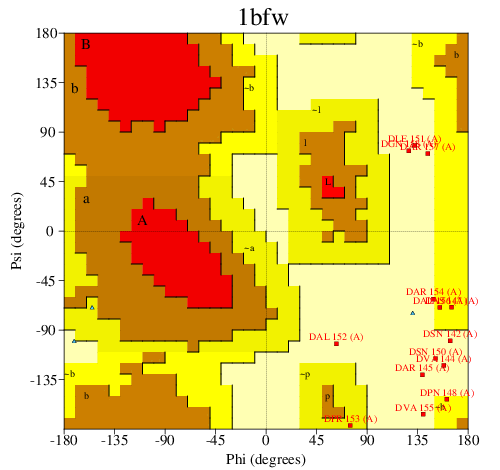
PROCHECK
|
|
|
|
|
|
Headers
|
|
|
|
References
|
|
|
|
|
|

|
|
No UniProt id for this chain
|
|
|
|
|
|
|
|
|
|
|
|
|
|
|
|
|
|
|
|
|
|
|
|
|
|
|
|
|
|
|
 |
|
|
|
|
|
|
| |
|
DOI no:
|
J Biol Chem
274:3686-3692
(1999)
|
|
PubMed id:
|
|
|
|
|
|
| |
|
Solution structure of a retro-inverso peptide analogue mimicking the foot-and-mouth disease virus major antigenic site. Structural basis for its antigenic cross-reactivity with the parent peptide.
|
|
M.C.Petit,
N.Benkirane,
G.Guichard,
A.P.Du,
M.Marraud,
M.T.Cung,
J.P.Briand,
S.Muller.
|
|
|
|
|
| |
ABSTRACT
|
|
|
|
| |
|
|
The antigenic activity of a 19-mer peptide corresponding to the major antigenic
region of foot-and-mouth disease virus and its retro-enantiomeric analogue was
found to be completely abolished when they were tested in a biosensor system in
trifluoroethanol. This suggests that the folding pattern, which is alpha-helix
in trifluoroethanol (confirmed by CD measurement), does not correspond to the
biologically relevant conformation(s) recognized by antibodies. The NMR
structures of both peptides were thus determined in aqueous solution. These
studies showed that the two peptides exhibit similar folding features,
particularly in their C termini. This may explain in part the cross-reactive
properties of the two peptides in aqueous solution. However, the retro-inverso
analogue appears to be more rigid than the parent peptide and contains five
atypical beta-turns. This feature may explain why retro-inverso foot-and-mouth
disease virus peptides are often better recognized than the parent peptide by
anti-virion antibodies.
|
|
|
|
|
|
| |
Selected figure(s)
|
|
|
|
| |
|
|

|
|

|
|
Figure 1.
Fig. 1. Antigenic activity of the parent and
retro-inverso (RI) peptide in TFE measured using the biosensor
instrument BIAcore. The successive steps of the assay and the
controls are described under "Materials and Methods." The
results reflect the effect of TFE on the antigenicity of
peptides. The antibodies used as probes were not in contact with
the TFE solution during the test. The peptides tested are
described in the figure. The antibodies tested were from guinea
pig antisera (diluted 1:50) raised against the L-peptide 141-159
(a) and RI-peptide 141-159 (b) and from rabbit antisera (diluted
1:20) raised against the L-peptide 141-159 (c) and RI-peptide
141-159 (d). The mouse monoclonal antibody 4x11 directed against
the parent peptide IRGERA was tested as a control with the L-
and retro-inverso peptides IRGERA (e). The results are expressed
in RU.
|
|
Figure 4.
Fig. 4. Summary of nonambiguous observed connectivities
for the parent (a) and retro-inverso peptide (b). For
conventional reasons the numbering of residues was maintained in
L- and retro-inverso peptides regardless the orientation of the
peptide bonds. The strong, medium, or weak intensities of the
NOE cross-peaks are indicated by the thickness of the lines.
|
|
|
|
|
|
| |
The above figures are
reprinted
by permission from the ASBMB:
J Biol Chem
(1999,
274,
3686-3692)
copyright 1999.
|
|
| |
Figures were
selected
by an automated process.
|
|
|
|
|
|
|
|
|
|
|
|
|
|
|
|
 |
 |
 |
|
Literature references that cite this PDB file's key reference
|
|
|
| |
PubMed id
|
|
Reference
|
|
|
|
|
|
G.Revilla-López,
F.Rodríguez-Ropero,
D.Curcó,
J.Torras,
M.Isabel Calaza,
D.Zanuy,
A.I.Jiménez,
C.Cativiela,
R.Nussinov,
and
C.Alemán
(2011).
Integrating the intrinsic conformational preferences of noncoded α-amino acids modified at the peptide bond into the noncoded amino acids database.
|
| |
Proteins,
79,
1841-1852.
|
|
|
|
|
|
|
L.Johannessen,
J.Remsberg,
V.Gaponenko,
K.M.Adams,
J.J.Barchi,
S.G.Tarasov,
S.Jiang,
and
N.I.Tarasova
(2011).
Peptide structure stabilization by membrane anchoring and its general applicability to the development of potent cell-permeable inhibitors.
|
| |
Chembiochem,
12,
914-921.
|
|
|
|
|
|
|
N.P.Croft,
and
A.W.Purcell
(2011).
Peptidomimetics: modifying peptides in the pursuit of better vaccines.
|
| |
Expert Rev Vaccines,
10,
211-226.
|
|
|
|
|
|
|
S.A.Kim,
C.M.Liang,
I.C.Cheng,
Y.C.Cheng,
M.T.Chiao,
C.J.Tseng,
F.Lee,
M.H.Jong,
M.H.Tao,
N.S.Yang,
and
S.M.Liang
(2006).
DNA vaccination against foot-and-mouth disease via electroporation: study of molecular approaches for enhancing VP1 antigenicity.
|
| |
J Gene Med,
8,
1182-1191.
|
|
|
|
|
|
|
N.S.Yang,
J.H.Wang,
K.F.Lin,
C.Y.Wang,
S.A.Kim,
Y.L.Yang,
M.H.Jong,
T.Y.Kuo,
S.S.Lai,
R.H.Cheng,
M.T.Chan,
and
S.M.Liang
(2005).
Comparative studies of the capsid precursor polypeptide P1 and the capsid protein VP1 cDNA vectors for DNA vaccination against foot-and-mouth disease virus.
|
| |
J Gene Med,
7,
708-717.
|
|
|
|
|
|
|
A.Poschalko,
N.Lancelot,
J.Marin,
V.Larras,
D.Limal,
K.Elbayed,
J.Raya,
M.Piotto,
J.P.Briand,
G.Guichard,
and
A.Bianco
(2004).
DEUSS: a perdeuterated poly(oxyethylene)-based resin for improving HRMAS NMR studies of solid-supported molecules.
|
| |
Chemistry,
10,
4532-4537.
|
|
|
|
|
|
|
V.T.Ivanov,
E.Y.Blishchenko,
O.V.Sazonova,
A.A.Karelin,
and
E.Fischer
(2003).
What to synthesize? From Emil Fischer to peptidomics.
|
| |
J Pept Sci,
9,
553-562.
|
|
|
|
|
|
|
R.L.Rich,
and
D.G.Myszka
(2000).
Skerra A, 2000. Engineered scaffolds for molecular recognition. Journal of Molecular Recognition13:167-187.
|
| |
J Mol Recognit,
13,
409-410.
|
|
|
|
|
|
The most recent references are shown first.
Citation data come partly from CiteXplore and partly
from an automated harvesting procedure. Note that this is likely to be
only a partial list as not all journals are covered by
either method. However, we are continually building up the citation data
so more and more references will be included with time.
|
|


 Links
Links


