
|
|
|
|
|
 |
Contents |
 |
|
|
|
|
|
|
|
|
|
|
|
|
* Residue conservation analysis
|
|
|
|
|
|
PDB id:
|
|
|
|
| Name: |
|
Transferase/DNA binding protein
|
|
|
Title:
|
|
Crystal structure of the fha domain of mouse polynucleotide kinase in complex with an xrcc4-derived phosphopeptide.
|
|
Structure:
|
|
Polynucleotide 5'-hydroxyl-kinase. Chain: a, b, c. Fragment: fha domain. Engineered: yes. 12-mer peptide from DNA-repair protein xrcc4. Chain: e, f, g. Synonym: x-ray repair cross-complementing protein 4. Engineered: yes
|
|
Source:
|
|
Mus musculus. House mouse. Organism_taxid: 10090. Gene: pnk. Expressed in: escherichia coli. Expression_system_taxid: 562. Synthetic: yes. Other_details: chemically synthesized phospho-peptide
|
|
Biol. unit:
|
|
 Dimer (from
)
Dimer (from
)
|
|
Resolution:
|
|
|
2.20Å
|
R-factor:
|
0.213
|
R-free:
|
0.243
|
|
|
Authors:
|
|
N.K.Bernstein,R.S.Williams,M.L.Rakovszky,D.Cui,R.Green,F.Karimi- Busheri,R.S.Mani,S.Galicia,C.A.Koch,C.E.Cass,D.Durocher,M.Weinfeld, J.N.M.Glover
|
Key ref:

|
|
N.K.Bernstein
et al.
(2005).
The molecular architecture of the mammalian DNA repair enzyme, polynucleotide kinase.
Mol Cell,
17,
657-670.
PubMed id:
DOI:

|
|
|
Date:
|
|
|
14-Jan-05
|
Release date:
|
15-Mar-05
|
|
|
|
|
|
|
PROCHECK
|

|
|
|
|
|
Headers
|
|
|
|
References
|
|
|
|
|
|
|
|
|
|
|
|
Enzyme class 2:
|
|
Chains A, B, C:
E.C.2.7.1.78
- polynucleotide 5'-hydroxyl-kinase.
|
|
|
|
|
|
|
Reaction:
|
|
a 5'-end dephospho-2'-deoxyribonucleoside-DNA + ATP = a 5'-end 5'-phospho-2'-deoxyribonucleoside-DNA + ADP + H+
|
|
|
|
|
|
5'-end dephospho-2'-deoxyribonucleoside-DNA
|
+
|
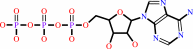 ATP
ATP
|
=
|
5'-end 5'-phospho-2'-deoxyribonucleoside-DNA
|
+
|
 ADP
ADP
|
+
|
H(+)
|
|
|
|
|
|
|
|
|
|
Enzyme class 3:
|
|
Chains A, B, C:
E.C.3.1.3.32
- polynucleotide 3'-phosphatase.
|
|
|
|
|
|
|
Reaction:
|
|
a 3'end (2'-deoxyribonucleotide 3'-phosphate)-DNA + H2O = a 3'-end 2'-deoxyribonucleotide-DNA + phosphate
|
|
|
|
|
|
3'end (2'-deoxyribonucleotide 3'-phosphate)-DNA
|
+
|
H2O
|
=
|
3'-end 2'-deoxyribonucleotide-DNA
|
+
|
phosphate
Bound ligand (Het Group name = )
matches with 45.45% similarity
|
|
|
|
|
|
|
|
|
|
|
|
|
Note, where more than one E.C. class is given (as above), each may
correspond to a different protein domain or, in the case of polyprotein
precursors, to a different mature protein.
|
|
|
|
Molecule diagrams generated from .mol files obtained from the
KEGG ftp site
|
|
|
|
|
|
|
|
|
|
|
|
|
|
 |
|
|
|
|
|
|
| |
|
|
| |
|
DOI no:
|
Mol Cell
17:657-670
(2005)
|
|
PubMed id:
|
|
|
|
|
|
| |
|
The molecular architecture of the mammalian DNA repair enzyme, polynucleotide kinase.
|
|
N.K.Bernstein,
R.S.Williams,
M.L.Rakovszky,
D.Cui,
R.Green,
F.Karimi-Busheri,
R.S.Mani,
S.Galicia,
C.A.Koch,
C.E.Cass,
D.Durocher,
M.Weinfeld,
J.N.Glover.
|
|
|
|
|
| |
ABSTRACT
|
|
|
|
| |
|
|
Mammalian polynucleotide kinase (PNK) is a key component of both the base
excision repair (BER) and nonhomologous end-joining (NHEJ) DNA repair pathways.
PNK acts as a 5'-kinase/3'-phosphatase to create 5'-phosphate/3'-hydroxyl
termini, which are a necessary prerequisite for ligation during repair. PNK is
recruited to repair complexes through interactions between its N-terminal FHA
domain and phosphorylated components of either pathway. Here, we describe the
crystal structure of intact mammalian PNK and a structure of the PNK FHA bound
to a cognate phosphopeptide. The kinase domain has a broad substrate binding
pocket, which preferentially recognizes double-stranded substrates with recessed
5' termini. In contrast, the phosphatase domain efficiently dephosphorylates
single-stranded 3'-phospho termini as well as double-stranded substrates. The
FHA domain is linked to the kinase/phosphatase catalytic domain by a flexible
tether, and it exhibits a mode of target selection based on electrostatic
complementarity between the binding surface and the phosphothreonine peptide.
|
|
|
|
|
|
| |
Selected figure(s)
|
|
|
|
| |
|
|

|
|

|
|
Figure 1.
Figure 1. Structure of Mouse PNK
|
|
Figure 3.
Figure 3. The Kinase Domain
|
|
|
|
|
|
| |
The above figures are
reprinted
by permission from Cell Press:
Mol Cell
(2005,
17,
657-670)
copyright 2005.
|
|
| |
Figures were
selected
by the author.
|
|
|
|
|
|
|
|
|
|
|
|
|
|
|
|
 |
 |
 |
|
Literature references that cite this PDB file's key reference
|
|
|
| |
PubMed id
|
|
Reference
|
|
|
|
|
|
M.J.Schellenberg,
C.D.Appel,
S.Adhikari,
P.D.Robertson,
D.A.Ramsden,
and
R.S.Williams
(2012).
Mechanism of repair of 5'-topoisomerase II-DNA adducts by mammalian tyrosyl-DNA phosphodiesterase 2.
|
| |
Nat Struct Mol Biol,
19,
1363-1371.
|
|
|
PDB codes:
|
|
|
|
|
|
|
|
M.Weinfeld,
R.S.Mani,
I.Abdou,
R.D.Aceytuno,
and
J.N.Glover
(2011).
Tidying up loose ends: the role of polynucleotide kinase/phosphatase in DNA strand break repair.
|
| |
Trends Biochem Sci,
36,
262-271.
|
|
|
|
|
|
|
P.Tumbale,
C.D.Appel,
R.Kraehenbuehl,
P.D.Robertson,
J.S.Williams,
J.Krahn,
I.Ahel,
and
R.S.Williams
(2011).
Structure of an aprataxin-DNA complex with insights into AOA1 neurodegenerative disease.
|
| |
Nat Struct Mol Biol,
18,
1189-1195.
|
|
|
PDB code:
|
|
|
|
|
|
|
|
W.Wu,
H.Hu,
F.Li,
L.Wang,
J.Gao,
J.Lu,
and
C.Fan
(2011).
A graphene oxide-based nano-beacon for DNA phosphorylation analysis.
|
| |
Chem Commun (Camb),
47,
1201-1203.
|
|
|
|
|
|
|
C.Ma,
and
E.S.Yeung
(2010).
Highly sensitive detection of DNA phosphorylation by counting single nanoparticles.
|
| |
Anal Bioanal Chem,
397,
2279-2284.
|
|
|
|
|
|
|
G.K.Freschauf,
R.S.Mani,
T.R.Mereniuk,
M.Fanta,
C.A.Virgen,
G.L.Dianov,
J.M.Grassot,
D.G.Hall,
and
M.Weinfeld
(2010).
Mechanism of action of an imidopiperidine inhibitor of human polynucleotide kinase/phosphatase.
|
| |
J Biol Chem,
285,
2351-2360.
|
|
|
|
|
|
|
G.Y.Li,
R.D.McCulloch,
A.L.Fenton,
M.Cheung,
L.Meng,
M.Ikura,
and
C.A.Koch
(2010).
Structure and identification of ADP-ribose recognition motifs of APLF and role in the DNA damage response.
|
| |
Proc Natl Acad Sci U S A,
107,
9129-9134.
|
|
|
|
|
|
|
J.Shen,
E.C.Gilmore,
C.A.Marshall,
M.Haddadin,
J.J.Reynolds,
W.Eyaid,
A.Bodell,
B.Barry,
D.Gleason,
K.Allen,
V.S.Ganesh,
B.S.Chang,
A.Grix,
R.S.Hill,
M.Topcu,
K.W.Caldecott,
A.J.Barkovich,
and
C.A.Walsh
(2010).
Mutations in PNKP cause microcephaly, seizures and defects in DNA repair.
|
| |
Nat Genet,
42,
245-249.
|
|
|
|
|
|
|
L.K.Wang,
and
S.Shuman
(2010).
Mutational analysis of the 5'-OH oligonucleotide phosphate acceptor site of T4 polynucleotide kinase.
|
| |
Nucleic Acids Res,
38,
1304-1311.
|
|
|
|
|
|
|
M.Lu,
R.S.Mani,
F.Karimi-Busheri,
M.Fanta,
H.Wang,
D.W.Litchfeld,
and
M.Weinfeld
(2010).
Independent mechanisms of stimulation of polynucleotide kinase/phosphatase by phosphorylated and non-phosphorylated XRCC1.
|
| |
Nucleic Acids Res,
38,
510-521.
|
|
|
|
|
|
|
M.R.Lieber
(2010).
The mechanism of double-strand DNA break repair by the nonhomologous DNA end-joining pathway.
|
| |
Annu Rev Biochem,
79,
181-211.
|
|
|
|
|
|
|
O.J.Becherel,
B.Jakob,
A.L.Cherry,
N.Gueven,
M.Fusser,
A.W.Kijas,
C.Peng,
S.Katyal,
P.J.McKinnon,
J.Chen,
B.Epe,
S.J.Smerdon,
G.Taucher-Scholz,
and
M.F.Lavin
(2010).
CK2 phosphorylation-dependent interaction between aprataxin and MDC1 in the DNA damage response.
|
| |
Nucleic Acids Res,
38,
1489-1503.
|
|
|
PDB code:
|
|
|
|
|
|
|
|
P.A.Nair,
P.Smith,
and
S.Shuman
(2010).
Structure of bacterial LigD 3'-phosphoesterase unveils a DNA repair superfamily.
|
| |
Proc Natl Acad Sci U S A,
107,
12822-12827.
|
|
|
PDB codes:
|
|
|
|
|
|
|
|
S.L.Allinson
(2010).
DNA end-processing enzyme polynucleotide kinase as a potential target in the treatment of cancer.
|
| |
Future Oncol,
6,
1031-1042.
|
|
|
|
|
|
|
S.Pennell,
S.Westcott,
M.Ortiz-Lombardía,
D.Patel,
J.Li,
T.J.Nott,
D.Mohammed,
R.S.Buxton,
M.B.Yaffe,
C.Verma,
and
S.J.Smerdon
(2010).
Structural and functional analysis of phosphothreonine-dependent FHA domain interactions.
|
| |
Structure,
18,
1587-1595.
|
|
|
PDB codes:
|
|
|
|
|
|
|
|
T.Ochi,
B.L.Sibanda,
Q.Wu,
D.Y.Chirgadze,
V.M.Bolanos-Garcia,
and
T.L.Blundell
(2010).
Structural biology of DNA repair: spatial organisation of the multicomponent complexes of nonhomologous end joining.
|
| |
J Nucleic Acids,
2010,
0.
|
|
|
|
|
|
|
A.A.Ali,
R.M.Jukes,
L.H.Pearl,
and
A.W.Oliver
(2009).
Specific recognition of a multiply phosphorylated motif in the DNA repair scaffold XRCC1 by the FHA domain of human PNK.
|
| |
Nucleic Acids Res,
37,
1701-1712.
|
|
|
PDB codes:
|
|
|
|
|
|
|
|
B.L.Mahaney,
K.Meek,
and
S.P.Lees-Miller
(2009).
Repair of ionizing radiation-induced DNA double-strand breaks by non-homologous end-joining.
|
| |
Biochem J,
417,
639-650.
|
|
|
|
|
|
|
N.K.Bernstein,
M.Hammel,
R.S.Mani,
M.Weinfeld,
M.Pelikan,
J.A.Tainer,
and
J.N.Glover
(2009).
Mechanism of DNA substrate recognition by the mammalian DNA repair enzyme, Polynucleotide Kinase.
|
| |
Nucleic Acids Res,
37,
6161-6173.
|
|
|
|
|
|
|
R.Jain,
and
S.Shuman
(2009).
Characterization of a thermostable archaeal polynucleotide kinase homologous to human Clp1.
|
| |
RNA,
15,
923-931.
|
|
|
|
|
|
|
R.S.Williams,
G.E.Dodson,
O.Limbo,
Y.Yamada,
J.S.Williams,
G.Guenther,
S.Classen,
J.N.Glover,
H.Iwasaki,
P.Russell,
and
J.A.Tainer
(2009).
Nbs1 flexibly tethers Ctp1 and Mre11-Rad50 to coordinate DNA double-strand break processing and repair.
|
| |
Cell,
139,
87-99.
|
|
|
PDB codes:
|
|
|
|
|
|
|
|
C.C.Lin,
Y.S.Huoh,
K.R.Schmitz,
L.E.Jensen,
and
K.M.Ferguson
(2008).
Pellino proteins contain a cryptic FHA domain that mediates interaction with phosphorylated IRAK1.
|
| |
Structure,
16,
1806-1816.
|
|
|
PDB codes:
|
|
|
|
|
|
|
|
N.K.Bernstein,
F.Karimi-Busheri,
A.Rasouli-Nia,
R.Mani,
G.Dianov,
J.N.Glover,
and
M.Weinfeld
(2008).
Polynucleotide kinase as a potential target for enhancing cytotoxicity by ionizing radiation and topoisomerase I inhibitors.
|
| |
Anticancer Agents Med Chem,
8,
358-367.
|
|
|
|
|
|
|
X.Liang,
and
S.R.Van Doren
(2008).
Mechanistic insights into phosphoprotein-binding FHA domains.
|
| |
Acc Chem Res,
41,
991-999.
|
|
|
|
|
|
|
H.K.Saini,
and
D.Fischer
(2007).
Structural and functional insights into Mimivirus ORFans.
|
| |
BMC Genomics,
8,
115.
|
|
|
|
|
|
|
H.Zhu,
P.Smith,
L.K.Wang,
and
S.Shuman
(2007).
Structure-function analysis of the 3' phosphatase component of T4 polynucleotide kinase/phosphatase.
|
| |
Virology,
366,
126-136.
|
|
|
PDB code:
|
|
|
|
|
|
|
|
N.Iles,
S.Rulten,
S.F.El-Khamisy,
and
K.W.Caldecott
(2007).
APLF (C2orf13) is a novel human protein involved in the cellular response to chromosomal DNA strand breaks.
|
| |
Mol Cell Biol,
27,
3793-3803.
|
|
|
|
|
|
|
N.Keppetipola,
and
S.Shuman
(2007).
Characterization of the 2',3' cyclic phosphodiesterase activities of Clostridium thermocellum polynucleotide kinase-phosphatase and bacteriophage lambda phosphatase.
|
| |
Nucleic Acids Res,
35,
7721-7732.
|
|
|
|
|
|
|
R.S.Mani,
M.Fanta,
F.Karimi-Busheri,
E.Silver,
C.A.Virgen,
K.W.Caldecott,
C.E.Cass,
and
M.Weinfeld
(2007).
XRCC1 stimulates polynucleotide kinase by enhancing its damage discrimination and displacement from DNA repair intermediates.
|
| |
J Biol Chem,
282,
28004-28013.
|
|
|
|
|
|
|
C.J.Dobson,
and
S.L.Allinson
(2006).
The phosphatase activity of mammalian polynucleotide kinase takes precedence over its kinase activity in repair of single strand breaks.
|
| |
Nucleic Acids Res,
34,
2230-2237.
|
|
|
|
|
|
|
E.S.Rangarajan,
A.Proteau,
J.Wagner,
M.N.Hung,
A.Matte,
and
M.Cygler
(2006).
Structural snapshots of Escherichia coli histidinol phosphate phosphatase along the reaction pathway.
|
| |
J Biol Chem,
281,
37930-37941.
|
|
|
PDB codes:
|
|
|
|
|
|
|
|
H.Zhu,
and
S.Shuman
(2006).
Substrate specificity and structure-function analysis of the 3'-phosphoesterase component of the bacterial NHEJ protein, DNA ligase D.
|
| |
J Biol Chem,
281,
13873-13881.
|
|
|
|
|
|
|
N.Keppetipola,
and
S.Shuman
(2006).
Mechanism of the phosphatase component of Clostridium thermocellum polynucleotide kinase-phosphatase.
|
| |
RNA,
12,
73-82.
|
|
|
|
|
|
|
A.Martins,
and
S.Shuman
(2005).
An end-healing enzyme from Clostridium thermocellum with 5' kinase, 2',3' phosphatase, and adenylyltransferase activities.
|
| |
RNA,
11,
1271-1280.
|
|
|
|
|
|
|
H.Zhu,
L.K.Wang,
and
S.Shuman
(2005).
Essential constituents of the 3'-phosphoesterase domain of bacterial DNA ligase D, a nonhomologous end-joining enzyme.
|
| |
J Biol Chem,
280,
33707-33715.
|
|
|
|
|
|
|
R.S.Williams,
N.Bernstein,
M.S.Lee,
M.L.Rakovszky,
D.Cui,
R.Green,
M.Weinfeld,
and
J.N.Glover
(2005).
Structural basis for phosphorylation-dependent signaling in the DNA-damage response.
|
| |
Biochem Cell Biol,
83,
721-727.
|
|
|
|
|
|
The most recent references are shown first.
Citation data come partly from CiteXplore and partly
from an automated harvesting procedure. Note that this is likely to be
only a partial list as not all journals are covered by
either method. However, we are continually building up the citation data
so more and more references will be included with time.
Where a reference describes a PDB structure, the PDB
codes are
shown on the right.
|
 |


 Links
Links


