 |
PDBsum entry 1w8m

|
|
|
|
|
 |
Contents |
 |
|
|
|
|
|
|
|
|
|
|
|
|
* Residue conservation analysis
|
|
|
|
|
|
|
|
|
|
|
Enzyme class:
|
|
E.C.5.2.1.8
- peptidylprolyl isomerase.
|
|
|
|
|
|
|
Reaction:
|
|
[protein]-peptidylproline (omega=180) = [protein]-peptidylproline (omega=0)
|
|
|
|
|
|
 Peptidylproline (omega=180)
|
=
|
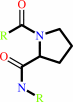 peptidylproline (omega=0)
|
|
|
|
|
|
|
|
|
|
|
|
|
Molecule diagrams generated from .mol files obtained from the
KEGG ftp site
|
|
|
|
|
|
|
|
|
|
|
|
|
|
 |
|
|
|
|
|
|
| |
|
|
| |
|
DOI no:
|
Acta Crystallogr D Biol Crystallogr
60:479-485
(2004)
|
|
PubMed id:
|
|
|
|
|
|
| |
|
Enzymatic and structural characterization of non-peptide ligand-cyclophilin complexes.
|
|
G.Kontopidis,
P.Taylor,
M.D.Walkinshaw.
|
|
|
|
|
| |
ABSTRACT
|
|
|
|
| |
|
|
Piperidine ligands are described that provide the first examples of non-peptidic
ligand structures for the cyclophilin family of proteins. Crystal structures of
two ligand complexes are compared with the unliganded protein and show
ligand-induced changes in side-chain conformation and water binding. A
peptidylprolyl cis-trans-isomerase assay showed the dissociation constants of
the two ligands to be 320 and 25 mM. This study also provides the first
published data for both enzymatic activity and three-dimensional structure for
any protein-ligand complex that binds with a high-millimolar dissociation
constant. The structures may be of relevance in the field of drug design, as
they suggest starting points for the design of larger tighter-binding analogues.
|
|
|
|
|
|
| |
Selected figure(s)
|
|
|
|
| |
|
|

|
|

|
|
Figure 3.
Figure 3 (a) Overlay of native hCypA (cyan) with hCypA-ACMPIP
(atom-type colours). Close contacts between the ACMPIP ligand
with surrounding atoms are shown. ACMPIP makes one hydrogen bond
to Asn102 N (2.8 Å). The most hydrophobic part of the ACMPIP
molecule (the methylpiperidine ring) fits into the hydrophobic
pocket. van der Waals contacts are made from the ligand to the
side chains of six amino acids (Arg55, Phe 60, Met61, Gln63,
Phe113 and His126). (b) Overlay of native hCypA (cyan) with the
hCypA-ETPIPG in both binding modes (ALT2, green; ALT1, purple).
The main difference between the native protein structure and the
structure with ETPIPG in the binding site is the movement of the
side chain of Met61. The overall backbone conformations of the
three structures are very similar. An r.m.s. fit of all protein
atoms except residues 1-4, 67-76 and 162-165 between native and
the ACMPIP complex is 0.286 Å and that between the ACMPIP and
ETPIPG complexes is 0.367 Å.
|
|
Figure 5.
Figure 5 Diagrammatic representation of the major ligand-protein
interactions. Hydrogen bonds are shown as dotted lines. The
hydrophobic pocket is primarily bounded by the side chains of
Phe113 and Phe60, which are shown as green ovals.
|
|
|
|
|
|
| |
The above figures are
reprinted
by permission from the IUCr:
Acta Crystallogr D Biol Crystallogr
(2004,
60,
479-485)
copyright 2004.
|
|
| |
Figures were
selected
by an automated process.
|
|
|
|
|
|
|
|
|
|
|
|
|
|
|
|
 |
 |
 |
|


 Links
Links


