 |
PDBsum entry 1snr

|
|
|
|
|
|

|

|

|

|
|

|
|

|
|

|
|

|
|

|
|

|
|

|
|
|
 |

|

|
|
|
|
|
|
|
|
|
|
|
|
|
|
|
|
|
|
|
|
|
|
|
|
|
|
|
|
|
|
|
|
|
|
|
|
Oxidoreductase
|
PDB id
|
|
|
|
1snr
|
|
|
|
|
|
|
|
|
|
|
|
|
|
|

|

|

|
|
|
|
|
|
|
|
 |
Contents |
 |
|
|
|
|
|
|
|
|
|
|
|
|
|
|
* Residue conservation analysis
|
|
|
|
|
|
|
|
|
|
|
Enzyme class:
|
|
E.C.1.7.2.1
- nitrite reductase (NO-forming).
|
|
|
|
|
|
|
Reaction:
|
|
nitric oxide + Fe(III)-[cytochrome c] + H2O = Fe(II)-[cytochrome c] + nitrite + 2 H+
|
|
|
|
|
|
 nitric oxide
|
+
|
Fe(III)-[cytochrome c]
|
+
|
H2O
Bound ligand (Het Group name = )
corresponds exactly
|
=
|
Fe(II)-[cytochrome c]
|
+
|
 nitrite
|
+
|
2
×
H(+)
|
|
|
|
|
|
|
|
|
|
Cofactor:
|
|
Cu cation or Fe cation; FAD
|
|
|
|
|
|
Cu cation
|
or
|
Fe cation
|
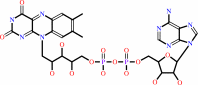 FAD
FAD
|
|
|
|
|
|
|
Molecule diagrams generated from .mol files obtained from the
KEGG ftp site
|
|
|
|
|
|
|
|
|
|
|
|
|
|
 |
|
|
|
|
|
|
| |
|
|
| |
|
DOI no:
|
Science
304:867-870
(2004)
|
|
PubMed id:
|
|
|
|
|
|
| |
|
Side-on copper-nitrosyl coordination by nitrite reductase.
|
|
E.I.Tocheva,
F.I.Rosell,
A.G.Mauk,
M.E.Murphy.
|
|
|
|
|
| |
ABSTRACT
|
|
|
|
| |
|
|
A copper-nitrosyl intermediate forms during the catalytic cycle of nitrite
reductase, the enzyme that mediates the committed step in bacterial
denitrification. The crystal structure of a type 2 copper-nitrosyl complex of
nitrite reductase reveals an unprecedented side-on binding mode in which the
nitrogen and oxygen atoms are nearly equidistant from the copper cofactor.
Comparison of this structure with a refined nitrite-bound crystal structure
explains how coordination can change between copper-oxygen and copper-nitrogen
during catalysis. The side-on copper-nitrosyl in nitrite reductase expands the
possibilities for nitric oxide interactions in copper proteins such as
superoxide dismutase and prions.
|
|
|
|
|
|
| |
Selected figure(s)
|
|
|
|
| |
|
|

|
|

|
|
Figure 1.
Fig. 1. Stereo views of the type 2 Cu sites with (A) bound
nitrite and (B) nitric oxide. In each panel, the electron
density represented in gray is a 2F[o] - F[c] map contoured at
0.55 e^-/Å3 (1.2  for each
structure). Omit difference maps of the nitrite and nitric oxide
ligands are colored in green and contoured at 0.6 e^-/Å3
(5.1 for NO[2]^- and
4.6 for NO). Carbons
(orange), oxygens (red), nitrogens (blue), type 2 Cu (brown),
and waters (cyan) are colored as indicated. (C) Overview of the
essential features of the active sites of NiR bound with nitrite
(left) and with nitric oxide (right). Metal-ligand bonds
(solid), as well as H bonds and other electrostatic interactions
(dashed), are shown as gray lines of the type indicated. for each
structure). Omit difference maps of the nitrite and nitric oxide
ligands are colored in green and contoured at 0.6 e^-/Å3
(5.1 for NO[2]^- and
4.6 for NO). Carbons
(orange), oxygens (red), nitrogens (blue), type 2 Cu (brown),
and waters (cyan) are colored as indicated. (C) Overview of the
essential features of the active sites of NiR bound with nitrite
(left) and with nitric oxide (right). Metal-ligand bonds
(solid), as well as H bonds and other electrostatic interactions
(dashed), are shown as gray lines of the type indicated.
|
|
Figure 3.
Fig. 3. Revised mechanism of Cu-containing nitrite reductase.
|
|
|
|
|
|
| |
The above figures are
reprinted
by permission from the AAAs:
Science
(2004,
304,
867-870)
copyright 2004.
|
|
| |
Figures were
selected
by the author.
|
|
|
|
|
|
|
|
|
|
|
|
|
|
|
|
 |
 |
 |
|
Literature references that cite this PDB file's key reference
|
|
|
| |
PubMed id
|
|
Reference
|
|
|
|
|
|
C.S.Chen,
and
W.Y.Yeh
(2010).
Coordination of NO(2)(-) ligand to Cu(I) ion in an O,O-bidentate fashion that evolves NO gas upon protonation: a model reaction relevant to the denitrification process.
|
| |
Chem Commun (Camb),
46,
3098-3100.
|
|
|
|
|
|
|
G.K.Lahiri,
and
W.Kaim
(2010).
Electronic structure alternatives in nitrosylruthenium complexes.
|
| |
Dalton Trans,
39,
4471-4478.
|
|
|
|
|
|
|
I.S.MacPherson,
F.I.Rosell,
M.Scofield,
A.G.Mauk,
and
M.E.Murphy
(2010).
Directed evolution of copper nitrite reductase to a chromogenic reductant.
|
| |
Protein Eng Des Sel,
23,
137-145.
|
|
|
PDB codes:
|
|
|
|
|
|
|
|
A.K.Boes,
P.S.Wheatley,
B.Xiao,
I.L.Megson,
and
R.E.Morris
(2008).
Simultaneous and cooperative gas storage and gas production using bifunctional zeolites.
|
| |
Chem Commun (Camb),
(),
6146-6148.
|
|
|
|
|
|
|
S.Guo,
J.Boyd,
R.Sammynaiken,
and
M.C.Loewen
(2008).
Identification and characterization of a unique cysteine residue proximal to the catalytic site of Arabidopsis thaliana carotenoid cleavage enzyme 1.
|
| |
Biochem Cell Biol,
86,
262-270.
|
|
|
|
|
|
|
G.Periyasamy,
M.Sundararajan,
I.H.Hillier,
N.A.Burton,
and
J.J.McDouall
(2007).
The binding of nitric oxide at the Cu(i) site of copper nitrite reductase and of inorganic models: DFT calculations of the energetics and EPR parameters of side-on and end-on structures.
|
| |
Phys Chem Chem Phys,
9,
2498-2506.
|
|
|
|
|
|
|
K.Paraskevopoulos,
M.A.Hough,
R.G.Sawers,
R.R.Eady,
and
S.S.Hasnain
(2007).
The structure of the Met144Leu mutant of copper nitrite reductase from Alcaligenes xylosoxidans provides the first glimpse of a protein-protein complex with azurin II.
|
| |
J Biol Inorg Chem,
12,
789-796.
|
|
|
PDB code:
|
|
|
|
|
|
|
|
S.A.De Marothy,
M.R.Blomberg,
and
P.E.Siegbahn
(2007).
Elucidating the mechanism for the reduction of nitrite by copper nitrite reductase--a contribution from quantum chemical studies.
|
| |
J Comput Chem,
28,
528-539.
|
|
|
|
|
|
|
T.Hayashi,
I.J.Lin,
Y.Chen,
J.A.Fee,
and
P.Moënne-Loccoz
(2007).
Fourier transform infrared characterization of a CuB-nitrosyl complex in cytochrome ba3 from Thermus thermophilus: relevance to NO reductase activity in heme-copper terminal oxidases.
|
| |
J Am Chem Soc,
129,
14952-14958.
|
|
|
|
|
|
|
M.Kujime,
and
H.Fujii
(2006).
Spectroscopic characterization of reaction intermediates in a model for copper nitrite reductase.
|
| |
Angew Chem Int Ed Engl,
45,
1089-1092.
|
|
|
|
|
|
|
W.B.Tolman
(2006).
Using synthetic chemistry to understand copper protein active sites: a personal perspective.
|
| |
J Biol Inorg Chem,
11,
261-271.
|
|
|
|
|
|
|
F.Jacobson,
H.Guo,
K.Olesen,
M.Okvist,
R.Neutze,
and
L.Sjölin
(2005).
Structures of the oxidized and reduced forms of nitrite reductase from Rhodobacter sphaeroides 2.4.3 at high pH: changes in the interactions of the type 2 copper.
|
| |
Acta Crystallogr D Biol Crystallogr,
61,
1190-1198.
|
|
|
PDB codes:
|
|
|
|
|
|
|
|
M.T.Gladwin,
A.N.Schechter,
D.B.Kim-Shapiro,
R.P.Patel,
N.Hogg,
S.Shiva,
R.O.Cannon,
M.Kelm,
D.A.Wink,
M.G.Espey,
E.H.Oldfield,
R.M.Pluta,
B.A.Freeman,
J.R.Lancaster,
M.Feelisch,
and
J.O.Lundberg
(2005).
The emerging biology of the nitrite anion.
|
| |
Nat Chem Biol,
1,
308-314.
|
|
|
|
|
|
|
S.V.Antonyuk,
R.W.Strange,
G.Sawers,
R.R.Eady,
and
S.S.Hasnain
(2005).
Atomic resolution structures of resting-state, substrate- and product-complexed Cu-nitrite reductase provide insight into catalytic mechanism.
|
| |
Proc Natl Acad Sci U S A,
102,
12041-12046.
|
|
|
PDB codes:
|
|
|
|
|
|
|
|
V.M.Iluc,
A.J.Miller,
and
G.L.Hillhouse
(2005).
Synthesis and characterization of side-bound aryldiazo and end-bound nitrosyl complexes of nickel.
|
| |
Chem Commun (Camb),
(),
5091-5093.
|
|
|
|
|
|
|
Z.Huang,
S.Shiva,
D.B.Kim-Shapiro,
R.P.Patel,
L.A.Ringwood,
C.E.Irby,
K.T.Huang,
C.Ho,
N.Hogg,
A.N.Schechter,
and
M.T.Gladwin
(2005).
Enzymatic function of hemoglobin as a nitrite reductase that produces NO under allosteric control.
|
| |
J Clin Invest,
115,
2099-2107.
|
|
|
|
|
|
|
O.Einsle,
and
P.M.Kroneck
(2004).
Structural basis of denitrification.
|
| |
Biol Chem,
385,
875-883.
|
|
|
|
|
|
|
Y.Xie,
T.Inoue,
N.Seike,
H.Matsumura,
K.Kanbayashi,
K.Itoh,
K.Kataoka,
K.Yamaguchi,
S.Suzuki,
and
Y.Kai
(2004).
Crystallization and preliminary X-ray crystallographic studies of dissimilatory nitrite reductase isolated from Hyphomicrobium denitrificans A3151.
|
| |
Acta Crystallogr D Biol Crystallogr,
60,
2383-2386.
|
|
|
|
|
|
The most recent references are shown first.
Citation data come partly from CiteXplore and partly
from an automated harvesting procedure. Note that this is likely to be
only a partial list as not all journals are covered by
either method. However, we are continually building up the citation data
so more and more references will be included with time.
Where a reference describes a PDB structure, the PDB
codes are
shown on the right.
|
|


 Links
Links


