 |
PDBsum entry 1m9a

|
|
|
|
|
 |
Contents |
 |
|
|
|
|
|
|
|
|
|
|
|
|
* Residue conservation analysis
|
|
|
|
|
|
|
|
|
|
|
Enzyme class:
|
|
E.C.2.5.1.18
- glutathione transferase.
|
|
|
|
|
|
|
Reaction:
|
|
RX + glutathione = an S-substituted glutathione + a halide anion + H+
|
|
|
|
|
|
RX
Bound ligand (Het Group name = )
matches with 76.92% similarity
|
+
|
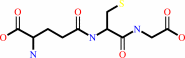 glutathione
|
=
|
S-substituted glutathione
|
+
|
halide anion
|
+
|
H(+)
|
|
|
|
|
|
|
|
|
|
|
|
|
Molecule diagrams generated from .mol files obtained from the
KEGG ftp site
|
|
|
|
|
|
|
|
|
|
|
|
|
|
 |
|
|
|
|
|
|
| |
|
|
| |
|
DOI no:
|
Proteins
51:137-146
(2003)
|
|
PubMed id:
|
|
|
|
|
|
| |
|
Characterization of the electrophile binding site and substrate binding mode of the 26-kDa glutathione S-transferase from Schistosoma japonicum.
|
|
R.M.Cardoso,
D.S.Daniels,
C.M.Bruns,
J.A.Tainer.
|
|
|
|
|
| |
ABSTRACT
|
|
|
|
| |
|
|
The 26-kDa glutathione S-transferase from Schistosoma japonicum (Sj26GST), a
helminth worm that causes schistosomiasis, catalyzes the conjugation of
glutathione with toxic secondary products of membrane lipid peroxidation.
Crystal structures of Sj26GST in complex with glutathione sulfonate
(Sj26GSTSLF), S-hexyl glutathione (Sj26GSTHEX), and S-2-iodobenzyl glutathione
(Sj26GSTIBZ) allow characterization of the electrophile binding site (H site) of
Sj26GST. The S-hexyl and S-2-iodobenzyl moieties of these product analogs bind
in a pocket defined by side-chains from the beta1-alpha1 loop (Tyr7, Trp8,
Ile10, Gly12, Leu13), helix alpha4 (Arg103, Tyr104, Ser107, Tyr111), and the
C-terminal coil (Gln204, Gly205, Trp206, Gln207). Changes in the Ser107 and
Gln204 dihedral angles make the H site more hydrophobic in the Sj26GSTHEX
complex relative to the ligand-free structure. These structures, together with
docking studies, indicate a possible binding mode of Sj26GST to its physiologic
substrates 4-hydroxynon-2-enal (4HNE), trans-non-2-enal (NE), and ethacrynic
acid (EA). In this binding mode, hydrogen bonds of Tyr111 and Gln207 to the
carbonyl oxygen atoms of 4HNE, NE, and EA could orient the substrates and
enhance their electrophilicity to promote conjugation with glutathione.
|
|
|
|
|
|
| |
Selected figure(s)
|
|
|
|
| |
|
|

|
|

|
|
Figure 1.
Figure 1. Binding of product analogs to the H and G sites of
Sj26GST.  A-weighted
Fo - Fc electron density, contoured at 3.0 ,
is shown for the ligands (glutathione in brown, S-hexyl and
S-2-iodobenzyl in yellow). Functionally important H site
residues are shown in purple. (A) Glutathione sulfonate. Tyr7
and a water molecule participate in a hydrogen bond with the
sulfonate. (B) S-hexyl glutathione. Tyr7, Gly12, Leu13, Arg103,
Ser107, Tyr111, and Gln204 participate in the S-hexyl moiety
binding to the H site. (C) S-2-Iodobenzyl glutathione. Tyr7,
Leu13, Ser107, and Tyr111 participate in binding the
2-iodobenzyl moiety at the H site. A-weighted
Fo - Fc electron density, contoured at 3.0 ,
is shown for the ligands (glutathione in brown, S-hexyl and
S-2-iodobenzyl in yellow). Functionally important H site
residues are shown in purple. (A) Glutathione sulfonate. Tyr7
and a water molecule participate in a hydrogen bond with the
sulfonate. (B) S-hexyl glutathione. Tyr7, Gly12, Leu13, Arg103,
Ser107, Tyr111, and Gln204 participate in the S-hexyl moiety
binding to the H site. (C) S-2-Iodobenzyl glutathione. Tyr7,
Leu13, Ser107, and Tyr111 participate in binding the
2-iodobenzyl moiety at the H site.
|
|
Figure 3.
Figure 3. Superposition of the Sj26GST and hGST A4-4 H sites.
Functionally important H site residues of Sj26GST (pink trace
and yellow side-chains) and hGST A4-4 (blue trace pink and green
side-chains) are shown. The C-terminal coil of Sj26GST adopts an
 -helical
structure in A4-4. -helical
structure in A4-4.
|
|
|
|
|
|
| |
The above figures are
reprinted
by permission from John Wiley & Sons, Inc.:
Proteins
(2003,
51,
137-146)
copyright 2003.
|
|
| |
Figures were
selected
by an automated process.
|
|
|
|
|
|
|
|
|
|
|
|
|
|
|
|
 |
 |
 |
|
Literature references that cite this PDB file's key reference
|
|
|
| |
PubMed id
|
|
Reference
|
|
|
|
|
|
V.T.Bhat,
A.M.Caniard,
T.Luksch,
R.Brenk,
D.J.Campopiano,
and
M.F.Greaney
(2010).
Nucleophilic catalysis of acylhydrazone equilibration for protein-directed dynamic covalent chemistry.
|
| |
Nat Chem,
2,
490-497.
|
|
|
|
|
|
|
X.Chen,
J.Liu,
P.Yang,
and
D.Chen
(2010).
Identifying functional residues in arabidopsis thaliana zeta class glutathione S-transferase through screening inactive point mutants.
|
| |
Biochemistry (Mosc),
75,
110-120.
|
|
|
|
|
|
|
V.Kasam,
J.Salzemann,
M.Botha,
A.Dacosta,
G.Degliesposti,
R.Isea,
D.Kim,
A.Maass,
C.Kenyon,
G.Rastelli,
M.Hofmann-Apitius,
and
V.Breton
(2009).
WISDOM-II: Screening against multiple targets implicated in malaria using computational grid infrastructures.
|
| |
Malar J,
8,
88.
|
|
|
|
|
|
|
E.H.Jang,
H.Park,
A.K.Park,
J.H.Moon,
Y.M.Chi,
and
I.Y.Ahn
(2008).
Crystallization and preliminary X-ray crystallographic studies of the rho-class glutathione S-transferase from the Antarctic clam Laternula elliptica.
|
| |
Acta Crystallogr Sect F Struct Biol Cryst Commun,
64,
1132-1134.
|
|
|
|
|
|
|
Y.Tanaka,
Y.Tsuruda,
M.Nishi,
N.Kamiya,
and
M.Goto
(2007).
Exploring enzymatic catalysis at a solid surface: a case study with transglutaminase-mediated protein immobilization.
|
| |
Org Biomol Chem,
5,
1764-1770.
|
|
|
|
|
|
|
A.C.Rufer,
L.Thiebach,
K.Baer,
H.W.Klein,
and
M.Hennig
(2005).
X-ray structure of glutathione S-transferase from Schistosoma japonicum in a new crystal form reveals flexibility of the substrate-binding site.
|
| |
Acta Crystallogr Sect F Struct Biol Cryst Commun,
61,
263-265.
|
|
|
PDB code:
|
|
|
|
|
|
|
|
M.Perbandt,
C.Burmeister,
R.D.Walter,
C.Betzel,
and
E.Liebau
(2004).
Native and inhibited structure of a Mu class-related glutathione S-transferase from Plasmodium falciparum.
|
| |
J Biol Chem,
279,
1336-1342.
|
|
|
PDB codes:
|
|
|
|
|
|
|
The most recent references are shown first.
Citation data come partly from CiteXplore and partly
from an automated harvesting procedure. Note that this is likely to be
only a partial list as not all journals are covered by
either method. However, we are continually building up the citation data
so more and more references will be included with time.
Where a reference describes a PDB structure, the PDB
code is
shown on the right.
|
|


 Links
Links


