 |
PDBsum entry 1gsq

|
|
|
|
|
 |
Contents |
 |
|
|
|
|
|
|
|
|
|
|
|
|
* Residue conservation analysis
|
|
|
|
|
|
PDB id:
|
|
|
|
| Name: |
|
Transferase
|
|
|
Title:
|
|
Three-dimensional structure, catalytic properties and evolution of a sigma class glutathione transferase from squid, a progenitor of the lens-crystallins of cephalopods
|
|
Structure:
|
|
Glutathione s-transferase. Chain: a. Engineered: yes
|
|
Source:
|
|
Ommastrephes sloani pacificus. Organism_taxid: 6634. Strain: pacificus. Organ: digestive gland. Gene: cdna insert of clone pgst5. Expressed in: escherichia coli. Expression_system_taxid: 562.
|
|
Biol. unit:
|
|
 Dimer (from
)
Dimer (from
)
|
|
Resolution:
|
|
|
|
Authors:
|
|
X.Ji,E.C.V.Rosenvinge,R.N.Armstrong,G.L.Gilliland
|
Key ref:

|
|
X.Ji
et al.
(1995).
Three-dimensional structure, catalytic properties, and evolution of a sigma class glutathione transferase from squid, a progenitor of the lens S-crystallins of cephalopods.
Biochemistry,
34,
5317-5328.
PubMed id:
|
|
|
Date:
|
|
|
09-Jan-95
|
Release date:
|
03-Jun-95
|
|
|
|
|
|
|
PROCHECK
|

|
|
|
|
|
Headers
|
|
|
|
References
|
|
|
|
|
|

|
|
P46088
(GST_NOTSL) -
Glutathione S-transferase from Nototodarus sloanii
|
|
|
|
Seq:
Struc:
|
|
|
|
203 a.a.
202 a.a.
|
|

|

|
|
|
|
|
|
|
|
|
|
|
|
Key: |
|
 |
Secondary structure |
|
 |
CATH domain |
|
|
|
|
|
|
|
|
|
|
|
|
|
Enzyme class:
|
|
E.C.2.5.1.18
- glutathione transferase.
|
|
|
|
|
|
|
Reaction:
|
|
RX + glutathione = an S-substituted glutathione + a halide anion + H+
|
|
|
|
|
|
RX
Bound ligand (Het Group name = )
matches with 62.50% similarity
|
+
|
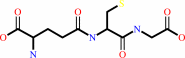 glutathione
|
=
|
S-substituted glutathione
|
+
|
halide anion
|
+
|
H(+)
|
|
|
|
|
|
|
|
|
|
|
|
|
Molecule diagrams generated from .mol files obtained from the
KEGG ftp site
|
|
|
|
|
|
|
|
|
|
|
|
|
|
 |
|
|
|
|
|
|
| |
|
|
| |
|
|
Biochemistry
34:5317-5328
(1995)
|
|
PubMed id:
|
|
|
|
|
|
| |
|
Three-dimensional structure, catalytic properties, and evolution of a sigma class glutathione transferase from squid, a progenitor of the lens S-crystallins of cephalopods.
|
|
X.Ji,
E.C.von Rosenvinge,
W.W.Johnson,
S.I.Tomarev,
J.Piatigorsky,
R.N.Armstrong,
G.L.Gilliland.
|
|
|
|
|
| |
ABSTRACT
|
|
|
|
| |
|
|
The glutathione transferase from squid digestive gland is unique in its very
high catalytic activity toward 1-chloro-2,4-dinitrobenzene and in its ancestral
relationship to the genes encoding the S-crystallins of the lens of cephalopod
eye. The three-dimensional structure of this glutathione transferase in complex
with the product 1-(S-glutathionyl)-2,4-dinitrobenzene (GSDNB) has been solved
by multiple isomorphous replacement techniques at a resolution of 2.4 A. Like
the cytosolic enzymes from vertebrates, the squid protein is a dimer. The
structure is similar in overall topology to the vertebrate enzymes but has a
dimer interface that is unique when compared to all of the vertebrate and
invertebrate structures thus far reported. The active site of the enzyme is very
open, a fact that appears to correlate with the high turnover number (800 s-1 at
pH 6.5) toward 1-chloro-2,4-dinitrobenzene. Both kcat and kcat/KmCDNB exhibit pH
dependencies consistent with a pKa for the thiol of enzyme-bound GSH of 6.3. The
enzyme is not very efficient at catalyzing the addition of GSH to enones and
epoxides. This particular characteristic appears to be due to the lack of an
electrophilic residue at position 106, which is often found in other GSH
transferases. The F106Y mutant enzyme is much improved in catalyzing these
reactions. Comparisons of the primary structure, gene structure, and
three-dimensional structure with class alpha, mu, and pi enzymes support placing
the squid protein in a separate enzyme class, sigma. The unique dimer interface
suggests that the class sigma enzyme diverged from the ancestral precursor prior
to the divergence of the precursor gene for the alpha, mu, and pi classes.
|
|
|
|
|
|
|
|
|
|
|
|
|
|
|
|
|
|
 |
 |
 |
|
Literature references that cite this PDB file's key reference
|
|
|
| |
PubMed id
|
|
Reference
|
|
|
|
|
|
A.Oakley
(2011).
Glutathione transferases: a structural perspective.
|
| |
Drug Metab Rev,
43,
138-151.
|
|
|
|
|
|
|
J.U.Flanagan,
and
M.L.Smythe
(2011).
Sigma-class glutathione transferases.
|
| |
Drug Metab Rev,
43,
194-214.
|
|
|
|
|
|
|
J.Wongsantichon,
R.C.Robinson,
and
A.J.Ketterman
(2010).
Structural contributions of delta class glutathione transferase active-site residues to catalysis.
|
| |
Biochem J,
428,
25-32.
|
|
|
PDB codes:
|
|
|
|
|
|
|
|
C.Abad-Zapatero
(2009).
Notes of a protein crystallographer: the molecular structure of evolutionary theory.
|
| |
Acta Crystallogr D Biol Crystallogr,
65,
1341-1349.
|
|
|
|
|
|
|
A.M.Sweeney,
D.L.Des Marais,
Y.E.Ban,
and
S.Johnsen
(2007).
Evolution of graded refractive index in squid lenses.
|
| |
J R Soc Interface,
4,
685-698.
|
|
|
|
|
|
|
B.Blanchette,
X.Feng,
and
B.R.Singh
(2007).
Marine glutathione S-transferases.
|
| |
Mar Biotechnol (NY),
9,
513-542.
|
|
|
|
|
|
|
S.Zheng,
H.Deng,
T.Ladd,
B.L.Tomkins,
P.J.Krell,
and
Q.Feng
(2007).
Cloning and characterization of two glutathione S-transferase cDNAs in the spruce budworm, Choristoneura fumiferana.
|
| |
Arch Insect Biochem Physiol,
66,
146-157.
|
|
|
|
|
|
|
D.Zhang,
H.Lu,
J.Li,
X.Shi,
and
C.Huang
(2006).
Essential roles of ERKs and p38K in up-regulation of GST A1 expression by Maotai content in human hepatoma cell line Hep3B.
|
| |
Mol Cell Biochem,
293,
161-171.
|
|
|
|
|
|
|
R.Téllez-Sanz,
E.Cesareo,
M.Nuccetelli,
A.M.Aguilera,
C.Barón,
L.J.Parker,
J.J.Adams,
C.J.Morton,
M.Lo Bello,
M.W.Parker,
and
L.García-Fuentes
(2006).
Calorimetric and structural studies of the nitric oxide carrier S-nitrosoglutathione bound to human glutathione transferase P1-1.
|
| |
Protein Sci,
15,
1093-1105.
|
|
|
PDB codes:
|
|
|
|
|
|
|
|
T.Watanabe,
Y.Ohashi,
T.Kosaka,
S.Arakawa,
Y.Shibaya,
T.Yamoto,
S.Manabe,
and
W.Takasaki
(2006).
Expression of the theta class GST isozyme, YdfYdf, in low GST dogs.
|
| |
Arch Toxicol,
80,
250-257.
|
|
|
|
|
|
|
A.M.Hansen,
Y.Gu,
M.Li,
M.Andrykovitch,
D.S.Waugh,
D.J.Jin,
and
X.Ji
(2005).
Structural basis for the function of stringent starvation protein a as a transcription factor.
|
| |
J Biol Chem,
280,
17380-17391.
|
|
|
PDB code:
|
|
|
|
|
|
|
|
B.Naso,
D.Perrone,
M.C.Ferrante,
M.Bilancione,
and
A.Lucisano
(2005).
Persistent organic pollutants in edible marine species from the Gulf of Naples, Southern Italy.
|
| |
Sci Total Environ,
343,
83-95.
|
|
|
|
|
|
|
J.Li,
Z.Xia,
and
J.Ding
(2005).
Thioredoxin-like domain of human kappa class glutathione transferase reveals sequence homology and structure similarity to the theta class enzyme.
|
| |
Protein Sci,
14,
2361-2369.
|
|
|
PDB code:
|
|
|
|
|
|
|
|
A.Arif,
P.Vasanthi,
I.A.Hansen,
K.Scheller,
and
A.Dutta-Gupta
(2004).
The insect hemolymph protein HP19 mediates the nongenomic effect of ecdysteroids on acid phosphatase activity.
|
| |
J Biol Chem,
279,
28000-28008.
|
|
|
|
|
|
|
L.A.Ralat,
and
R.F.Colman
(2004).
Glutathione S-transferase Pi has at least three distinguishable xenobiotic substrate sites close to its glutathione-binding site.
|
| |
J Biol Chem,
279,
50204-50213.
|
|
|
|
|
|
|
A.Pennelli,
P.Sacchetta,
C.Catitti,
F.Amicarelli,
and
C.Di Ilio
(2003).
Effects of glutathione on kinetics and structural properties of amphibian BbGSTP1-1.
|
| |
Int J Biochem Cell Biol,
35,
415-421.
|
|
|
|
|
|
|
M.G.Jeppesen,
P.Ortiz,
W.Shepard,
T.G.Kinzy,
J.Nyborg,
and
G.R.Andersen
(2003).
The crystal structure of the glutathione S-transferase-like domain of elongation factor 1Bgamma from Saccharomyces cerevisiae.
|
| |
J Biol Chem,
278,
47190-47198.
|
|
|
PDB code:
|
|
|
|
|
|
|
|
R.M.Cardoso,
D.S.Daniels,
C.M.Bruns,
and
J.A.Tainer
(2003).
Characterization of the electrophile binding site and substrate binding mode of the 26-kDa glutathione S-transferase from Schistosoma japonicum.
|
| |
Proteins,
51,
137-146.
|
|
|
PDB codes:
|
|
|
|
|
|
|
|
B.Dainelli,
D.Paludi,
B.Dragani,
R.Cocco,
D.R.Principe,
M.Petrucci,
F.Mucilli,
A.Faraone,
and
A.Aceto
(2002).
A novel glutathione transferase from Haemophilus influenzae which has high affinity towards antibiotics.
|
| |
Int J Biochem Cell Biol,
34,
916-920.
|
|
|
|
|
|
|
A.J.Oakley,
K.Jirajaroenrat,
T.Harnnoi,
A.J.Ketterman,
and
M.C.Wilce
(2001).
Crystallization of two glutathione S-transferases from an unusual gene family.
|
| |
Acta Crystallogr D Biol Crystallogr,
57,
870-872.
|
|
|
|
|
|
|
A.J.Oakley,
T.Harnnoi,
R.Udomsinprasert,
K.Jirajaroenrat,
A.J.Ketterman,
and
M.C.Wilce
(2001).
The crystal structures of glutathione S-transferases isozymes 1-3 and 1-4 from Anopheles dirus species B.
|
| |
Protein Sci,
10,
2176-2185.
|
|
|
PDB codes:
|
|
|
|
|
|
|
|
A.Sommer,
M.Nimtz,
H.S.Conradt,
N.Brattig,
K.Boettcher,
P.Fischer,
R.D.Walter,
and
E.Liebau
(2001).
Structural analysis and antibody response to the extracellular glutathione S-transferases from Onchocerca volvulus.
|
| |
Infect Immun,
69,
7718-7728.
|
|
|
|
|
|
|
B.Agianian,
J.D.Clayton,
K.Leonard,
P.Tucker,
B.Bullard,
and
P.Gros
(2001).
Crystallization and preliminary X-ray analysis of Drosophila glutathione S-transferase-2.
|
| |
Acta Crystallogr D Biol Crystallogr,
57,
725-727.
|
|
|
|
|
|
|
C.J.Cha,
B.F.Coles,
and
C.E.Cerniglia
(2001).
Purification and characterization of a glutathione S-transferase from the fungus Cunninghamella elegans.
|
| |
FEMS Microbiol Lett,
203,
257-261.
|
|
|
|
|
|
|
E.Ortiz-Salmerón,
Z.Yassin,
M.J.Clemente-Jimenez,
F.J.Las Heras-Vazquez,
F.Rodriguez-Vico,
C.Barón,
and
L.García-Fuentes
(2001).
Thermodynamic analysis of the binding of glutathione to glutathione S-transferase over a range of temperatures.
|
| |
Eur J Biochem,
268,
4307-4314.
|
|
|
|
|
|
|
G.Polekhina,
P.G.Board,
A.C.Blackburn,
and
M.W.Parker
(2001).
Crystal structure of maleylacetoacetate isomerase/glutathione transferase zeta reveals the molecular basis for its remarkable catalytic promiscuity.
|
| |
Biochemistry,
40,
1567-1576.
|
|
|
PDB code:
|
|
|
|
|
|
|
|
S.P.Singh,
J.A.Coronella,
H.Benes,
B.J.Cochrane,
and
P.Zimniak
(2001).
Catalytic function of Drosophila melanogaster glutathione S-transferase DmGSTS1-1 (GST-2) in conjugation of lipid peroxidation end products.
|
| |
Eur J Biochem,
268,
2912-2923.
|
|
|
|
|
|
|
T.C.Umland,
K.L.Taylor,
S.Rhee,
R.B.Wickner,
and
D.R.Davies
(2001).
The crystal structure of the nitrogen regulation fragment of the yeast prion protein Ure2p.
|
| |
Proc Natl Acad Sci U S A,
98,
1459-1464.
|
|
|
PDB code:
|
|
|
|
|
|
|
|
C.Micaloni,
A.P.Mazzetti,
M.Nuccetelli,
J.Rossjohn,
W.J.McKinstry,
G.Antonini,
A.M.Caccuri,
A.J.Oakley,
G.Federici,
G.Ricci,
M.W.Parker,
and
M.Lo Bello
(2000).
Valine 10 may act as a driver for product release from the active site of human glutathione transferase P1-1.
|
| |
Biochemistry,
39,
15961-15970.
|
|
|
|
|
|
|
H.C.Chang,
T.L.Lin,
and
G.G.Chang
(2000).
Molecular basis for the polymerization of octopus lens S-crystallin.
|
| |
Biophys J,
78,
2070-2080.
|
|
|
|
|
|
|
J.U.Flanagan,
W.King,
M.W.Parker,
P.G.Board,
and
G.Chelvanayagam
(2000).
Ab initio calculations on hidden modulators of theta class glutathione transferase activity.
|
| |
Proteins,
39,
235-243.
|
|
|
|
|
|
|
J.Wang,
S.Bauman,
and
R.F.Colman
(2000).
Probing subunit interactions in alpha class rat liver glutathione S-transferase with the photoaffinity label glutathionyl S-[4-(succinimidyl)benzophenone].
|
| |
J Biol Chem,
275,
5493-5503.
|
|
|
|
|
|
|
C.C.Chuang,
S.H.Wu,
S.H.Chiou,
and
G.G.Chang
(1999).
Homology modeling of cephalopod lens S-crystallin: a natural mutant of sigma-class glutathione transferase with diminished endogenous activity.
|
| |
Biophys J,
76,
679-690.
|
|
|
|
|
|
|
H.W.Dirr,
and
L.A.Wallace
(1999).
Role of the C-terminal helix 9 in the stability and ligandin function of class alpha glutathione transferase A1-1.
|
| |
Biochemistry,
38,
15631-15640.
|
|
|
|
|
|
|
L.A.Wallace,
and
H.W.Dirr
(1999).
Folding and assembly of dimeric human glutathione transferase A1-1.
|
| |
Biochemistry,
38,
16686-16694.
|
|
|
|
|
|
|
J.M.Stevens,
J.A.Hornby,
R.N.Armstrong,
and
H.W.Dirr
(1998).
Class sigma glutathione transferase unfolds via a dimeric and a monomeric intermediate: impact of subunit interface on conformational stability in the superfamily.
|
| |
Biochemistry,
37,
15534-15541.
|
|
|
|
|
|
|
J.Rossjohn,
W.J.McKinstry,
A.J.Oakley,
D.Verger,
J.Flanagan,
G.Chelvanayagam,
K.L.Tan,
P.G.Board,
and
M.W.Parker
(1998).
Human theta class glutathione transferase: the crystal structure reveals a sulfate-binding pocket within a buried active site.
|
| |
Structure,
6,
309-322.
|
|
|
PDB codes:
|
|
|
|
|
|
|
|
J.U.Flanagan,
J.Rossjohn,
M.W.Parker,
P.G.Board,
and
G.Chelvanayagam
(1998).
A homology model for the human theta-class glutathione transferase T1-1.
|
| |
Proteins,
33,
444-454.
|
|
|
|
|
|
|
J.Wang,
S.Bauman,
and
R.F.Colman
(1998).
Photoaffinity labeling of rat liver glutathione S-transferase, 4-4, by glutathionyl S-[4-(succinimidyl)-benzophenone].
|
| |
Biochemistry,
37,
15671-15679.
|
|
|
|
|
|
|
L.A.Wallace,
N.Sluis-Cremer,
and
H.W.Dirr
(1998).
Equilibrium and kinetic unfolding properties of dimeric human glutathione transferase A1-1.
|
| |
Biochemistry,
37,
5320-5328.
|
|
|
|
|
|
|
L.Stella,
A.M.Caccuri,
N.Rosato,
M.Nicotra,
M.Lo Bello,
F.De Matteis,
A.P.Mazzetti,
G.Federici,
and
G.Ricci
(1998).
Flexibility of helix 2 in the human glutathione transferase P1-1. time-resolved fluorescence spectroscopy.
|
| |
J Biol Chem,
273,
23267-23273.
|
|
|
|
|
|
|
M.Nicotra,
M.Paci,
M.Sette,
A.J.Oakley,
M.W.Parker,
M.Lo Bello,
A.M.Caccuri,
G.Federici,
and
G.Ricci
(1998).
Solution structure of glutathione bound to human glutathione transferase P1-1: comparison of NMR measurements with the crystal structure.
|
| |
Biochemistry,
37,
3020-3027.
|
|
|
|
|
|
|
W.J.McKinstry,
A.J.Oakley,
J.Rossjohn,
D.Verger,
K.L.Tan,
P.G.Board,
and
M.W.Parker
(1998).
Preliminary X-ray crystallographic studies of a newly defined human theta-class glutathione transferase.
|
| |
Acta Crystallogr D Biol Crystallogr,
54,
148-150.
|
|
|
|
|
|
|
A.J.Oakley,
J.Rossjohn,
M.Lo Bello,
A.M.Caccuri,
G.Federici,
and
M.W.Parker
(1997).
The three-dimensional structure of the human Pi class glutathione transferase P1-1 in complex with the inhibitor ethacrynic acid and its glutathione conjugate.
|
| |
Biochemistry,
36,
576-585.
|
|
|
PDB codes:
|
|
|
|
|
|
|
|
A.M.Caccuri,
G.Antonini,
M.Nicotra,
A.Battistoni,
M.Lo Bello,
P.G.Board,
M.W.Parker,
and
G.Ricci
(1997).
Catalytic mechanism and role of hydroxyl residues in the active site of theta class glutathione S-transferases. Investigation of Ser-9 and Tyr-113 in a glutathione S-transferase from the Australian sheep blowfly, Lucilia cuprina.
|
| |
J Biol Chem,
272,
29681-29686.
|
|
|
|
|
|
|
A.Marsh,
and
D.M.Ferguson
(1997).
Knowledge-based modeling of a bacterial dichloromethane dehalogenase.
|
| |
Proteins,
28,
217-226.
|
|
|
|
|
|
|
A.Vlamis-Gardikas,
F.Aslund,
G.Spyrou,
T.Bergman,
and
A.Holmgren
(1997).
Cloning, overexpression, and characterization of glutaredoxin 2, an atypical glutaredoxin from Escherichia coli.
|
| |
J Biol Chem,
272,
11236-11243.
|
|
|
|
|
|
|
G.Chelvanayagam,
M.C.Wilce,
M.W.Parker,
K.L.Tan,
and
P.G.Board
(1997).
Homology model for the human GSTT2 Theta class glutathione transferase.
|
| |
Proteins,
27,
118-130.
|
|
|
|
|
|
|
L.Prade,
P.Hof,
and
B.Bieseler
(1997).
Dimer interface of glutathione S-transferase from Arabidopsis thaliana: influence of the G-site architecture on the dimer interface and implications for classification.
|
| |
Biol Chem,
378,
317-320.
|
|
|
|
|
|
|
L.Prade,
R.Huber,
T.H.Manoharan,
W.E.Fahl,
and
W.Reuter
(1997).
Structures of class pi glutathione S-transferase from human placenta in complex with substrate, transition-state analogue and inhibitor.
|
| |
Structure,
5,
1287-1295.
|
|
|
PDB codes:
|
|
|
|
|
|
|
|
M.Kuge,
Y.Fujii,
T.Shimizu,
F.Hirose,
A.Matsukage,
and
T.Hakoshima
(1997).
Use of a fusion protein to obtain crystals suitable for X-ray analysis: crystallization of a GST-fused protein containing the DNA-binding domain of DNA replication-related element-binding factor, DREF.
|
| |
Protein Sci,
6,
1783-1786.
|
|
|
|
|
|
|
M.Lo Bello,
A.J.Oakley,
A.Battistoni,
A.P.Mazzetti,
M.Nuccetelli,
G.Mazzarese,
J.Rossjohn,
M.W.Parker,
and
G.Ricci
(1997).
Multifunctional role of Tyr 108 in the catalytic mechanism of human glutathione transferase P1-1. Crystallographic and kinetic studies on the Y108F mutant enzyme.
|
| |
Biochemistry,
36,
6207-6217.
|
|
|
PDB code:
|
|
|
|
|
|
|
|
R.T.Koehler,
H.O.Villar,
K.E.Bauer,
and
D.L.Higgins
(1997).
Ligand-based protein alignment and isozyme specificity of glutathione S-transferase inhibitors.
|
| |
Proteins,
28,
202-216.
|
|
|
|
|
|
|
W.Kaplan,
P.Hüsler,
H.Klump,
J.Erhardt,
N.Sluis-Cremer,
and
H.Dirr
(1997).
Conformational stability of pGEX-expressed Schistosoma japonicum glutathione S-transferase: a detoxification enzyme and fusion-protein affinity tag.
|
| |
Protein Sci,
6,
399-406.
|
|
|
|
|
|
|
X.Ji,
M.Tordova,
R.O'Donnell,
J.F.Parsons,
J.B.Hayden,
G.L.Gilliland,
and
P.Zimniak
(1997).
Structure and function of the xenobiotic substrate-binding site and location of a potential non-substrate-binding site in a class pi glutathione S-transferase.
|
| |
Biochemistry,
36,
9690-9702.
|
|
|
PDB codes:
|
|
|
|
|
|
|
|
G.Xiao,
S.Liu,
X.Ji,
W.W.Johnson,
J.Chen,
J.F.Parsons,
W.J.Stevens,
G.L.Gilliland,
and
R.N.Armstrong
(1996).
First-sphere and second-sphere electrostatic effects in the active site of a class mu gluthathione transferase.
|
| |
Biochemistry,
35,
4753-4765.
|
|
|
PDB codes:
|
|
|
|
|
|
|
|
H.W.Sun,
J.Bernhagen,
R.Bucala,
and
E.Lolis
(1996).
Crystal structure at 2.6-A resolution of human macrophage migration inhibitory factor.
|
| |
Proc Natl Acad Sci U S A,
93,
5191-5196.
|
|
|
PDB code:
|
|
|
|
|
|
|
|
J.Wang,
J.J.Barycki,
and
R.F.Colman
(1996).
Tyrosine 8 contributes to catalysis but is not required for activity of rat liver glutathione S-transferase, 1-1.
|
| |
Protein Sci,
5,
1032-1042.
|
|
|
|
|
|
|
N.Sluis-Cremer,
N.N.Naidoo,
W.H.Kaplan,
T.H.Manoharan,
W.E.Fahl,
and
H.W.Dirr
(1996).
Determination of a binding site for a non-substrate ligand in mammalian cytosolic glutathione S-transferases by means of fluorescence-resonance energy transfer.
|
| |
Eur J Biochem,
241,
484-488.
|
|
|
|
|
|
|
S.I.Tomarev,
and
J.Piatigorsky
(1996).
Lens crystallins of invertebrates--diversity and recruitment from detoxification enzymes and novel proteins.
|
| |
Eur J Biochem,
235,
449-465.
|
|
|
|
|
|
|
S.S.Tang,
C.C.Lin,
and
G.G.Chang
(1996).
Metal-catalyzed oxidation and cleavage of octopus glutathione transferase by the Cu(II)-ascorbate system.
|
| |
Free Radic Biol Med,
21,
955-964.
|
|
|
|
|
|
|
S.Vuilleumier,
and
T.Leisinger
(1996).
Protein engineering studies of dichloromethane dehalogenase/glutathione S-transferase from Methylophilus sp. strain DM11. Ser12 but not Tyr6 is required for enzyme activity.
|
| |
Eur J Biochem,
239,
410-417.
|
|
|
|
|
|
|
X.Ji,
E.C.von Rosenvinge,
W.W.Johnson,
R.N.Armstrong,
and
G.L.Gilliland
(1996).
Location of a potential transport binding site in a sigma class glutathione transferase by x-ray crystallography.
|
| |
Proc Natl Acad Sci U S A,
93,
8208-8213.
|
|
|
PDB code:
|
|
|
|
|
|
|
|
J.D.Hayes,
and
D.J.Pulford
(1995).
The glutathione S-transferase supergene family: regulation of GST and the contribution of the isoenzymes to cancer chemoprotection and drug resistance.
|
| |
Crit Rev Biochem Mol Biol,
30,
445-600.
|
|
|
|
|
|
The most recent references are shown first.
Citation data come partly from CiteXplore and partly
from an automated harvesting procedure. Note that this is likely to be
only a partial list as not all journals are covered by
either method. However, we are continually building up the citation data
so more and more references will be included with time.
Where a reference describes a PDB structure, the PDB
codes are
shown on the right.
|
|


 Links
Links


