 |
PDBsum entry 1ex8

|
|
|
|
|
 |
Contents |
 |
|
|
|
|
|
|
|
|
|
|
|
|
|
|
* Residue conservation analysis
|
|
|
|
|
|
|
|
|
|
|
Enzyme class:
|
|
E.C.2.7.6.3
- 2-amino-4-hydroxy-6-hydroxymethyldihydropteridine diphosphokinase.
|
|
|
|
|
|
|
Pathway:
|
|
Folate Biosynthesis (late stages)
|
|
|
|
|
|
Reaction:
|
|
6-hydroxymethyl-7,8-dihydropterin + ATP = (7,8-dihydropterin-6-yl)methyl diphosphate + AMP + H+
|
|
|
|
|
|
6-hydroxymethyl-7,8-dihydropterin
|
+
|
ATP
Bound ligand (Het Group name = )
matches with 64.58% similarity
|
=
|
(7,8-dihydropterin-6-yl)methyl diphosphate
|
+
|
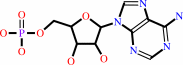 AMP
AMP
|
+
|
H(+)
|
|
|
|
|
|
|
|
|
|
Cofactor:
|
|
Mg(2+)
|
|
|
|
|
|
|
|
|
Molecule diagrams generated from .mol files obtained from the
KEGG ftp site
|
|
|
|
|
|
|
|
|
|
|
|
|
|
 |
|
|
|
|
|
|
| |
|
|
| |
|
DOI no:
|
J Med Chem
44:1364-1371
(2001)
|
|
PubMed id:
|
|
|
|
|
|
| |
|
Bisubstrate analogue inhibitors of 6-hydroxymethyl-7,8-dihydropterin pyrophosphokinase: synthesis and biochemical and crystallographic studies.
|
|
G.Shi,
J.Blaszczyk,
X.Ji,
H.Yan.
|
|
|
|
|
| |
ABSTRACT
|
|
|
|
| |
|
|
6-Hydroxymethyl-7,8-dihydropterin pyrophosphokinase (HPPK) catalyzes the
transfer of pyrophosphate from ATP to 6-hydroxymethyl-7,8-dihydropterin (HP),
leading to the biosynthesis of folate cofactors. Like other enzymes in the
folate pathway, HPPK is an ideal target for the development of antimicrobial
agents because the enzyme is essential for microorganisms but is absent from
human and animals. Three bisubstrate analogues have been synthesized for HPPK
and characterized by biochemical and X-ray crystallographic analyses. All three
bisubstrate analogues consist of a pterin, an adenosine moiety, and a link
composed of 2-4 phosphoryl groups.
P(1)-(6-Hydroxymethylpterin)-P(2)-(5'-adenosyl)diphosphate (HP(2)A, 5) shows
little affinity and inhibitory activity for E. coli HPPK.
P(1)-(6-Hydroxymethylpterin)-P(3)-(5'-adenosyl)triphosphate (HP(3)A, 6) shows
moderate affinity and inhibitory activity with K(d) = 4.25 microM in the
presence of Mg(2+) and IC(50) = 1.27 microM.
P(1)-(6-Hydroxymethylpterin)-P(4)-(5'-adenosyl)tetraphosphate (HP(4)A, 7) shows
the highest affinity and inhibitory activity with K(d) = 0.47 microM in the
presence of Mg(2+) and IC(50) = 0.44 microM. The affinity of MgHP(4)A for HPPK
is approximately 116 and 76 times higher than that of MgADP and
6-hydroxymethylpterin, respectively. The crystal structure of HPPK in complex
with 7 (HPPK.MgHP(4)A) has been determined at 1.85 A resolution with a
crystallographic R factor of 0.185. The crystal structure shows that 7 occupies
both HP- and ATP-binding sites and induces significant conformational changes in
HPPK. The biochemical and structural studies of the bisubstrate analogues
indicate that the bisubstrate analogue approach can produce more potent
inhibitors for HPPK and the minimum length of the link for a bisubstrate
analogue is approximately 7 A.
|
|
|
|
|
|
|
|
|
|
|
|
|
|
|
|
|
|
 |
 |
 |
|
Literature references that cite this PDB file's key reference
|
|
|
| |
PubMed id
|
|
Reference
|
|
|
|
|
|
J.E.Hyde
(2007).
Targeting purine and pyrimidine metabolism in human apicomplexan parasites.
|
| |
Curr Drug Targets,
8,
31-47.
|
|
|
|
|
|
|
A.Nzila
(2006).
Inhibitors of de novo folate enzymes in Plasmodium falciparum.
|
| |
Drug Discov Today,
11,
939-944.
|
|
|
|
|
|
|
A.Nzila,
S.A.Ward,
K.Marsh,
P.F.Sims,
and
J.E.Hyde
(2005).
Comparative folate metabolism in humans and malaria parasites (part II): activities as yet untargeted or specific to Plasmodium.
|
| |
Trends Parasitol,
21,
334-339.
|
|
|
|
|
|
|
R.Yang,
M.C.Lee,
H.Yan,
and
Y.Duan
(2005).
Loop conformation and dynamics of the Escherichia coli HPPK apo-enzyme and its binary complex with MgATP.
|
| |
Biophys J,
89,
95.
|
|
|
|
|
|
|
N.Gresh,
and
G.B.Shi
(2004).
Conformation-dependent intermolecular interaction energies of the triphosphate anion with divalent metal cations. Application to the ATP-binding site of a binuclear bacterial enzyme. A parallel quantum chemical and polarizable molecular mechanics investigation.
|
| |
J Comput Chem,
25,
160-168.
|
|
|
|
|
|
|
A.Bermingham,
and
J.P.Derrick
(2002).
The folic acid biosynthesis pathway in bacteria: evaluation of potential for antibacterial drug discovery.
|
| |
Bioessays,
24,
637-648.
|
|
|
|
|
|
The most recent references are shown first.
Citation data come partly from CiteXplore and partly
from an automated harvesting procedure. Note that this is likely to be
only a partial list as not all journals are covered by
either method. However, we are continually building up the citation data
so more and more references will be included with time.
|
|


 Links
Links


