 |
PDBsum entry 1art

|
|
|
|
|
|

|

|

|

|
|

|
|

|
|

|
|
|
 |

|

|
|
|
|
|
|
|
|
|
|
|
|
|
|
|
|
|
|
|
|
|
|
|
|
|
|
|
|
|
|
|
|
Transferase(aminotransferase)
|
PDB id
|
|
|
|
1art
|
|
|
|
|
|
|
|
|
|
|
|
|
|
|

|

|

|
|
|
|
|
|
|
|
 |
Contents |
 |
|
|
|
|
|
|
|
|
|
|
|
|
* Residue conservation analysis
|
|
|
|
|
|
|
|
|
|
|
Enzyme class:
|
|
E.C.2.6.1.1
- aspartate transaminase.
|
|
|
|
|
|
|
Reaction:
|
|
L-aspartate + 2-oxoglutarate = oxaloacetate + L-glutamate
|
|
|
|
|
|
 L-aspartate
|
+
|
2-oxoglutarate
Bound ligand (Het Group name = )
matches with 72.73% similarity
|
=
|
 oxaloacetate
|
+
|
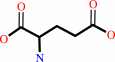 L-glutamate
|
|
|
|
|
|
|
|
|
|
Cofactor:
|
|
Pyridoxal 5'-phosphate
|
|
|
|
|
|
Pyridoxal 5'-phosphate
Bound ligand (Het Group name =
PLP)
matches with 93.75% similarity
|
|
|
|
|
|
|
Molecule diagrams generated from .mol files obtained from the
KEGG ftp site
|
|
|
|
|
|
|
|
|
|
|
|
|
|
 |
|
|
|
|
|
|
| |
|
|
| |
|
|
J Biochem (tokyo)
116:95
(1994)
|
|
PubMed id:
|
|
|
|
|
|
| |
|
X-ray crystallographic study of pyridoxal 5'-phosphate-type aspartate aminotransferases from Escherichia coli in open and closed form.
|
|
A.Okamoto,
T.Higuchi,
K.Hirotsu,
S.Kuramitsu,
H.Kagamiyama.
|
|
|
|
|
| |
ABSTRACT
|
|
|
|
| |
|
|
We determined the three-dimensional structures of aspartate aminotransferase
(AspAT) from Escherichia coli and its complex with inhibitor
(2-methyl-L-aspartate) at 1.8A resolution. This enzyme reversibly catalyzes the
transamination reaction and is a dimer of two identical subunits. Each subunit
has 396 amino acid residues and one pyridoxal 5'-phosphate as a cofactor, and is
divided into two domains, one large and the other small. Upon binding of the
inhibitor, the small domain rotates by 5 degrees toward the large domain to
close the active site. This domain movement is caused mainly by small but
important main-chain conformational changes in the residues located over the
domain interface of the small domain. In chicken mitochondrial AspAT, the domain
movement was larger, with a rotational angle of 13 degrees. By comparison of
these two structures, the difference in the rotational angles was found to be
caused by the larger opening of the domain in the open form of chicken
mitochondrial AspAT. Although the overall structures of these two enzymes were
almost identical, the surface area of the domain interface in the E. coli enzyme
was larger than that in mitochondrial AspAT, suggesting that the structure of
the domain interface is responsible for the degree of movement of the small
domain.
|
|
|
|
|
|
|
|
|
|
|
|
|
|
|
|
|
|
 |
 |
 |
|
Literature references that cite this PDB file's key reference
|
|
|
| |
PubMed id
|
|
Reference
|
|
|
|
|
|
H.J.Wu,
Y.Yang,
S.Wang,
J.Q.Qiao,
Y.F.Xia,
Y.Wang,
W.D.Wang,
S.F.Gao,
J.Liu,
P.Q.Xue,
and
X.W.Gao
(2011).
Cloning, expression and characterization of a new aspartate aminotransferase from Bacillus subtilis B3.
|
| |
FEBS J,
278,
1345-1357.
|
|
|
|
|
|
|
Q.Han,
T.Cai,
D.A.Tagle,
and
J.Li
(2010).
Structure, expression, and function of kynurenine aminotransferases in human and rodent brains.
|
| |
Cell Mol Life Sci,
67,
353-368.
|
|
|
PDB code:
|
|
|
|
|
|
|
|
M.Goto,
T.Yamauchi,
N.Kamiya,
I.Miyahara,
T.Yoshimura,
H.Mihara,
T.Kurihara,
K.Hirotsu,
and
N.Esaki
(2009).
Crystal structure of a homolog of mammalian serine racemase from Schizosaccharomyces pombe.
|
| |
J Biol Chem,
284,
25944-25952.
|
|
|
PDB codes:
|
|
|
|
|
|
|
|
J.M.Thornburg,
K.K.Nelson,
B.F.Clem,
A.N.Lane,
S.Arumugam,
A.Simmons,
J.W.Eaton,
S.Telang,
and
J.Chesney
(2008).
Targeting aspartate aminotransferase in breast cancer.
|
| |
Breast Cancer Res,
10,
R84.
|
|
|
|
|
|
|
Q.Han,
T.Cai,
D.A.Tagle,
H.Robinson,
and
J.Li
(2008).
Substrate specificity and structure of human aminoadipate aminotransferase/kynurenine aminotransferase II.
|
| |
Biosci Rep,
28,
205-215.
|
|
|
PDB code:
|
|
|
|
|
|
|
|
Q.Han,
Y.G.Gao,
H.Robinson,
and
J.Li
(2008).
Structural insight into the mechanism of substrate specificity of aedes kynurenine aminotransferase.
|
| |
Biochemistry,
47,
1622-1630.
|
|
|
PDB codes:
|
|
|
|
|
|
|
|
R.Z.Liao,
W.J.Ding,
J.G.Yu,
W.H.Fang,
and
R.Z.Liu
(2008).
Theoretical studies on pyridoxal 5'-phosphate-dependent transamination of alpha-amino acids.
|
| |
J Comput Chem,
29,
1919-1929.
|
|
|
|
|
|
|
I.Matsui,
and
K.Harata
(2007).
Implication for buried polar contacts and ion pairs in hyperthermostable enzymes.
|
| |
FEBS J,
274,
4012-4022.
|
|
|
|
|
|
|
K.Hirotsu,
M.Goto,
A.Okamoto,
and
I.Miyahara
(2005).
Dual substrate recognition of aminotransferases.
|
| |
Chem Rec,
5,
160-172.
|
|
|
|
|
|
|
A.C.Eliot,
and
J.F.Kirsch
(2004).
Pyridoxal phosphate enzymes: mechanistic, structural, and evolutionary considerations.
|
| |
Annu Rev Biochem,
73,
383-415.
|
|
|
|
|
|
|
D.E.Ward,
W.M.de Vos,
and
J.van der Oost
(2002).
Molecular analysis of the role of two aromatic aminotransferases and a broad-specificity aspartate aminotransferase in the aromatic amino acid metabolism of Pyrococcus furiosus.
|
| |
Archaea,
1,
133-141.
|
|
|
|
|
|
|
E.Deu,
K.A.Koch,
and
J.F.Kirsch
(2002).
The role of the conserved Lys68*:Glu265 intersubunit salt bridge in aspartate aminotransferase kinetics: multiple forced covariant amino acid substitutions in natural variants.
|
| |
Protein Sci,
11,
1062-1073.
|
|
|
|
|
|
|
A.Matharu,
H.Hayashi,
H.Kagamiyama,
B.Maras,
and
R.A.John
(2001).
Contributions of the substrate-binding arginine residues to maleate-induced closure of the active site of Escherichia coli aspartate aminotransferase.
|
| |
Eur J Biochem,
268,
1640-1645.
|
|
|
|
|
|
|
H.Kagamiyama,
and
H.Hayashi
(2001).
Release of enzyme strain during catalysis reduces the activation energy barrier.
|
| |
Chem Rec,
1,
385-394.
|
|
|
|
|
|
|
H.Mizuguchi,
H.Hayashi,
K.Okada,
I.Miyahara,
K.Hirotsu,
and
H.Kagamiyama
(2001).
Strain is more important than electrostatic interaction in controlling the pKa of the catalytic group in aspartate aminotransferase.
|
| |
Biochemistry,
40,
353-360.
|
|
|
PDB codes:
|
|
|
|
|
|
|
|
K.Haruyama,
T.Nakai,
I.Miyahara,
K.Hirotsu,
H.Mizuguchi,
H.Hayashi,
and
H.Kagamiyama
(2001).
Structures of Escherichia coli histidinol-phosphate aminotransferase and its complexes with histidinol-phosphate and N-(5'-phosphopyridoxyl)-L-glutamate: double substrate recognition of the enzyme.
|
| |
Biochemistry,
40,
4633-4644.
|
|
|
PDB codes:
|
|
|
|
|
|
|
|
N.Yennawar,
J.Dunbar,
M.Conway,
S.Hutson,
and
G.Farber
(2001).
The structure of human mitochondrial branched-chain aminotransferase.
|
| |
Acta Crystallogr D Biol Crystallogr,
57,
506-515.
|
|
|
PDB codes:
|
|
|
|
|
|
|
|
R.Contestabile,
A.Paiardini,
S.Pascarella,
M.L.di Salvo,
S.D'Aguanno,
and
F.Bossa
(2001).
l-Threonine aldolase, serine hydroxymethyltransferase and fungal alanine racemase. A subgroup of strictly related enzymes specialized for different functions.
|
| |
Eur J Biochem,
268,
6508-6525.
|
|
|
|
|
|
|
F.S.Tahanejad,
H.Naderi-Manesh,
B.Habibinejad,
and
M.Mahmoudian
(2000).
Homology-based molecular modelling of PLP-dependent histidine decarboxylase from Mmorganella morganii.
|
| |
Eur J Med Chem,
35,
567-576.
|
|
|
|
|
|
|
G.Schneider,
H.Käck,
and
Y.Lindqvist
(2000).
The manifold of vitamin B6 dependent enzymes.
|
| |
Structure,
8,
R1-R6.
|
|
|
|
|
|
|
M.M.Islam,
H.Hayashi,
H.Mizuguchi,
and
H.Kagamiyama
(2000).
The substrate activation process in the catalytic reaction of Escherichia coli aromatic amino acid aminotransferase.
|
| |
Biochemistry,
39,
15418-15428.
|
|
|
|
|
|
|
T.Fujii,
M.Maeda,
H.Mihara,
T.Kurihara,
N.Esaki,
and
Y.Hata
(2000).
Structure of a NifS homologue: X-ray structure analysis of CsdB, an Escherichia coli counterpart of mammalian selenocysteine lyase.
|
| |
Biochemistry,
39,
1263-1273.
|
|
|
PDB code:
|
|
|
|
|
|
|
|
A.Okamoto,
S.Ishii,
K.Hirotsu,
and
H.Kagamiyama
(1999).
The active site of Paracoccus denitrificans aromatic amino acid aminotransferase has contrary properties: flexibility and rigidity.
|
| |
Biochemistry,
38,
1176-1184.
|
|
|
PDB codes:
|
|
|
|
|
|
|
|
J.N.Scarsdale,
G.Kazanina,
S.Radaev,
V.Schirch,
and
H.T.Wright
(1999).
Crystal structure of rabbit cytosolic serine hydroxymethyltransferase at 2.8 A resolution: mechanistic implications.
|
| |
Biochemistry,
38,
8347-8358.
|
|
|
PDB code:
|
|
|
|
|
|
|
|
K.A.Denessiouk,
A.I.Denesyuk,
J.V.Lehtonen,
T.Korpela,
and
M.S.Johnson
(1999).
Common structural elements in the architecture of the cofactor-binding domains in unrelated families of pyridoxal phosphate-dependent enzymes.
|
| |
Proteins,
35,
250-261.
|
|
|
|
|
|
|
T.Nakai,
K.Okada,
S.Akutsu,
I.Miyahara,
S.Kawaguchi,
R.Kato,
S.Kuramitsu,
and
K.Hirotsu
(1999).
Structure of Thermus thermophilus HB8 aspartate aminotransferase and its complex with maleate.
|
| |
Biochemistry,
38,
2413-2424.
|
|
|
PDB codes:
|
|
|
|
|
|
|
|
T.P.Ko,
S.P.Wu,
W.Z.Yang,
H.Tsai,
and
H.S.Yuan
(1999).
Crystallization and preliminary crystallographic analysis of the Escherichia coli tyrosine aminotransferase.
|
| |
Acta Crystallogr D Biol Crystallogr,
55,
1474-1477.
|
|
|
PDB code:
|
|
|
|
|
|
|
|
W.Blankenfeldt,
C.Nowicki,
M.Montemartini-Kalisz,
H.M.Kalisz,
and
H.J.Hecht
(1999).
Crystal structure of Trypanosoma cruzi tyrosine aminotransferase: substrate specificity is influenced by cofactor binding mode.
|
| |
Protein Sci,
8,
2406-2417.
|
|
|
PDB code:
|
|
|
|
|
|
|
|
C.J.Jeffery,
T.Barry,
S.Doonan,
G.A.Petsko,
and
D.Ringe
(1998).
Crystal structure of Saccharomyces cerevisiae cytosolic aspartate aminotransferase.
|
| |
Protein Sci,
7,
1380-1387.
|
|
|
PDB code:
|
|
|
|
|
|
|
|
H.Hayashi,
H.Mizuguchi,
and
H.Kagamiyama
(1998).
The imine-pyridine torsion of the pyridoxal 5'-phosphate Schiff base of aspartate aminotransferase lowers its pKa in the unliganded enzyme and is crucial for the successive increase in the pKa during catalysis.
|
| |
Biochemistry,
37,
15076-15085.
|
|
|
|
|
|
|
J.N.Jansonius
(1998).
Structure, evolution and action of vitamin B6-dependent enzymes.
|
| |
Curr Opin Struct Biol,
8,
759-769.
|
|
|
|
|
|
|
S.Pascarella,
S.Angelaccio,
R.Contestabile,
S.Delle Fratte,
M.Di Salvo,
and
F.Bossa
(1998).
The structure of serine hydroxymethyltransferase as modeled by homology and validated by site-directed mutagenesis.
|
| |
Protein Sci,
7,
1976-1982.
|
|
|
|
|
|
|
T.Yano,
S.Oue,
and
H.Kagamiyama
(1998).
Directed evolution of an aspartate aminotransferase with new substrate specificities.
|
| |
Proc Natl Acad Sci U S A,
95,
5511-5515.
|
|
|
|
|
|
|
E.T.Mollova,
D.E.Metzler,
A.Kintanar,
H.Kagamiyama,
H.Hayashi,
K.Hirotsu,
and
I.Miyahara
(1997).
Use of 1H-15N heteronuclear multiple-quantum coherence NMR spectroscopy to study the active site of aspartate aminotransferase.
|
| |
Biochemistry,
36,
615-625.
|
|
|
|
|
|
|
H.Hayashi,
and
H.Kagamiyama
(1997).
Transient-state kinetics of the reaction of aspartate aminotransferase with aspartate at low pH reveals dual routes in the enzyme-substrate association process.
|
| |
Biochemistry,
36,
13558-13569.
|
|
|
|
|
|
|
M.Petukhov,
Y.Kil,
S.Kuramitsu,
and
V.Lanzov
(1997).
Insights into thermal resistance of proteins from the intrinsic stability of their alpha-helices.
|
| |
Proteins,
29,
309-320.
|
|
|
|
|
|
|
H.Hayashi,
K.Inoue,
H.Mizuguchi,
and
H.Kagamiyama
(1996).
Analysis of the substrate-recognition mode of aromatic amino acid aminotransferase by combined use of quasisubstrates and site-directed mutagenesis: systematic hydroxy-group addition/deletion studies to probe the enzyme-substrate interactions.
|
| |
Biochemistry,
35,
6754-6761.
|
|
|
|
|
|
|
J.J.Onuffer,
B.T.Ton,
I.Klement,
and
J.F.Kirsch
(1995).
The use of natural and unnatural amino acid substrates to define the substrate specificity differences of Escherichia coli aspartate and tyrosine aminotransferases.
|
| |
Protein Sci,
4,
1743-1749.
|
|
|
|
|
|
|
R.Graber,
P.Kasper,
V.N.Malashkevich,
E.Sandmeier,
P.Berger,
H.Gehring,
J.N.Jansonius,
and
P.Christen
(1995).
Changing the reaction specificity of a pyridoxal-5'-phosphate-dependent enzyme.
|
| |
Eur J Biochem,
232,
686-690.
|
|
|
PDB codes:
|
|
|
|
|
|
|
The most recent references are shown first.
Citation data come partly from CiteXplore and partly
from an automated harvesting procedure. Note that this is likely to be
only a partial list as not all journals are covered by
either method. However, we are continually building up the citation data
so more and more references will be included with time.
Where a reference describes a PDB structure, the PDB
code is
shown on the right.
|
|


 Links
Links


