CIFLIB is a software library that was developed
to provide an application interface to information in CIF format.
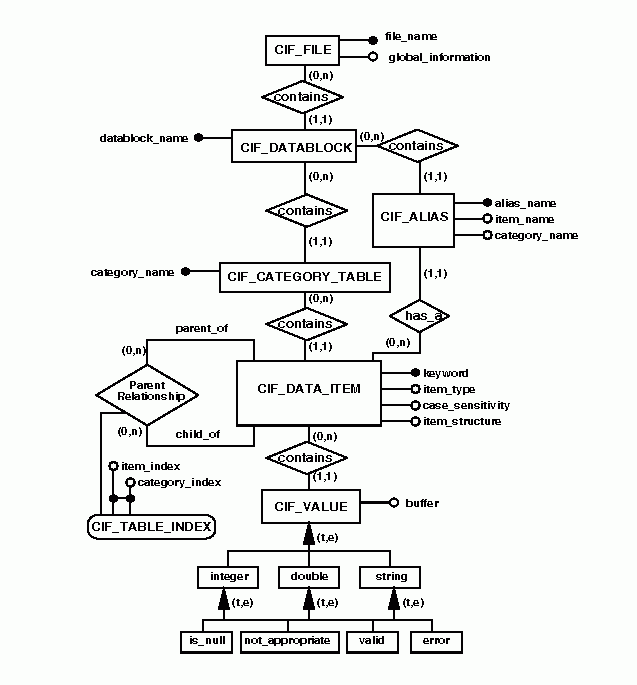
The entity relationship diagram of the CIFLIB class library in the figure below
illustrates that CIFLIB follows the essentially relational organization used in the mmCIF
dictionary. CIFLIB provides functions which perform the following types of operations:
- read and write operations on CIF format data files and dictionaries.
- read, write and update operations on individual data items
and dictionary definition components.
- detailed integrity checks of CIF data and dictionaries
as defined by the Dictionary Description Language
(DDL) 2.1.
- efficient access to the CIF dictionary data model.
- robust syntatic and semantic error handling.
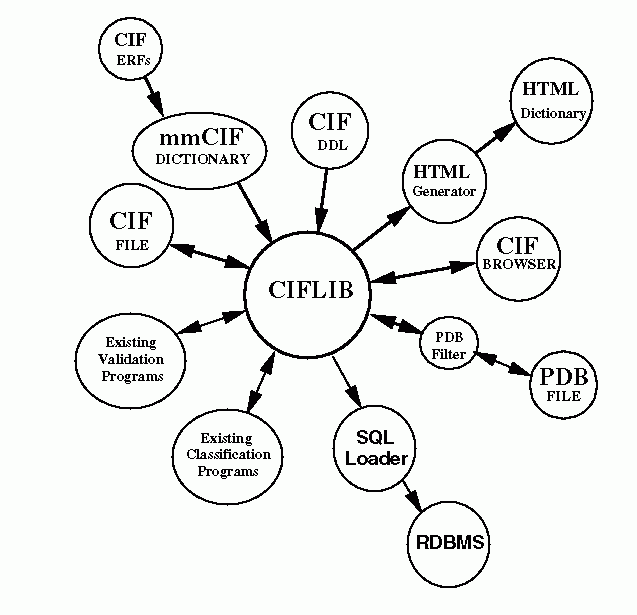
The previous diagram shows how this software library
facilitates integrating the CIF interchange format
with other applications.
As the figure illustrates, CIFLIB provides complete access
to the DDL, CIF dictionaries and CIF data files.
This library can be used to build wrappers and filters around existing
applications which need to access CIF data.
Since CIFLIB provides complete access to the dictionary
data model, the library can be conveniently used as an in-memory database
or as a loader for an external database.
Accessing data in CIF format using CIFLIB is a multistep process. CIFLIB first
reads the DDL dictionary. Once the DDL is loaded and checked against
internally coded rules based on DDL 2.1, a
CIF dictionary which is based on this DDL is read and checked. This process
can be quite time consuming for large dictionaries, so a provision has been made
to retain the state of any file which has been checked in an auxiliary file.
This auxiliary file will be used in preference to the original file in
subsequent file accesses if its modification date is more recent. Finally, CIF
data files are read and checked with respect to the CIF dictionary. In any file
access, CIFLIB provides complete access to the data blocks containing the DDL,
the CIF dictionary, and any number of blocks containing user data.
Each CIF file may be divided into data block sections.
CIFLIB treats each data block as an independent database loaded
into the data model defined in its associated dictionary. The CIF DDL
is at the top of the chain and provides the data model for a
CIF dictionary. The CIF dictionary in turn provides the
data model for CIF data files. CIFLIB provides functions to
read, write and merge data blocks. Any number of data blocks can be
managed by the library.
Within each individual data block, category groups provide a mechanism
for organizing categories into conceptually meaningful collections.
CIFLIB provides functions to obtain the list of category groups defined
within a data block as well as the names of the member categories of
each group.
The library provides a set of functions for accessing category level
features within a data block. These functions provide
a complete list of the categories specified within a data block,
the list of data items specified within each category, and
the number of rows of data in a category. The attributes of a category defined
in the CIF dictionary such as the category description, category examples,
member data items, key data items, and member subcategories can also be obtained.
Functions are provided to read, write and update individual data items,
rows of data items, and columns of data items.
These functions also check the integrity of item values with respect the
their dictionary definitions.
Access to all of the item attributes defined in the CIF dictionary is
provided, and convenience functions
are provided for the most commonly used attributes such as
alias names, data type, default value, and enumeration.
CIFLIB provides a set of functions which give
information about parent/child relationships, and provide
access to the parent and child item values. The parent and child
relationships returned by the functions in this section span
a single generation; however, complicated hierarchies of
parentage can be easily traced.
Although the extended DDL uses different conventions for naming data,
it provides a mechanism to reference alternative data names. The
mmCIF dictionary uses this feature to show the correspondence
between the mmCIF data items and the existing core CIF data items.
Because the mmCIF dictionary incorporates all of the definitions
in the core CIF dictionary, it is possible for software developed
for the extended DDL to use the mmCIF dictionary to read, write
and check data items derived from either dictionary.
-
The CIFLIB class library is stored in a compressed tar file
ciflib-v3-prod.tar.Z
-
The simple installation instructions are stored in this
README file.
A C language application program interface to CIFLIB has been
developed to provide a convenient functional interface to the CIFLIB class library.
A reference manual
which describes each interface function in detail is available.
CIFLIB provides a set of functions which
access the error codes generated by those library functions which
perform integrity checking.
The CIFLIB functions which access and update individual item values return
only a single error code. Functions providing read access return only
the first error encountered in checking the target item.
Similarly, functions providing update access return only the first
error encountered in the checking process; however, all of the errors
that may be detected during an I/O operation are appended to the warning or error lists
maintained for each datablock.
Higher level functions, which read and write files and data blocks also append their
diagnostic codes to internal error and warning lists.
A set of functions has been provided to access and
refresh these lists. Functions are also provided to translate individual
error codes and to print the contents of an entire data block.
-
The CIFLIB class library is stored in a compressed tar file
ciflib-v3-prod.tar.Z
-
The simple installation instructions are stored in this
README file.
To demonstrate some of the functionality of the C API
a dictionary-to-HTML converter application has been developed to
provide flexible access to the contents of the mmCIF and DDL
dictionaries on the World Wide Web.
The HTML mmCIF dictionary is organized so that a user can flexibly
navigate through the hierarchy of the definitions and between
all data item relationships. The first level of presentation is
a page of category groups and group descriptions.
The contents of each category group can be explored and specific
categories within each group can be selected. Each category is
presented on a page which includes all of the DDL attributes
pertaining to the category description. From within the category presentation,
individual data items can be selected. The data item presentation
includes all of the relevant DDL attributes and selections for all related data items.
In many instances it is desirable to be able to read and write information
in CIF format without the overhead of dictionary based integrity processing.
The CIFPARSE function library was developed to provide convenient tools
to access CIF data without any semantic checking.
CIFPARSE uses a simple lex/yacc parser to read and check the syntax
of mmCIF data files. CIF data is stored as strings in a simple data structure
and a collection of access functions are provided to retrieve individual
items of data.
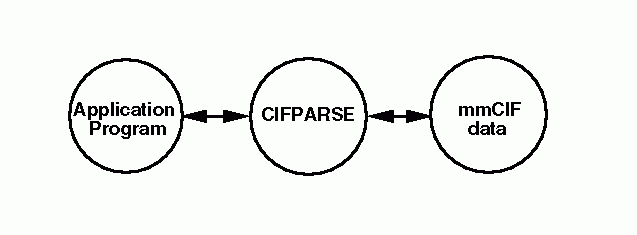
This library is particularly useful for applications that exchange CIF data
between program applications or for repetitive access to static CIF data that has
been previously semantically validated.
A reference manual
which describes each function in detail is available.
-
The CIFPARSE function library is stored in a compressed tar file
cifparse-v2-prod.tar.Z
-
The simple installation instructions are stored in this
README file.
The design CIFLIB class library closely follows the relational model that
is specified in DDL 2.1. Categories in mmCIF dictionaries and data files
are mapped into tabular data structures in the class, and the data access methods
provided by the class are all row oriented.
This design is satisfactory for applications which access CIF data
in the CIF dictionary one category at a time; however, it is not particularly efficient for
applications which access dictionary data item-wise.
This pattern of access is common for applications which have to assemble all of the dictionary
attributes of a data item for the purpose of integrity processing.
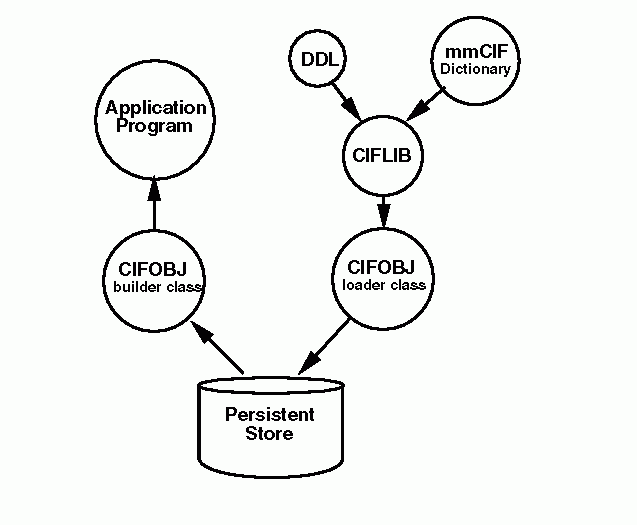
The CIFOBJ class library was developed in order to provide an object view of the mmCIF dictionary.
The class library has two components as illustrated in diagram below.
The first component builds a persistent store of
objects of type: item, sub-category, category, and dictionary. Each object is a
container for all relevant attributes for that object type. CIBOBJ accesses and
checks the dictionary contents using methods provided by CIFLIB. The CIFOBJ loader
class assembles the dictionary objects and passes these to the object storage manager.
The second component of the CIFOBJ class library provides methods for building
dictionary objects from the persistent store. CIFOBJ implements methods to access
all of the attributes for each object type and returns this information as a string
or an array of strings. A reference manual
which describes these classes in detail is available.
-
The CIFOBJ loader class library is stored in a compressed tar file
cifobj-v3-prod.tar.Z
-
The simple installation instructions for the loader class are stored in this
README file.
-
The CIFOBJ builder class library is stored in a compressed tar file
cifobj-builder-v3-prod.tar.Z
-
The simple installation instructions for the builder class are stored in this
README file.
The CIFTable package contains several files that converge together in the SSTable class,
a searchable string table . The SSTable class has a number of characteristics that make
it useful for a wide variety of applications:
-
SSTable objects are general to the data types supported. Other types can be stored as
strings and converted to the native data typeat a higher level.
-
SSTable objects are extremely flexible. Data can be inserted and removed easily, by row,
by column, or by individual cell.
-
SSTable objects provide for their own persistent storage management.
-
SSTable objects have an efficient searching mechanism built internally.
This mechanism allows for multiple column searching with logical conjunction
and intersection.
A reference manual is available for the public and static interface to the SSTable class.
-
The CIFOBJ loader class library is stored in a compressed tar file
cif-table-obj-v3-prod.tar.Z
-
The simple installation instructions for the loader class are stored in this
README file.