
Briony Jackson
Head of Science Education and Public Engagement
bjackson [at] ebi.ac.uk
EditIoanna Kalvari and Anton Petrov are part of the team that manages EMBL-EBI’s database for non-coding RNA families, Rfam. RNA may not be as famous as its “cousin”, DNA, but according to Ioanna and Anton, it’s just as interesting, if not more so. To share their fascination with RNA, Ioanna and Anton developed a public engagement activity called Genome Explorers.
Head of Science Education and Public Engagement
bjackson [at] ebi.ac.uk
Edit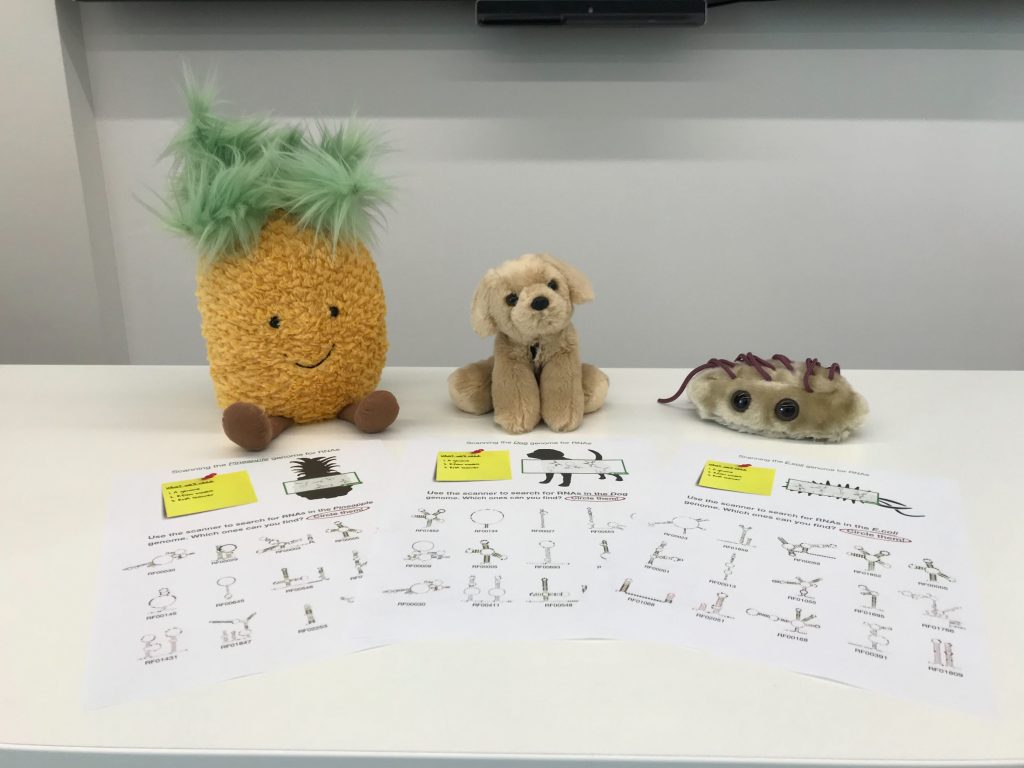
What is the Genome Explorers activity?
Ioanna: We created Genome Explorers to reflect the work we do in Rfam, which is a database that contains all known non-coding RNAs. An RNA family is made up of RNAs which have similar characteristics, just like our families, but RNA families share similar structures and sequences.
Genome Explorers has three steps. The first is a card sorting activity which represents the family building process in the database. The participants have to sort the cards of different RNAs by their shapes (secondary structures), putting those that look alike into groups.
Rfam uses specialised software to detect the RNA in different genomes by using statistical models – scientists can scan these model genomes or their own datasets to find RNAs. The second step in our activity demonstrates this; participants use the families they’ve built during the first activity to find RNA in different genomes using a magic scanner! We have a dog genome, a bacterium – E. coli – and a pineapple, which everybody loves!
Rfam is like an online RNA encyclopaedia that scientists can use to find more information about RNAs. To illustrate this, in the third step participants are given little booklets with simplified information, in which they can look for the RNAs they have discovered and find out more information about them!
Who was your target audience for Genome Explorers?
Anton: One of our grant applications required a strong public engagement plan. This really got us thinking about how we can make this complex topic more exciting and accessible to non-scientists.
That was the first time I’d even thought about public engagement. We wanted to find an opportunity to engage so we approached the Connecting Science Public Engagement team, who were tremendously helpful in providing an opportunity for us at the Cambridge Launchpad project day on Campus. The day was aimed at Year 7 students (11-12-year olds) so the activity was developed with that audience in mind, but we designed it in such a way that it could be adapted for different audiences. We have already run it with younger children, adults and even toddlers.
What do you think are benefits of engaging the public in your science?
Anton: For one thing, it has certainly benefitted our science. For the card sorting activity, the RNA structures needed to be orientated in the same way to allow participants to compare them. This gave us an idea for improving our database to make it easier to use. We developed algorithms that would ensure the RNAs were visualised in the same orientation and deployed the new feature on our website.
It would be presumptuous of us to say what the benefits are for the participants. But we do believe that this could be a useful stepping stone into science, and it could help connect our campus with the community. It’s important to engage because we assume that everyone has access to some opportunities and that’s not always the case.
Ioanna: It’s a good thing that we are making ourselves available to people who don’t have access to science and providing a way for them to find out more, sharing what we do and engaging and discussing with them. We benefit because sometimes they have ideas and help us see things in a way that we have never thought of before.
Did anything surprise you about public engagement?
Ioanna: My biggest surprise is that I’m really enjoying it! I’m more of an introvert and I wasn’t expecting to enjoy it as much as I do. I’ve learned a lot from the process, and I get so much from people; I hope I’m giving back as much as I’m getting. People are enthusiastic about what we do, seeing them having fun and speaking with us, being interested and enjoying the activity is very rewarding.
What’s next?
Ioanna: We are aiming to improve our activity, and we’ve been awarded a Connecting Science Enabling Fund grant so now we can give our activity a more professional look. We are going to attend off-campus events, such as Girl Guiding STEM events, and visit Icknield Primary School every three months for the PSQM project and anything else that comes through the STEM ambassador network, wherever we can support, we will.
Anton: We will still participate in other activities even though we have our own because we can learn something new and improve our activity. Hopefully we can get more people in the team involved too and get them certified as STEM ambassadors.
Unfortunately, due to the COVID-19 pandemic, we can’t currently run our activity face-to-face with audiences so we are exploring ways to make it available online, watch this space!
Anton and Ioanna would like to thank colleagues from across the Wellcome Genome Campus who supported them in this activity including Colin Barker, Kim Judge and the Connecting Science Public Engagement team.
Contact our Public Engagement team
Interested in having us run an event, visit your school or partner with us? We develop and deliver a wide range of activities to highlight science and technology.
Discover what’s on at Welcome Genome Campus
Learn about public engagement activities on the Wellcome Genome Campus and upcoming events you can join.