
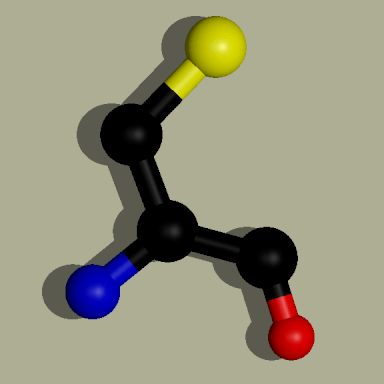
 His-Cys distribution
His-Cys distribution
His-Cys distributionNumber of His sidechains in dataset 11167 ( 2.3% )
Number of Cys sidechains in dataset 6510 ( 1.3% )
Total number of His-Cys contacts 639
* Non-random at 95.0% confidence level.
** Non-random at 97.5% confidence level.
*** Non-random at 99.0% confidence level.
**** Non-random at 99.5% confidence level.
The significance of any clustering in the contacts is assessed with reference to packing-geometries generated at random from 52 trials of 639 randomly-chosen and randomly placed contacts.
Cluster 1. Size: Mean 8.63 St.dev. 1.16
Cluster 2. Size: Mean 7.77 St.dev. 0.77
Cluster 3. Size: Mean 7.31 St.dev. 0.61
Cluster 4. Size: Mean 7.08 St.dev. 0.51
Cluster 5. Size: Mean 6.87 St.dev. 0.44
Cluster 6. Size: Mean 6.56 St.dev. 0.53
The pairs of plots below show a representative sidechain for each cluster.
In the first plot of each pair the sidechains are shown as ball-and-stick models; in the second plot the van der Waals surfaces are superimposed as wire-cage contours. The reference sidechain is shown in purple while the cluster representative is shown in orange. Click on the first plot to get a magnified view, including the other cluster members.
Each cluster representative is chosen to have a r.m.s.d. of <1.5 Angstroms from all other members of the cluster. The standard deviation shows how significant the clustering is, when compared with a randomly-generated contact distribution for these two sidechains.
The ticks on the back walls in the plots correspond to distances of 1 Angstrom.
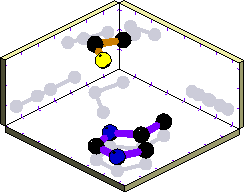
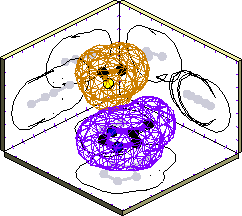
Cluster 1. Size 18 ( 8.07 st. devs. from mean )
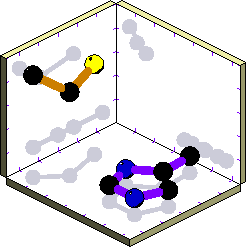
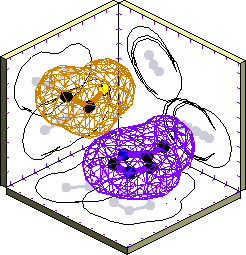
Cluster 2. Size 15 ( 9.33 st. devs. from mean )
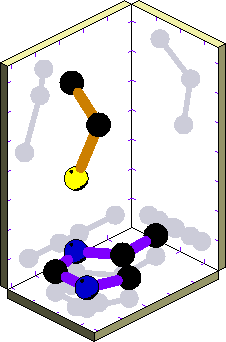

Cluster 3. Size 13 ( 9.40 st. devs. from mean )
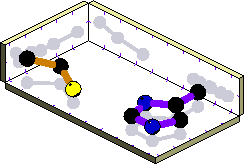

Cluster 4. Size 13 ( 11.54 st. devs. from mean )
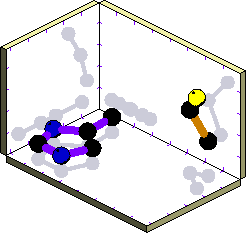

Cluster 5. Size 11 ( 9.40 st. devs. from mean )
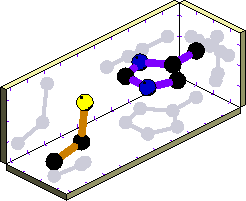
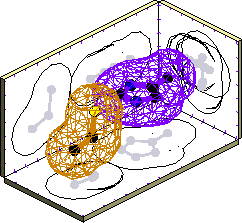
Cluster 6. Size 11 ( 8.32 st. devs. from mean )
Other His distributions