
 Arg-Tyr distribution
Arg-Tyr distribution
Arg-Tyr distributionNumber of Arg sidechains in dataset 24542 ( 5.1% )
Number of Tyr sidechains in dataset 17058 ( 3.5% )
Total number of Arg-Tyr contacts 4587
* Non-random at 95.0% confidence level.
** Non-random at 97.5% confidence level.
*** Non-random at 99.0% confidence level.
**** Non-random at 99.5% confidence level.
The significance of any clustering in the contacts is assessed with reference to packing-geometries generated at random from 20 trials of 3000 randomly-chosen and randomly placed contacts.
Cluster 1. Size: Mean 29.05 St.dev. 1.53
Cluster 2. Size: Mean 27.60 St.dev. 1.16
Cluster 3. Size: Mean 26.60 St.dev. 0.92
Cluster 4. Size: Mean 25.75 St.dev. 0.83
Cluster 5. Size: Mean 25.25 St.dev. 1.09
Cluster 6. Size: Mean 24.90 St.dev. 0.83
The pairs of plots below show a representative sidechain for each cluster.
In the first plot of each pair the sidechains are shown as ball-and-stick models; in the second plot the van der Waals surfaces are superimposed as wire-cage contours. The reference sidechain is shown in purple while the cluster representative is shown in orange. Click on the first plot to get a magnified view, including the other cluster members.
Each cluster representative is chosen to have a r.m.s.d. of <1.5 Angstroms from all other members of the cluster. The standard deviation shows how significant the clustering is, when compared with a randomly-generated contact distribution for these two sidechains.
The ticks on the back walls in the plots correspond to distances of 1 Angstrom.
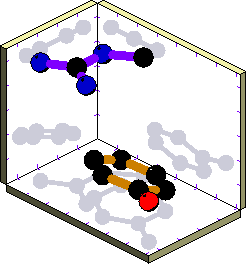
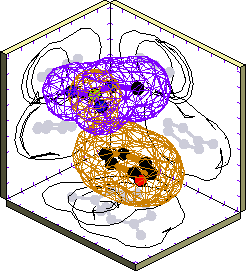
Cluster 1. Size 68 ( 25.42 st. devs. from mean )
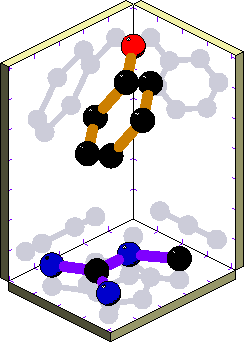
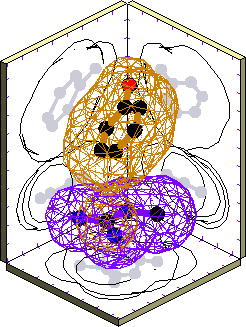
Cluster 2. Size 62 ( 29.72 st. devs. from mean )
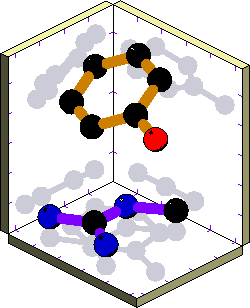
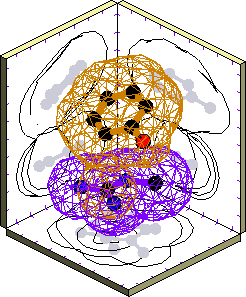
Cluster 3. Size 47 ( 22.26 st. devs. from mean )
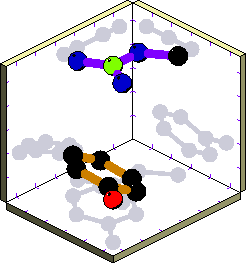
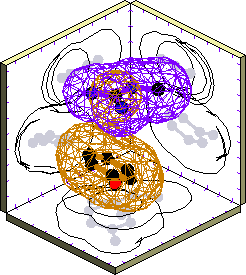
Cluster 4. Size 44 ( 22.01 st. devs. from mean )
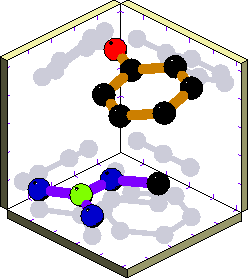
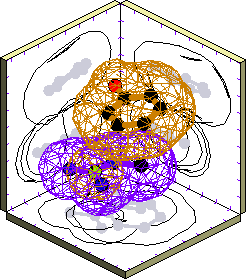
Cluster 5. Size 38 ( 11.70 st. devs. from mean )
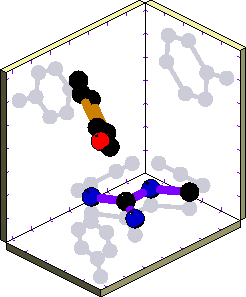
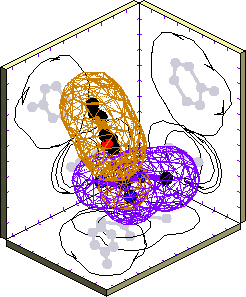
Cluster 6. Size 37 ( 14.57 st. devs. from mean )
Other Arg distributions