 |
PDBsum entry 6e4z

|
|
|
|
|
|

|

|

|

|
|

|
|

|
|

|
|

|
|

|
|

|
|

|
|
|
 |

|

|
|
|
|
|
|
|
|
|
|
|
|
|
|
|
|
|
|
|
|
|
|
|
|
|
|
|
|
|
|
|
|
|
|
|
|
Immune system
|
PDB id
|
|
|
|
6e4z
|
|
|
|
|
|
|
|
|
|
|
|
|
|
|

|

|

|
|
|
|
|
|
|
|
 |
Contents |
 |
|
|
|
|
|
|
|
|
|
|
|
 210 a.a.
|
|
|
|
|
|
|
|
|
|
|
 218 a.a.
|
|
|
|
|
|
|
|
|
|
|
 15 a.a.
|
|
|
|
|
|
|
|
|
|
|
|
|
|
|
|
|
PDB id:
|
|
|
|
| Name: |
|
Immune system
|
|
|
Title:
|
|
Anti-pcsk9 fab 6e2 bound to the modified n-terminal peptide from pcsk9
|
|
Structure:
|
|
6e2 heavy chain. Chain: h. Fragment: fab. Engineered: yes. 6e2 light chain. Chain: l. Fragment: fab. Engineered: yes. Proprotein convertase subtilisin/kexin type 9.
|
|
Source:
|
|
Mus musculus. Mouse. Organism_taxid: 10090. Expressed in: escherichia coli. Expression_system_taxid: 562. Synthetic: yes. Homo sapiens. Human. Organism_taxid: 9606
|
|
Resolution:
|
|
|
2.20Å
|
R-factor:
|
0.197
|
R-free:
|
0.236
|
|
|
Authors:
|
|
M.H.Ultsch,D.K.Kirchhofer
|
|
Key ref:
|
|
M.Ultsch
et al.
(2019).
Identification of a Helical Segment within the Intrinsically Disordered Region of the PCSK9 Prodomain.
J Mol Biol,
431,
885-903.
PubMed id:
DOI:
|
|
|
Date:
|
|
|
18-Jul-18
|
Release date:
|
10-Apr-19
|
|
|
|
|
|
|
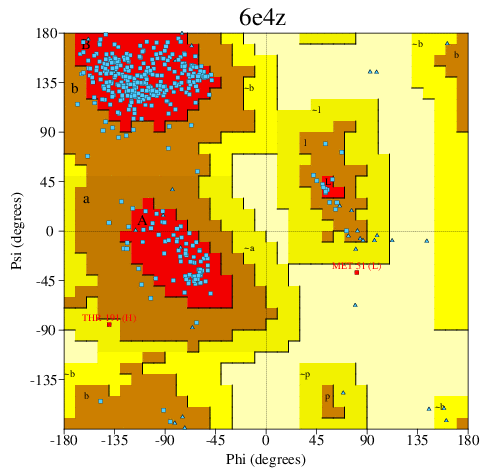
PROCHECK
|
|
|
|
|
|
Headers
|
|
|
|
References
|
|
|
|
|
|

|
|
No UniProt id for this chain
|
|
|
|
|
|
|
|
|
|
|
|
|
|
|
|
|
|
|
|
|
Enzyme class 2:
|
|
Chain L:
E.C.?
|
|
|
|
|
|
|
Enzyme class 3:
|
|
Chain P:
E.C.3.4.21.-
- ?????
|
|
|
|
|
|
|
|
|
|
Note, where more than one E.C. class is given (as above), each may
correspond to a different protein domain or, in the case of polyprotein
precursors, to a different mature protein.
|
|
|
|
|
|
|
|
|
|
|
|
|
|
 |
|
|
|
|
|
|
| |
|
DOI no:
|
J Mol Biol
431:885-903
(2019)
|
|
PubMed id:
|
|
|
|
|
|
| |
|
Identification of a Helical Segment within the Intrinsically Disordered Region of the PCSK9 Prodomain.
|
|
M.Ultsch,
W.Li,
C.Eigenbrot,
P.Di Lello,
M.T.Lipari,
S.Gerhardy,
A.P.AhYoung,
J.Quinn,
Y.Franke,
Y.Chen,
M.Kong Beltran,
A.Peterson,
D.Kirchhofer.
|
|
|
|
|
| |
ABSTRACT
|
|
|
|
| |
|
|
Proprotein convertase subtilisin/kexin 9 (PCSK9) is a key regulator of lipid
metabolism by degrading liver LDL receptors. Structural studies have provided
molecular details of PCSK9 function. However, the N-terminal acidic stretch of
the PCSK9 prodomain (Q31-T60) has eluded structural investigation, since it is
in a disordered state. The interest in this region is intensified by the
presence of human missense mutations associated with low and high LDL-c levels
(E32K, D35Y, and R46L, respectively), as well as two posttranslationally
modified sites, sulfated Y38 and phosphorylated S47. Herein we show that a
segment within this region undergoes disorder-to-order transition. Experiments
with acidic stretch-derived peptides demonstrated that the folding is centered
at the segment Y38-L45, which adopts an α-helix as determined by NMR analysis
of free peptides and by X-ray crystallography of peptides in complex with
antibody 6E2 (Ab6E2). In the Fab6E2-peptide complexes, the structured region
features a central 2 1/4-turn α-helix and encompasses up to 2/3 of the length
of the acidic stretch, including the missense mutations and posttranslationally
modified sites. Experiments with helix-breaking proline substitutions in
peptides and in PCSK9 protein indicated that Ab6E2 specifically recognizes the
helical conformation of the acidic stretch. Therefore, the observed quantitative
binding of Ab6E2 to native PCSK9 from various cell lines suggests that the
disorder-to-order transition is a true feature of PCSK9 and not limited to
peptides. Because the helix provides a constrained spatial orientation of the
missense mutations and the posttranslationally modified residues, it is probable
that their biological functions take place in the context of an ordered
conformational state.
|
|
|
|
|
|
|
|
|
|
|
|
|
|
|
|
|
|
 |
 |
 |
|
| |


 Links
Links








