|
PDBsum entry 5kjc

|
|
|
|
|
|

|

|

|

|
|

|
|

|
|

|
|

|
|

|
|

|
|

|
|
|
 |

|

|
|
|
|
|
|
|
|
|
|
|
|
|
|
|
|
|
|
|
|
|
|
|
|
|
|
|
|
|
|
|
|
|
|
|
|
Oxidoreductase
|
PDB id
|
|
|
|
5kjc
|
|
|
|
|
|
|
|
|
|
|
|
|
|
|

|

|

|
|
|
|
|
|
|
|
|
Enzyme class:
|
|
E.C.1.1.1.1
- alcohol dehydrogenase.
|
|
|
|
|
|
|
Reaction:
|
|
|
1.
|
a primary alcohol + NAD+ = an aldehyde + NADH + H+
|
|
2.
|
a secondary alcohol + NAD+ = a ketone + NADH + H+
|
|
|
|
|
|
|
 primary alcohol
|
+
|
NAD(+)
Bound ligand (Het Group name = )
corresponds exactly
|
=
|
 aldehyde
|
+
|
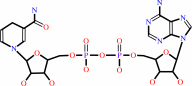 NADH
NADH
|
+
|
H(+)
|
|
|
|
|
|
|
 secondary alcohol
|
+
|
NAD(+)
Bound ligand (Het Group name = )
corresponds exactly
|
=
|
 ketone
|
+
|
NADH
|
+
|
H(+)
|
|
|
|
|
|
|
|
|
|
Cofactor:
|
|
Zn(2+) or Fe cation
|
|
|
|
|
|
|
|
|
Molecule diagrams generated from .mol files obtained from the
KEGG ftp site
|
|
|
|
|
|
|
|
|
|
|
|
|
|
 |
|
|
|
|
|
|
| |
|
|
| |
|
|
Protein Sci
27:750-768
(2018)
|
|
PubMed id:
|
|
|
|
|
|
| |
|
Contribution of buried distal amino acid residues in horse liver alcohol dehydrogenase to structure and catalysis.
|
|
K.K.Shanmuganatham,
R.S.Wallace,
A.Ting-I Lee,
B.V.Plapp.
|
|
|
|
|
| |
ABSTRACT
|
|
|
|
| |
|
|
The dynamics of enzyme catalysis range from the slow time scale (∼ms) for
substrate binding and conformational changes to the fast time (∼ps) scale for
reorganization of substrates in the chemical step. The contribution of global
dynamics to catalysis by alcohol dehydrogenase was tested by substituting five
different, conserved amino acid residues that are distal from the active site
and located in the hinge region for the conformational change or in hydrophobic
clusters. X-ray crystallography shows that the structures for the G173A, V197I,
I220 (V, L, or F), V222I, and F322L enzymes complexed with NAD+and an
analogue of benzyl alcohol are almost identical, except for small perturbations
at the sites of substitution. The enzymes have very similar kinetic constants
for the oxidation of benzyl alcohol and reduction of benzaldehyde as compared to
the wild-type enzyme, and the rates of conformational changes are not altered.
Less conservative substitutions of these amino acid residues, such as G173(V, E,
K, or R), V197(G, S, or T), I220(G, S, T, or N), and V222(G, S, or T) produced
unstable or poorly expressed proteins, indicating that the residues are critical
for global stability. The enzyme scaffold accommodates conservative
substitutions of distal residues, and there is no evidence that fast, global
dynamics significantly affect the rate constants for hydride transfers. In
contrast, other studies show that proximal residues significantly participate in
catalysis.
|
|
|
|
|
|
|
|
|
|
|
|
|
|
|
|
|
|
 |
 |
 |
|


 Links
Links