 |
PDBsum entry 5cxs
 |
|
|
|
|
|
|
Enzyme class:
|
|
E.C.2.4.2.1
- purine-nucleoside phosphorylase.
|
|
|
|
|
|
|
Reaction:
|
|
|
1.
|
a purine D-ribonucleoside + phosphate = a purine nucleobase + alpha- D-ribose 1-phosphate
|
|
2.
|
a purine 2'-deoxy-D-ribonucleoside + phosphate = a purine nucleobase + 2-deoxy-alpha-D-ribose 1-phosphate
|
|
|
|
|
|
|
purine D-ribonucleoside
|
+
|
 phosphate
|
=
|
purine nucleobase
|
+
|
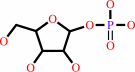 alpha- D-ribose 1-phosphate
|
|
|
|
|
|
|
purine 2'-deoxy-D-ribonucleoside
|
+
|
phosphate
|
=
|
purine nucleobase
|
+
|
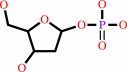 2-deoxy-alpha-D-ribose 1-phosphate
|
|
|
|
|
|
|
|
|
|
|
|
|
Molecule diagrams generated from .mol files obtained from the
KEGG ftp site
|
|
|
|
|
|
|
|
|
|
|
|
|
|
 |
|
|
|
|
|
|
| |
|
|
| |
|
|
PLoS One
13:e0203532
(2018)
|
|
PubMed id:
|
|
|
|
|
|
| |
|
The molecular structure of Schistosoma mansoni PNP isoform 2 provides insights into the nucleoside selectivity of PNPs.
|
|
J.R.Torini,
L.Romanello,
F.A.H.Batista,
V.H.B.Serrão,
M.Faheem,
A.E.Zeraik,
L.Bird,
J.Nettleship,
Y.Reddivari,
R.Owens,
R.DeMarco,
J.C.Borges,
J.Brandão-Neto,
H.D.Pereira.
|
|
|
|
|
| |
ABSTRACT
|
|
|
|
| |
|
|
Purine nucleoside phosphorylases (PNPs) play an important role in the blood
fluke parasite Schistosoma mansoni as a key enzyme of the purine salvage
pathway. Here we present the structural and kinetic characterization of a new
PNP isoform from S. mansoni, SmPNP2. Thermofluorescence screening of different
ligands suggested cytidine and cytosine are potential ligands. The binding of
cytosine and cytidine were confirmed by isothermal titration calorimetry, with a
KD of 27 μM for cytosine, and a KM of 76.3 μM for cytidine. SmPNP2 also
displays catalytic activity against inosine and adenosine, making it the first
described PNP with robust catalytic activity towards both pyrimidines and
purines. Crystal structures of SmPNP2 with different ligands were obtained and
comparison of these structures with the previously described S. mansoni PNP
(SmPNP1) provided clues for the unique capacity of SmPNP2 to bind pyrimidines.
When compared with the structure of SmPNP1, substitutions in the vicinity of
SmPNP2 active site alter the architecture of the nucleoside base binding site
thus permitting an alternative binding mode for nucleosides, with a 180°
rotation from the canonical binding mode. The remarkable plasticity of this
binding site enhances our understanding of the correlation between structure and
nucleotide selectivity, thus suggesting new ways to analyse PNP activity.
|
|
|
|
|
|
|
|
|
|
|
|
|
|
|
|
|
|
 |
 |
 |
|


 Links
Links


