 |
PDBsum entry 5ktq

|
|
|
|
|
 |
Contents |
 |
|
|
|
|
|
|
|
|
|
|
* Residue conservation analysis
|
|
|
|
|
|
|
|
|
|
|
Enzyme class:
|
|
E.C.2.7.7.7
- DNA-directed Dna polymerase.
|
|
|
|
|
|
|
Reaction:
|
|
DNA(n) + a 2'-deoxyribonucleoside 5'-triphosphate = DNA(n+1) + diphosphate
|
|
|
|
|
|
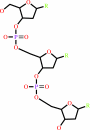 DNA(n)
|
+
|
2'-deoxyribonucleoside 5'-triphosphate
|
=
|
DNA(n+1)
|
+
|
 diphosphate
|
|
|
|
|
|
|
|
|
|
|
|
|
Molecule diagrams generated from .mol files obtained from the
KEGG ftp site
|
|
|
|
|
|
|
|
|
|
|
|
|
|
 |
|
|
|
|
|
|
| |
|
|
| |
|
DOI no:
|
Protein Sci
7:1116-1123
(1998)
|
|
PubMed id:
|
|
|
|
|
|
| |
|
Crystal structures of the Klenow fragment of Thermus aquaticus DNA polymerase I complexed with deoxyribonucleoside triphosphates.
|
|
Y.Li,
Y.Kong,
S.Korolev,
G.Waksman.
|
|
|
|
|
| |
ABSTRACT
|
|
|
|
| |
|
|
The crystal structures of the Klenow fragment of the Thermus aquaticus DNA
polymerase I (Klentaq1) complexed with four deoxyribonucleoside triphosphates
(dNTP) have been determined to 2.5 A resolution. The dNTPs bind adjacent to the
O helix of Klentaq1. The triphosphate moieties are at nearly identical positions
in all four complexes and are anchored by three positively charged residues,
Arg659, Lys663, and Arg587, and by two polar residues, His639 and Gln613. The
configuration of the base moieties in the Klentaq1/dNTP complexes demonstrates
variability suggesting that dNTP binding is primarily determined by recognition
and binding of the phosphate moiety. However, when superimposed on the Taq
polymerase/blunt end DNA complex structure (Eom et al., 1996), two of the
dNTP/Klentaq1 structures demonstrate appropriate stacking of the nucleotide base
with the 3' end of the DNA primer strand, suggesting that at least in these two
binary complexes, the observed dNTP conformations are functionally relevant.
|
|
|
|
|
|
| |
Selected figure(s)
|
|
|
|
| |
|
|

|
|

|
|
Figure 2.
Fig. 2. A: Schematic representation of the secondary structure of
Klentaql bound with dAW. The small vestigial 3â-5â exonuclease domain
is shown in yellow and the polymerase domaiins shown in green. The
secondarys tructure elements are labeled according to the notation of
Ollise t al. (1985). The helix 0 is shown in blue and tdhAeT P
molecule in red. The side chains of the three carboxylates, Asp610,
Asp785, Asp786, which form the catalytic core are shown in
purple. This figure was prepared using MOLSCRIPT and RASTER3D (Merritt
8c Murphy, 1994; Kraulis, 1991). B: Superimposition of the binary
complex of Klentaql bound to dCTP (this work; in purple) with the
binary complex of E. coli Klenow Pol I bound to dCTP ((Beese et al.,
1993); in pink). C Superimposition of d N T P s in the four
Klentaql/dNTP binary complexes. The binary complexoefs Klentaql with
dATP (green), dTTP (yellow), dCTP
(magenta), dGTP (cyan) were superimposed. The positions of the
triphosphaotef st he dNTP in the four complexa re nearly identical,
while those for the sugar and base differ. The orientation of the side
chain of Qr671 also differs in the four binary complexes. D:
Superimposition of the Klentaql/dCTP binary complex structure (in
purple) with the Taq/DNA complex structure of Eom et al.
(1996) (in yellow for the protein, and white and blue for the
template/primer DNA strands, respectively). The dCTP base is seen in a
stacking arrangement with the 3â end base of the primer strand,
suggesting that this complex is functionally relevant. (Figure
continues on facing page.)
|
|
Figure 3.
Fig. 3. Distances bwteen the nucleotides and interacting protein side chains.
Only potential H-bonds are shown. A: Klentaql with dATP.
B: Klentaql with dCTP. C: Klentaql with dGTP. D: Klentaql with dTTP.
|
|
|
|
|
|
| |
The above figures are
reprinted
from an Open Access publication published by the Protein Society:
Protein Sci
(1998,
7,
1116-1123)
copyright 1998.
|
|
| |
Figures were
selected
by an automated process.
|
|
|
|
|
|
|
|
|
|
|
|
|
|
|
|
 |
 |
 |
|
Literature references that cite this PDB file's key reference
|
|
|
| |
PubMed id
|
|
Reference
|
|
|
|
|
|
M.Yokoyama,
H.Mori,
and
H.Sato
(2010).
Allosteric regulation of HIV-1 reverse transcriptase by ATP for nucleotide selection.
|
| |
PLoS One,
5,
e8867.
|
|
|
|
|
|
|
R.G.Federley,
and
L.J.Romano
(2010).
DNA polymerase: structural homology, conformational dynamics, and the effects of carcinogenic DNA adducts.
|
| |
J Nucleic Acids,
2010,
0.
|
|
|
|
|
|
|
S.Obeid,
A.Baccaro,
W.Welte,
K.Diederichs,
and
A.Marx
(2010).
Structural basis for the synthesis of nucleobase modified DNA by Thermus aquaticus DNA polymerase.
|
| |
Proc Natl Acad Sci U S A,
107,
21327-21331.
|
|
|
PDB codes:
|
|
|
|
|
|
|
|
Y.Santoso,
C.M.Joyce,
O.Potapova,
L.Le Reste,
J.Hohlbein,
J.P.Torella,
N.D.Grindley,
and
A.N.Kapanidis
(2010).
Conformational transitions in DNA polymerase I revealed by single-molecule FRET.
|
| |
Proc Natl Acad Sci U S A,
107,
715-720.
|
|
|
|
|
|
|
A.L.Mikheikin,
H.K.Lin,
P.Mehta,
L.Jen-Jacobson,
and
M.A.Trakselis
(2009).
A trimeric DNA polymerase complex increases the native replication processivity.
|
| |
Nucleic Acids Res,
37,
7194-7205.
|
|
|
|
|
|
|
D.C.Tahmassebi,
and
D.P.Millar
(2009).
Fluorophore-quencher pair for monitoring protein motion.
|
| |
Biochem Biophys Res Commun,
380,
277-280.
|
|
|
|
|
|
|
J.N.Patro,
M.Urban,
and
R.D.Kuchta
(2009).
Interaction of human DNA polymerase alpha and DNA polymerase I from Bacillus stearothermophilus with hypoxanthine and 8-oxoguanine nucleotides.
|
| |
Biochemistry,
48,
8271-8278.
|
|
|
|
|
|
|
N.Hurt,
H.Wang,
M.Akeson,
and
K.R.Lieberman
(2009).
Specific nucleotide binding and rebinding to individual DNA polymerase complexes captured on a nanopore.
|
| |
J Am Chem Soc,
131,
3772-3778.
|
|
|
|
|
|
|
G.T.Hwang,
and
F.E.Romesberg
(2008).
Unnatural substrate repertoire of A, B, and X family DNA polymerases.
|
| |
J Am Chem Soc,
130,
14872-14882.
|
|
|
|
|
|
|
W.J.Allen,
P.J.Rothwell,
and
G.Waksman
(2008).
An intramolecular FRET system monitors fingers subdomain opening in Klentaq1.
|
| |
Protein Sci,
17,
401-408.
|
|
|
|
|
|
|
A.J.Berman,
S.Kamtekar,
J.L.Goodman,
J.M.Lázaro,
M.de Vega,
L.Blanco,
M.Salas,
and
T.A.Steitz
(2007).
Structures of phi29 DNA polymerase complexed with substrate: the mechanism of translocation in B-family polymerases.
|
| |
EMBO J,
26,
3494-3505.
|
|
|
PDB codes:
|
|
|
|
|
|
|
|
M.E.Arana,
K.Takata,
M.Garcia-Diaz,
R.D.Wood,
and
T.A.Kunkel
(2007).
A unique error signature for human DNA polymerase nu.
|
| |
DNA Repair (Amst),
6,
213-223.
|
|
|
|
|
|
|
O.Adelfinskaya,
M.Terrazas,
M.Froeyen,
P.Marlière,
K.Nauwelaerts,
and
P.Herdewijn
(2007).
Polymerase-catalyzed synthesis of DNA from phosphoramidate conjugates of deoxynucleotides and amino acids.
|
| |
Nucleic Acids Res,
35,
5060-5072.
|
|
|
|
|
|
|
R.T.Pomerantz,
D.Temiakov,
M.Anikin,
D.G.Vassylyev,
and
W.T.McAllister
(2006).
A mechanism of nucleotide misincorporation during transcription due to template-strand misalignment.
|
| |
Mol Cell,
24,
245-255.
|
|
|
|
|
|
|
P.J.Rothwell,
V.Mitaksov,
and
G.Waksman
(2005).
Motions of the fingers subdomain of klentaq1 are fast and not rate limiting: implications for the molecular basis of fidelity in DNA polymerases.
|
| |
Mol Cell,
19,
345-355.
|
|
|
|
|
|
|
R.Chen,
M.Yokoyama,
H.Sato,
C.Reilly,
and
L.M.Mansky
(2005).
Human immunodeficiency virus mutagenesis during antiviral therapy: impact of drug-resistant reverse transcriptase and nucleoside and nonnucleoside reverse transcriptase inhibitors on human immunodeficiency virus type 1 mutation frequencies.
|
| |
J Virol,
79,
12045-12057.
|
|
|
|
|
|
|
D.Temiakov,
V.Patlan,
M.Anikin,
W.T.McAllister,
S.Yokoyama,
and
D.G.Vassylyev
(2004).
Structural basis for substrate selection by t7 RNA polymerase.
|
| |
Cell,
116,
381-391.
|
|
|
PDB code:
|
|
|
|
|
|
|
|
I.Andricioaei,
A.Goel,
D.Herschbach,
and
M.Karplus
(2004).
Dependence of DNA polymerase replication rate on external forces: a model based on molecular dynamics simulations.
|
| |
Biophys J,
87,
1478-1497.
|
|
|
|
|
|
|
T.A.Steitz,
and
Y.W.Yin
(2004).
Accuracy, lesion bypass, strand displacement and translocation by DNA polymerases.
|
| |
Philos Trans R Soc Lond B Biol Sci,
359,
17-23.
|
|
|
|
|
|
|
Y.W.Yin,
and
T.A.Steitz
(2004).
The structural mechanism of translocation and helicase activity in T7 RNA polymerase.
|
| |
Cell,
116,
393-404.
|
|
|
PDB codes:
|
|
|
|
|
|
|
|
N.Paul,
V.C.Nashine,
G.Hoops,
P.Zhang,
J.Zhou,
D.E.Bergstrom,
and
V.J.Davisson
(2003).
DNA polymerase template interactions probed by degenerate isosteric nucleobase analogs.
|
| |
Chem Biol,
10,
815-825.
|
|
|
|
|
|
|
S.J.Johnson,
J.S.Taylor,
and
L.S.Beese
(2003).
Processive DNA synthesis observed in a polymerase crystal suggests a mechanism for the prevention of frameshift mutations.
|
| |
Proc Natl Acad Sci U S A,
100,
3895-3900.
|
|
|
PDB codes:
|
|
|
|
|
|
|
|
W.A.Beard,
and
S.H.Wilson
(2001).
DNA lesion bypass polymerases open up.
|
| |
Structure,
9,
759-764.
|
|
|
|
|
|
|
Y.Li,
and
G.Waksman
(2001).
Crystal structures of a ddATP-, ddTTP-, ddCTP, and ddGTP- trapped ternary complex of Klentaq1: insights into nucleotide incorporation and selectivity.
|
| |
Protein Sci,
10,
1225-1233.
|
|
|
|
|
|
|
J.Jäger,
and
J.D.Pata
(1999).
Getting a grip: polymerases and their substrate complexes.
|
| |
Curr Opin Struct Biol,
9,
21-28.
|
|
|
|
|
|
|
D.Arion,
N.Kaushik,
S.McCormick,
G.Borkow,
and
M.A.Parniak
(1998).
Phenotypic mechanism of HIV-1 resistance to 3'-azido-3'-deoxythymidine (AZT): increased polymerization processivity and enhanced sensitivity to pyrophosphate of the mutant viral reverse transcriptase.
|
| |
Biochemistry,
37,
15908-15917.
|
|
|
|
|
|
|
S.Doublié,
and
T.Ellenberger
(1998).
The mechanism of action of T7 DNA polymerase.
|
| |
Curr Opin Struct Biol,
8,
704-712.
|
|
|
|
|
|
|
Y.Li,
S.Korolev,
and
G.Waksman
(1998).
Crystal structures of open and closed forms of binary and ternary complexes of the large fragment of Thermus aquaticus DNA polymerase I: structural basis for nucleotide incorporation.
|
| |
EMBO J,
17,
7514-7525.
|
|
|
PDB codes:
|
|
|
|
|
|
|
The most recent references are shown first.
Citation data come partly from CiteXplore and partly
from an automated harvesting procedure. Note that this is likely to be
only a partial list as not all journals are covered by
either method. However, we are continually building up the citation data
so more and more references will be included with time.
Where a reference describes a PDB structure, the PDB
codes are
shown on the right.
|
|


 Links
Links


