|
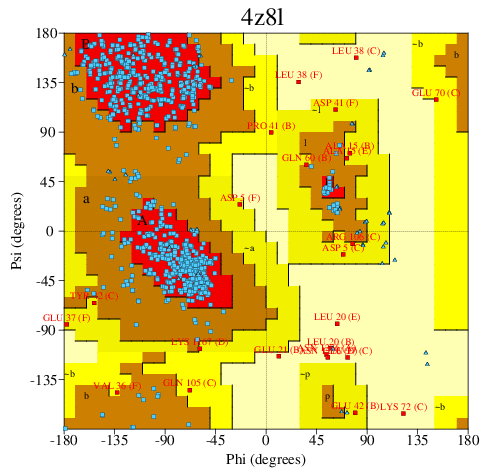
PDBsum entry 4z8l

|
|
|
|
|
|

|
|

|
|

|
|

|
|

|
|

|
|
|
 |

|

|
|
|
|
|
|
|
|
|
|
|
|
|
|
|
|
|
|
|
|
|
|
|
|
|
|
|
|
|
|
|
Viral protein/vpx-binding protein
|
PDB id
|
|
|
|
4z8l
|
|
|
|
|
|
|
|
|
|
|
|
|
|
|

|

|

|
|
|
|
|
|
|
|
 |
Contents |
 |
|
|
|
|
|
|
|
|
|
|
|

 305 a.a.
|
|
|
|
|
|
|
|
|
|
|

 79 a.a.
|
|
|
|
|
|
|
|
|
|
|
 92 a.a.
|
|
|
|
|
|
|
|
|
|
|
 95 a.a.
|
|
|
|
|
|
|
|
|
|
|
|
|
|
References listed in PDB file
|
|
|
Key reference
|
|
|
Title
|
|
Structural basis of clade-Specific engagement of samhd1 (sterile α motif and histidine/aspartate-Containing protein 1) restriction factors by lentiviral viral protein X (vpx) virulence factors.
|
|
|
Authors
|
|
Y.Wu,
L.M.Koharudin,
J.Mehrens,
M.Delucia,
C.H.Byeon,
I.J.Byeon,
G.Calero,
J.Ahn,
A.M.Gronenborn.
|
|
|
Ref.
|
|
J Biol Chem, 2015,
290,
17935-17945.
[DOI no: ]
|
|
|
PubMed id
|
|
|
|
|
|
Abstract
|
|
|
Sterile α motif (SAM) and histidine/aspartate (HD)-containing protein 1
(SAMHD1) restricts human/simian immunodeficiency virus infection in certain cell
types and is counteracted by the virulence factor Vpx. Current evidence
indicates that Vpx recruits SAMHD1 to the Cullin4-Ring Finger E3 ubiquitin
ligase (CRL4) by facilitating an interaction between SAMHD1 and the substrate
receptor DDB1- and Cullin4-associated factor 1 (DCAF1), thereby targeting SAMHD1
for proteasome-dependent down-regulation. Host-pathogen co-evolution and
positive selection at the interfaces of host-pathogen complexes are associated
with sequence divergence and varying functional consequences. Two alternative
interaction interfaces are used by SAMHD1 and Vpx: the SAMHD1 N-terminal tail
and the adjacent SAM domain or the C-terminal tail proceeding the HD domain are
targeted by different Vpx variants in a unique fashion. In contrast, the
C-terminal WD40 domain of DCAF1 interfaces similarly with the two above
complexes. Comprehensive biochemical and structural biology approaches permitted
us to delineate details of clade-specific recognition of SAMHD1 by lentiviral
Vpx proteins. We show that not only the SAM domain but also the N-terminal tail
engages in the DCAF1-Vpx interaction. Furthermore, we show that changing the
single Ser-52 in human SAMHD1 to Phe, the residue found in SAMHD1 of Red-capped
monkey and Mandrill, allows it to be recognized by Vpx proteins of simian
viruses infecting those primate species, which normally does not target wild
type human SAMHD1 for degradation.
|
|
|
|
|
|
|