 |
PDBsum entry 4yc7

|
|
|
|
|
|

|

|

|

|
|

|
|

|
|

|
|

|
|

|
|

|
|
|
 |

|

|
|
|
|
|
|
|
|
|
|
|
|
|
|
|
|
|
|
|
|
|
|
|
|
|
|
|
|
|
|
|
|
|
|
|
Signaling protein
|
PDB id
|
|
|
|
4yc7
|
|
|
|
|
|
|
|
|
|
|
|
|
|
|

|

|

|
|
|
|
|
|
|
|
|
|
|
Enzyme class 2:
|
|
Chain A:
E.C.3.6.5.2
- small monomeric GTPase.
|
|
|
|
|
|
|
Reaction:
|
|
GTP + H2O = GDP + phosphate + H+
|
|
|
|
|
|
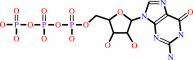 GTP
GTP
|
+
|
H2O
|
=
|
GDP
Bound ligand (Het Group name = )
matches with 81.82% similarity
|
+
|
 phosphate
|
+
|
H(+)
|
|
|
|
|
|
|
|
|
|
Enzyme class 3:
|
|
Chain B:
E.C.?
|
|
|
|
|
|
|
|
|
|
Note, where more than one E.C. class is given (as above), each may
correspond to a different protein domain or, in the case of polyprotein
precursors, to a different mature protein.
|
|
|
|
Molecule diagrams generated from .mol files obtained from the
KEGG ftp site
|
|
|
|
|
|
|
|
|
|
|
|
|
|
 |
|
|
|
|
|
|
| |
|
|
| |
|
DOI no:
|
Nat Commun
6:7088
(2015)
|
|
PubMed id:
|
|
|
|
|
|
| |
|
The structure of FMNL2-Cdc42 yields insights into the mechanism of lamellipodia and filopodia formation.
|
|
S.Kühn,
C.Erdmann,
F.Kage,
J.Block,
L.Schwenkmezger,
A.Steffen,
K.Rottner,
M.Geyer.
|
|
|
|
|
| |
ABSTRACT
|
|
|
|
| |
|
|
Formins are actin polymerization factors that elongate unbranched actin
filaments at the barbed end. Rho family GTPases activate Diaphanous-related
formins through the relief of an autoregulatory interaction. The crystal
structures of the N-terminal domains of human FMNL1 and FMNL2 in complex with
active Cdc42 show that Cdc42 mediates contacts with all five armadillo repeats
of the formin with specific interactions formed by the Rho-GTPase insert helix.
Mutation of three residues within Rac1 results in a gain-of-function mutation
for FMNL2 binding and reconstitution of the Cdc42 phenotype in vivo.
Dimerization of FMNL1 through a parallel coiled coil segment leads to formation
of an umbrella-shaped structure that-together with Cdc42-spans more than 15 nm
in diameter. The two interacting FMNL-Cdc42 heterodimers expose six membrane
interaction motifs on a convex protein surface, the assembly of which may
facilitate actin filament elongation at the leading edge of lamellipodia and
filopodia.
|
|
|
|
|
|
|
|
|
|
|
|
|
|
|
|
|
|
 |
 |
 |
|
|


 Links
Links


