 |
PDBsum entry 4xi9
|
|

|
|
PDB id:
|
|
|
|
| Name: |
|
Transferase
|
|
|
Title:
|
|
Human ogt in complex with udp-5s-glcnac and substrate peptide (rbl2)
|
|
Structure:
|
|
Udp-n-acetylglucosamine--peptide n- acetylglucosaminyltransferase 110 kda subunit. Chain: a, b, c, d. Fragment: unp residues 323-1041. Synonym: o-glcnac transferase subunit p110,o-linked n- acetylglucosamine transferase 110 kda subunit,ogt. Engineered: yes. Retinoblastoma-like protein 2. Chain: e, f, g, h.
|
|
Source:
|
|
Homo sapiens. Human. Organism_taxid: 9606. Gene: ogt. Expressed in: escherichia coli. Expression_system_taxid: 562. Synthetic: yes. Organism_taxid: 9606
|
|
Resolution:
|
|
|
3.10Å
|
R-factor:
|
0.203
|
R-free:
|
0.223
|
|
|
Authors:
|
|
M.Schimpl,D.M.F.Van Aalten
|
|
Key ref:
|
|
S.Pathak
et al.
(2015).
The active site of O-GlcNAc transferase imposes constraints on substrate sequence.
Nat Struct Biol,
22,
744-750.
PubMed id:
DOI:
|
|
|
Date:
|
|
|
06-Jan-15
|
Release date:
|
05-Aug-15
|
|
|
|
|
|
|
PROCHECK
|

|
|
|
|
|
Headers
|
|
|
|
References
|
|
|
|
|
|

|
|
O15294
(OGT1_HUMAN) -
UDP-N-acetylglucosamine--peptide N-acetylglucosaminyltransferase 110 kDa subunit from Homo sapiens
|
|
|
|
Seq:
Struc:
|
|
|
|
1046 a.a.
698 a.a.*
|
|

|

|
|
|
|
|
|
|
|
|
|
|
|
Key: |
 |
PfamA domain |
|
|
 |
Secondary structure |
|
 |
CATH domain |
|
|
*
PDB and UniProt seqs differ
at 1 residue position (black
cross)
|
|
|
|
|
|
|
|
|
|
|
|
|
Enzyme class:
|
|
E.C.2.4.1.255
- protein O-GlcNAc transferase.
|
|
|
|
|
|
|
Reaction:
|
|
|
1.
|
L-seryl-[protein] + UDP-N-acetyl-alpha-D-glucosamine = 3-O-(N-acetyl- beta-D-glucosaminyl)-L-seryl-[protein] + UDP + H+
|
|
2.
|
L-threonyl-[protein] + UDP-N-acetyl-alpha-D-glucosamine = 3-O- (N-acetyl-beta-D-glucosaminyl)-L-threonyl-[protein] + UDP + H+
|
|
|
|
|
|
|
L-seryl-[protein]
|
+
|
UDP-N-acetyl-alpha-D-glucosamine
|
=
|
3-O-(N-acetyl- beta-D-glucosaminyl)-L-seryl-[protein]
|
+
|
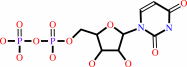 UDP
UDP
|
+
|
H(+)
Bound ligand (Het Group name = )
matches with 64.10% similarity
|
|
|
|
|
|
|
L-threonyl-[protein]
|
+
|
UDP-N-acetyl-alpha-D-glucosamine
|
=
|
3-O- (N-acetyl-beta-D-glucosaminyl)-L-threonyl-[protein]
|
+
|
UDP
|
+
|
H(+)
Bound ligand (Het Group name = )
matches with 64.10% similarity
|
|
|
|
|
|
|
|
|
|
|
|
|
Molecule diagrams generated from .mol files obtained from the
KEGG ftp site
|
|
|
|
|
|
|
|
|
|
|
|
|
|
 |
|
|
|
|
|
|
| |
|
|
| |
|
DOI no:
|
Nat Struct Biol
22:744-750
(2015)
|
|
PubMed id:
|
|
|
|
|
|
| |
|
The active site of O-GlcNAc transferase imposes constraints on substrate sequence.
|
|
S.Pathak,
J.Alonso,
M.Schimpl,
K.Rafie,
D.E.Blair,
V.S.Borodkin,
A.W.Schüttelkopf,
O.Albarbarawi,
D.M.van Aalten.
|
|
|
|
|
| |
ABSTRACT
|
|
|
|
| |
|
|
O-GlcNAc transferase (OGT) glycosylates a diverse range of intracellular
proteins with O-linked N-acetylglucosamine (O-GlcNAc), an essential and dynamic
post-translational modification in metazoans. Although this enzyme modifies
hundreds of proteins with O-GlcNAc, it is not understood how OGT achieves
substrate specificity. In this study, we describe the application of a
high-throughput OGT assay to a library of peptides. We mapped sites of O-GlcNAc
modification by electron transfer dissociation MS and found that they correlate
with previously detected O-GlcNAc sites. Crystal structures of four acceptor
peptides in complex with Homo sapiens OGT suggest that a combination of size and
conformational restriction defines sequence specificity in the -3 to +2
subsites. This work reveals that although the N-terminal TPR repeats of OGT may
have roles in substrate recognition, the sequence restriction imposed by the
peptide-binding site makes a substantial contribution to O-GlcNAc site
specificity.
|
|
|
|
|
|
|
|
|
|
|
|
|
|
|
|
|
|
 |
 |
 |
|


 Links
Links


