 |
PDBsum entry 4wys
|
|

|
|
PDB id:
|
|
|
|
| Name: |
|
Transferase
|
|
|
Title:
|
|
Crystal structure of thiolase from escherichia coli
|
|
Structure:
|
|
Acetyl-coa acetyltransferase. Chain: a, b, c, d. Synonym: acetoacetyl-coa thiolase. Engineered: yes
|
|
Source:
|
|
Escherichia coli. Organism_taxid: 83333. Strain: k12. Gene: atob, b2224, jw2218. Expressed in: escherichia coli. Expression_system_taxid: 562.
|
|
Resolution:
|
|
|
2.10Å
|
R-factor:
|
0.172
|
R-free:
|
0.218
|
|
|
Authors:
|
|
S.Kim,S.C.Ha,J.W.Ahn,E.J.Kim,J.H.Lim,K.J.Kim
|
|
Key ref:
|
|
S.Kim
et al.
(2015).
Redox-switch regulatory mechanism of thiolase from Clostridium acetobutylicum.
Nat Commun,
6,
8410.
PubMed id:
DOI:
|
|
|
Date:
|
|
|
18-Nov-14
|
Release date:
|
07-Oct-15
|
|
|
|
|
|
|
PROCHECK
|

|
|
|
|
|
Headers
|
|
|
|
References
|
|
|
|
|
|

|
|
P76461
(ATOB_ECOLI) -
Acetyl-CoA acetyltransferase from Escherichia coli (strain K12)
|
|
|
|
Seq:
Struc:
|
|
|
|
394 a.a.
396 a.a.
|
|

|

|

|
|
|
|
|
|
|
|
|
|
|
Key: |
 |
PfamA domain |
|
|
 |
Secondary structure |
|
 |
CATH domain |
|
|
|
|
|
|
|
|
|
|
|
|
|
Enzyme class:
|
|
E.C.2.3.1.9
- acetyl-CoA C-acetyltransferase.
|
|
|
|
|
|
|
Pathway:
|
|
Mevalonate Biosynthesis
|
|
|
|
|
|
Reaction:
|
|
2 acetyl-CoA = acetoacetyl-CoA + CoA
|
|
|
|
|
|
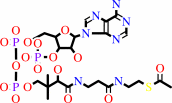 2
×
acetyl-CoA
2
×
acetyl-CoA
|
=
|
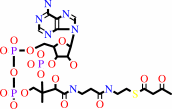 acetoacetyl-CoA
|
+
|
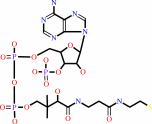 CoA
CoA
|
|
|
|
|
|
|
|
|
|
|
|
|
Molecule diagrams generated from .mol files obtained from the
KEGG ftp site
|
|
|
|
|
|
|
|
|
|
|
|
|
|
 |
|
|
|
|
|
|
| |
|
|
| |
|
DOI no:
|
Nat Commun
6:8410
(2015)
|
|
PubMed id:
|
|
|
|
|
|
| |
|
Redox-switch regulatory mechanism of thiolase from Clostridium acetobutylicum.
|
|
S.Kim,
Y.S.Jang,
S.C.Ha,
J.W.Ahn,
E.J.Kim,
J.H.Lim,
C.Cho,
Y.S.Ryu,
S.K.Lee,
S.Y.Lee,
K.J.Kim.
|
|
|
|
|
| |
ABSTRACT
|
|
|
|
| |
|
|
Thiolase is the first enzyme catalysing the condensation of two acetyl-coenzyme
A (CoA) molecules to form acetoacetyl-CoA in a dedicated pathway towards the
biosynthesis of n-butanol, an important solvent and biofuel. Here we elucidate
the crystal structure of Clostridium acetobutylicum thiolase (CaTHL) in its
reduced/oxidized states. CaTHL, unlike those from other aerobic bacteria such as
Escherichia coli and Zoogloea ramegera, is regulated by the redox-switch
modulation through reversible disulfide bond formation between two catalytic
cysteine residues, Cys88 and Cys378. When CaTHL is overexpressed in wild-type C.
acetobutylicum, butanol production is reduced due to the disturbance of
acidogenic to solventogenic shift. The CaTHL(V77Q/N153Y/A286K) mutant, which is
not able to form disulfide bonds, exhibits higher activity than wild-type CaTHL,
and enhances butanol production upon overexpression. On the basis of these
results, we suggest that CaTHL functions as a key enzyme in the regulation of
the main metabolism of C. acetobutylicum through a redox-switch regulatory
mechanism.
|
|
|
|
|
|
|
|
|
|
|
|
|
|
|
|
|
|
 |
 |
 |
|


 Links
Links


