 |
PDBsum entry 4wnm

|
|
|
|
|
|

|

|

|

|
|

|
|

|
|

|
|

|
|

|
|
|
 |

|

|
|
|
|
|
|
|
|
|
|
|
|
|
|
|
|
|
|
|
|
|
|
|
|
|
|
|
|
|
|
|
|
|
|
Transferase/transferase inhibitor
|
PDB id
|
|
|
|
4wnm
|
|
|
|
|
|
|
|
|
|
|
|
|
|
|

|

|

|
|
|
|
|
|
|
|
|
Enzyme class:
|
|
E.C.2.7.10.2
- non-specific protein-tyrosine kinase.
|
|
|
|
|
|
|
Reaction:
|
|
L-tyrosyl-[protein] + ATP = O-phospho-L-tyrosyl-[protein] + ADP + H+
|
|
|
|
|
|
L-tyrosyl-[protein]
|
+
|
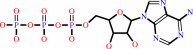 ATP
ATP
|
=
|
O-phospho-L-tyrosyl-[protein]
|
+
|
 ADP
ADP
|
+
|
H(+)
|
|
|
|
|
|
|
|
|
|
|
|
|
Molecule diagrams generated from .mol files obtained from the
KEGG ftp site
|
|
|
|
|
|
|
|
|
|
|
|
|
|
 |
|
|
|
|
|
|
| |
|
|
| |
|
DOI no:
|
Plos One
11:e0145705
(2016)
|
|
PubMed id:
|
|
|
|
|
|
| |
|
A Novel Triazolopyridine-Based Spleen Tyrosine Kinase Inhibitor That Arrests Joint Inflammation.
|
|
G.D.Ferguson,
M.Delgado,
V.Plantevin-Krenitsky,
K.Jensen-Pergakes,
R.J.Bates,
S.Torres,
M.Celeridad,
H.Brown,
K.Burnett,
L.Nadolny,
L.Tehrani,
G.Packard,
B.Pagarigan,
J.Haelewyn,
T.Nguyen,
L.Xu,
Y.Tang,
M.Hickman,
F.Baculi,
S.Pierce,
K.Miyazawa,
P.Jackson,
P.Chamberlain,
L.LeBrun,
W.Xie,
B.Bennett,
K.Blease.
|
|
|
|
|
| |
ABSTRACT
|
|
|
|
| |
|
|
Autoantibodies and the immunoreceptors to which they bind can contribute to the
pathogenesis of autoimmune diseases such as rheumatoid arthritis (RA). Spleen
Tyrosine Kinase (Syk) is a non-receptor tyrosine kinase with a central role in
immunoreceptor (FcR) signaling and immune cell functionality. Syk kinase
inhibitors have activity in antibody-dependent immune cell activation assays, in
preclinical models of arthritis, and have progressed into clinical trials for RA
and other autoimmune diseases. Here we describe the characterization of a novel
triazolopyridine-based Syk kinase inhibitor, CC-509. This compound is a potent
inhibitor of purified Syk enzyme, FcR-dependent and FcR-independent signaling in
primary immune cells, and basophil activation in human whole blood. CC-509 is
moderately selective across the kinome and against other non-kinase enzymes or
receptors. Importantly, CC-509 was optimized away from and has modest activity
against cellular KDR and Jak2, kinases that when inhibited in a preclinical and
clinical setting may promote hypertension and neutropenia, respectively. In
addition, CC-509 is orally bioavailable and displays dose-dependent efficacy in
two rodent models of immune-inflammatory disease. In passive cutaneous
anaphylaxis (PCA), CC-509 significantly inhibited skin edema. Moreover, CC-509
significantly reduced paw swelling and the tissue levels of pro-inflammatory
cytokines RANTES and MIP-1α in the collagen-induced arthritis (CIA) model. In
summary, CC-509 is a potent, moderately selective, and efficacious inhibitor of
Syk that has a differentiated profile when compared to other Syk compounds that
have progressed into the clinic for RA.
|
|
|
|
|
|
|
|
|
|
|
|
|
|
|
|
|
|
 |
 |
 |
|


 Links
Links


