 |
PDBsum entry 4rx5
|
|

|
|
PDB id:
|
|
|
|
| Name: |
|
Transferase
|
|
|
Title:
|
|
Bruton's tyrosine kinase (btk) with pyridazinone compound 23
|
|
Structure:
|
|
Tyrosine-protein kinase btk. Chain: a. Fragment: kinase domain (unp residues 393-657). Synonym: agammaglobulinemia tyrosine kinase, atk, b-cell progenitor kinase, bpk, bruton tyrosine kinase. Engineered: yes
|
|
Source:
|
|
Homo sapiens. Human. Organism_taxid: 9606. Gene: btk, agmx1, atk, bpk. Expressed in: spodoptera frugiperda. Expression_system_taxid: 7108
|
|
Resolution:
|
|
|
1.36Å
|
R-factor:
|
0.161
|
R-free:
|
0.179
|
|
|
Authors:
|
|
C.Eigenbrot,C.Yu
|
|
Key ref:
|
|
W.B.Young
et al.
(2016).
Discovery of highly potent and selective Bruton's tyrosine kinase inhibitors: Pyridazinone analogs with improved metabolic stability.
Bioorg Med Chem Lett,
26,
575-579.
PubMed id:
DOI:
|
|
|
Date:
|
|
|
08-Dec-14
|
Release date:
|
02-Dec-15
|
|
|
|
|
|
|
PROCHECK
|

|
|
|
|
|
Headers
|
|
|
|
References
|
|
|
|
|
|

|
|
Q06187
(BTK_HUMAN) -
Tyrosine-protein kinase BTK from Homo sapiens
|
|
|
|
Seq:
Struc:
|
|
|
|
659 a.a.
265 a.a.*
|
|

|

|
|
|
|
|
|
|
|
|
|
|
|
Key: |
|
 |
Secondary structure |
|
 |
CATH domain |
|
|
*
PDB and UniProt seqs differ
at 1 residue position (black
cross)
|
|
|
|
|
|
|
|
|
|
|
|
|
Enzyme class:
|
|
E.C.2.7.10.2
- non-specific protein-tyrosine kinase.
|
|
|
|
|
|
|
Reaction:
|
|
L-tyrosyl-[protein] + ATP = O-phospho-L-tyrosyl-[protein] + ADP + H+
|
|
|
|
|
|
L-tyrosyl-[protein]
|
+
|
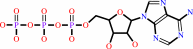 ATP
ATP
|
=
|
O-phospho-L-tyrosyl-[protein]
|
+
|
 ADP
ADP
|
+
|
H(+)
|
|
|
|
|
|
|
|
|
|
|
|
|
Molecule diagrams generated from .mol files obtained from the
KEGG ftp site
|
|
|
|
|
|
|
|
|
|
|
|
|
|
 |
|
|
|
|
|
|
| |
|
|
| |
|
DOI no:
|
Bioorg Med Chem Lett
26:575-579
(2016)
|
|
PubMed id:
|
|
|
|
|
|
| |
|
Discovery of highly potent and selective Bruton's tyrosine kinase inhibitors: Pyridazinone analogs with improved metabolic stability.
|
|
W.B.Young,
J.Barbosa,
P.Blomgren,
M.C.Bremer,
J.J.Crawford,
D.Dambach,
C.Eigenbrot,
S.Gallion,
A.R.Johnson,
J.E.Kropf,
S.H.Lee,
L.Liu,
J.W.Lubach,
J.Macaluso,
P.Maciejewski,
S.A.Mitchell,
D.F.Ortwine,
J.Di Paolo,
K.Reif,
H.Scheerens,
A.Schmitt,
X.Wang,
H.Wong,
J.M.Xiong,
J.Xu,
C.Yu,
Z.Zhao,
K.S.Currie.
|
|
|
|
|
| |
ABSTRACT
|
|
|
|
| |
|
|
BTK inhibitor GDC-0834 (1) was found to be rapidly metabolized in human studies,
resulting in a suspension of clinical trials. The primary route of metabolism
was through cleavage of the acyclic amide bond connecting the terminal
tetrahydrobenzothiophene with the central linker aryl ring. SAR studies were
focused on reducing metabolic cleavage of this amide, and resulted in the
identification of several central aryl linker substituents that conferred
improved stability. The most promising substituted aryl linkers were then
incorporated into an optimized pyridazinone scaffold, resulting in the
identification of lead analog 23, possessing improved potency, metabolic
stability and preclinical properties.
|
|
|
|
|
|
|
|
|
|
|
|
|
|
|
|
|
|
 |
 |
 |
|


 Links
Links


