 |
PDBsum entry 4riy
|
|
 |
|
|
|
|
|
|
Enzyme class:
|
|
Chains A, B, C, D:
E.C.2.7.10.1
- receptor protein-tyrosine kinase.
|
|
|
|
|
|
|
Reaction:
|
|
L-tyrosyl-[protein] + ATP = O-phospho-L-tyrosyl-[protein] + ADP + H+
|
|
|
|
|
|
L-tyrosyl-[protein]
|
+
|
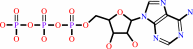 ATP
ATP
|
=
|
O-phospho-L-tyrosyl-[protein]
Bound ligand (Het Group name = )
corresponds exactly
|
+
|
 ADP
ADP
|
+
|
H(+)
|
|
|
|
|
|
|
|
|
|
|
|
|
Molecule diagrams generated from .mol files obtained from the
KEGG ftp site
|
|
|
|
|
|
|
|
|
|
|
|
|
|
 |
|
|
|
|
|
|
| |
|
|
| |
|
DOI no:
|
Sci Signal
7:ra114
(2014)
|
|
PubMed id:
|
|
|
|
|
|
| |
|
Structural analysis of the EGFR/HER3 heterodimer reveals the molecular basis for activating HER3 mutations.
|
|
P.Littlefield,
L.Liu,
V.Mysore,
Y.Shan,
D.E.Shaw,
N.Jura.
|
|
|
|
|
| |
ABSTRACT
|
|
|
|
| |
|
|
The human epidermal growth factor receptor (HER) tyrosine kinases homo- and
heterodimerize to activate downstream signaling pathways. HER3 is a
catalytically impaired member of the HER family that contributes to the
development of several human malignancies and is mutated in a subset of cancers.
HER3 signaling depends on heterodimerization with a catalytically active
partner, in particular epidermal growth factor receptor (EGFR) (the founding
family member, also known as HER1) or HER2. The activity of homodimeric
complexes of catalytically active HER family members depends on allosteric
activation between the two kinase domains. To determine the structural basis for
HER3 signaling through heterodimerization with a catalytically active HER family
member, we solved the crystal structure of the heterodimeric complex formed by
the isolated kinase domains of EGFR and HER3. The structure showed HER3 as an
allosteric activator of EGFR and revealed a conserved role of the allosteric
mechanism in activation of HER family members through heterodimerization. To
understand the effects of cancer-associated HER3 mutations at the molecular
level, we solved the structures of two kinase domains of HER3 mutants, each in a
heterodimeric complex with the kinase domain of EGFR. These structures, combined
with biochemical analysis and molecular dynamics simulations, indicated that the
cancer-associated HER3 mutations enhanced the allosteric activator function of
HER3 by redesigning local interactions at the dimerization interface.
|
|
|
|
|
|
|
|
|
|
|
|
|
|
|
|
|
|
 |
 |
 |
|
|


 Links
Links


