 |
PDBsum entry 4qps

|
|
|
|
|
|

|

|

|

|
|

|
|

|
|

|
|

|
|

|
|
|
 |

|

|
|
|
|
|
|
|
|
|
|
|
|
|
|
|
|
|
|
|
|
|
|
|
|
|
|
|
|
|
|
|
|
|
|
Transferase/transferase inhibitor
|
PDB id
|
|
|
|
4qps
|
|
|
|
|
|
|
|
|
|
|
|
|
|
|

|

|

|
|
|
|
|
|
|
|
|
|
|
Enzyme class:
|
|
Chains A, C:
E.C.2.7.10.2
- non-specific protein-tyrosine kinase.
|
|
|
|
|
|
|
Reaction:
|
|
L-tyrosyl-[protein] + ATP = O-phospho-L-tyrosyl-[protein] + ADP + H+
|
|
|
|
|
|
L-tyrosyl-[protein]
|
+
|
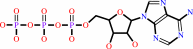 ATP
ATP
|
=
|
O-phospho-L-tyrosyl-[protein]
|
+
|
 ADP
ADP
|
+
|
H(+)
|
|
|
|
|
|
|
|
|
|
|
|
|
Molecule diagrams generated from .mol files obtained from the
KEGG ftp site
|
|
|
|
|
|
|
|
|
|
|
|
|
|
 |
|
|
|
|
|
|
| |
|
|
| |
|
DOI no:
|
J Biol Chem
290:4573-4589
(2015)
|
|
PubMed id:
|
|
|
|
|
|
| |
|
Tricyclic covalent inhibitors selectively target Jak3 through an active site thiol.
|
|
E.R.Goedken,
M.A.Argiriadi,
D.L.Banach,
B.A.Fiamengo,
S.E.Foley,
K.E.Frank,
J.S.George,
C.M.Harris,
A.D.Hobson,
D.C.Ihle,
D.Marcotte,
P.J.Merta,
M.E.Michalak,
S.E.Murdock,
M.J.Tomlinson,
J.W.Voss.
|
|
|
|
|
| |
ABSTRACT
|
|
|
|
| |
|
|
The action of Janus kinases (JAKs) is required for multiple cytokine signaling
pathways, and as such, JAK inhibitors hold promise for treatment of autoimmune
disorders, including rheumatoid arthritis, inflammatory bowel disease, and
psoriasis. However, due to high similarity in the active sites of the four
members (Jak1, Jak2, Jak3, and Tyk2), developing selective inhibitors within
this family is challenging. We have designed and characterized substituted,
tricyclic Jak3 inhibitors that selectively avoid inhibition of the other JAKs.
This is accomplished through a covalent interaction between an inhibitor
containing a terminal electrophile and an active site cysteine (Cys-909). We
found that these ATP competitive compounds are irreversible inhibitors of Jak3
enzyme activity in vitro. They possess high selectivity against other kinases
and can potently (IC50 < 100 nm) inhibit Jak3 activity in cell-based assays.
These results suggest irreversible inhibitors of this class may be useful
selective agents, both as tools to probe Jak3 biology and potentially as
therapies for autoimmune diseases.
|
|
|
|
|
|
|
|
|
|
|
|
|
|
|
|
|
|
 |
 |
 |
|
|


 Links
Links


