 |
PDBsum entry 4nqk

|
|
|
|
|
|

|

|

|

|
|

|
|

|
|

|
|
|
 |

|

|
|
|
|
|
|
|
|
|
|
|
|
|
|
|
|
|
|
|
|
|
|
|
|
|
|
|
|
|
|
|
|
Hydrolase/apoptosis
|
PDB id
|
|
|
|
4nqk
|
|
|
|
|
|
|
|
|
|
|
|
|
|
|

|

|

|
|
|
|
|
|
|
|
 |
Contents |
 |
|
|
|
|
|
|
|
|
|
|
|


 188 a.a.
|
|
|
|
|
|
|
|
|
|
|


 (+ 0 more)
72 a.a.
(+ 0 more)
72 a.a.
|
|
|
|
|
|
|
|
|
|
|
PDB id:
|
|
|
|
| Name: |
|
Hydrolase/apoptosis
|
|
|
Title:
|
|
Structure of an ubiquitin complex
|
|
Structure:
|
|
Probable atp-dependent RNA helicase ddx58. Chain: a, b, c, d. Fragment: n-terminal tandem card domain, unp residues 1-200. Synonym: dead box protein 58, rig-i-like receptor 1, rlr-1, retinoic acid-inducible gene 1 protein, rig-1, retinoic acid-inducible gene i protein, rig-i. Engineered: yes. Ubiquitin. Chain: e, f, g, h, i, j.
|
|
Source:
|
|
Homo sapiens. Human. Organism_taxid: 9606. Gene: ddx58. Expressed in: escherichia coli. Expression_system_taxid: 562. Gene: ubc. Expression_system_taxid: 562
|
|
Resolution:
|
|
|
3.70Å
|
R-factor:
|
0.225
|
R-free:
|
0.285
|
|
|
Authors:
|
|
A.Peisley,B.Wu,S.Hur
|
|
Key ref:
|
|
A.Peisley
et al.
(2014).
Structural basis for ubiquitin-mediated antiviral signal activation by RIG-I.
Nature,
509,
110-114.
PubMed id:
DOI:
|
|
|
Date:
|
|
|
25-Nov-13
|
Release date:
|
05-Mar-14
|
|
|
|
|
|
|
PROCHECK
|

|
|
|
|
|
Headers
|
|
|
|
References
|
|
|
|
|
|
|
|
|
|
|
|
Enzyme class 2:
|
|
Chains A, B, C, D:
E.C.3.6.4.13
- Rna helicase.
|
|
|
|
|
|
|
Reaction:
|
|
ATP + H2O = ADP + phosphate + H+
|
|
|
|
|
|
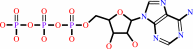 ATP
ATP
|
+
|
H2O
|
=
|
 ADP
ADP
|
+
|
 phosphate
|
+
|
H(+)
|
|
|
|
|
|
|
|
|
|
Enzyme class 3:
|
|
Chains E, F, G, H, I, J:
E.C.?
|
|
|
|
|
|
|
|
|
|
Note, where more than one E.C. class is given (as above), each may
correspond to a different protein domain or, in the case of polyprotein
precursors, to a different mature protein.
|
|
|
|
Molecule diagrams generated from .mol files obtained from the
KEGG ftp site
|
|
|
|
|
|
|
|
|
|
|
|
|
|
 |
|
|
|
|
|
|
| |
|
|
| |
|
DOI no:
|
Nature
509:110-114
(2014)
|
|
PubMed id:
|
|
|
|
|
|
| |
|
Structural basis for ubiquitin-mediated antiviral signal activation by RIG-I.
|
|
A.Peisley,
B.Wu,
H.Xu,
Z.J.Chen,
S.Hur.
|
|
|
|
|
| |
ABSTRACT
|
|
|
|
| |
|
|
Ubiquitin (Ub) has important roles in a wide range of intracellular signalling
pathways. In the conventional view, ubiquitin alters the signalling activity of
the target protein through covalent modification, but accumulating evidence
points to the emerging role of non-covalent interaction between ubiquitin and
the target. In the innate immune signalling pathway of a viral RNA sensor,
RIG-I, both covalent and non-covalent interactions with K63-linked ubiquitin
chains (K63-Ubn) were shown to occur in its signalling domain, a tandem caspase
activation and recruitment domain (hereafter referred to as 2CARD). Non-covalent
binding of K63-Ubn to 2CARD induces its tetramer formation, a requirement for
downstream signal activation. Here we report the crystal structure of the
tetramer of human RIG-I 2CARD bound by three chains of K63-Ub2. 2CARD assembles
into a helical tetramer resembling a 'lock-washer', in which the tetrameric
surface serves as a signalling platform for recruitment and activation of the
downstream signalling molecule, MAVS. Ubiquitin chains are bound along the outer
rim of the helical trajectory, bridging adjacent subunits of 2CARD and
stabilizing the 2CARD tetramer. The combination of structural and functional
analyses reveals that binding avidity dictates the K63-linkage and chain-length
specificity of 2CARD, and that covalent ubiquitin conjugation of 2CARD further
stabilizes the Ub-2CARD interaction and thus the 2CARD tetramer. Our work
provides unique insights into the novel types of ubiquitin-mediated
signal-activation mechanism, and previously unexpected synergism between the
covalent and non-covalent ubiquitin interaction modes.
|
|
|
|
|
|
|
|
|
|
|
|
|
|
|
|
|
|
 |
 |
 |
|
|


 Links
Links


