 |
PDBsum entry 4m3q

|
|
|
|
|
|

|

|

|

|
|

|
|

|
|

|
|

|
|

|
|

|
|

|
|
|
 |

|

|
|
|
|
|
|
|
|
|
|
|
|
|
|
|
|
|
|
|
|
|
|
|
|
|
|
|
|
|
|
|
|
|
|
|
|
Transferase/transferase inhibitor
|
PDB id
|
|
|
|
4m3q
|
|
|
|
|
|
|
|
|
|
|
|
|
|
|

|

|

|
|
|
|
|
|
|
PDB id:
|
|
|
|
| Name: |
|
Transferase/transferase inhibitor
|
|
|
Title:
|
|
Crystal structure of the catalytic domain of the proto-oncogene tyrosine-protein kinase mer in complex with inhibitor unc1917
|
|
Structure:
|
|
Tyrosine-protein kinase mer. Chain: a, b. Fragment: catalytic domain, unp residues 570-864. Synonym: proto-oncogenE C-mer, receptor tyrosine kinase mertk. Engineered: yes
|
|
Source:
|
|
Homo sapiens. Human. Organism_taxid: 9606. Gene: mer, mertk. Expressed in: escherichia coli. Expression_system_taxid: 469008.
|
|
Resolution:
|
|
|
2.72Å
|
R-factor:
|
0.248
|
R-free:
|
0.296
|
|
|
Authors:
|
|
W.Zhang,D.Zhang,M.A.Stashko,D.Deryckere,D.Hunter,D.B.Kireev,M.Miley, C.Cummings,M.Lee,J.Norris-Drouin,W.M.Stewart,S.Sather,Y.Zhou, G.Kirkpatrick,M.Machius,W.P.Janzen,H.S.Earp,D.K.Graham,S.Frye,X.Wang
|
|
Key ref:
|
|
W.Zhang
et al.
(2013).
Pseudo-cyclization through intramolecular hydrogen bond enables discovery of pyridine substituted pyrimidines as new Mer kinase inhibitors.
J Med Chem,
56,
9683-9692.
PubMed id:
DOI:
|
|
|
Date:
|
|
|
06-Aug-13
|
Release date:
|
27-Nov-13
|
|
|
|
|
|
|
PROCHECK
|

|
|
|
|
|
Headers
|
|
|
|
References
|
|
|
|
|
|
|
|
|
|
|
|
Enzyme class:
|
|
Chains A, B:
E.C.2.7.10.1
- receptor protein-tyrosine kinase.
|
|
|
|
|
|
|
Reaction:
|
|
L-tyrosyl-[protein] + ATP = O-phospho-L-tyrosyl-[protein] + ADP + H+
|
|
|
|
|
|
L-tyrosyl-[protein]
|
+
|
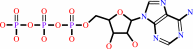 ATP
ATP
|
=
|
O-phospho-L-tyrosyl-[protein]
|
+
|
 ADP
ADP
|
+
|
H(+)
|
|
|
|
|
|
|
|
|
|
|
|
|
Molecule diagrams generated from .mol files obtained from the
KEGG ftp site
|
|
|
|
|
|
|
|
|
|
|
|
|
|
 |
|
|
|
|
|
|
| |
|
|
| |
|
DOI no:
|
J Med Chem
56:9683-9692
(2013)
|
|
PubMed id:
|
|
|
|
|
|
| |
|
Pseudo-cyclization through intramolecular hydrogen bond enables discovery of pyridine substituted pyrimidines as new Mer kinase inhibitors.
|
|
W.Zhang,
D.Zhang,
M.A.Stashko,
D.DeRyckere,
D.Hunter,
D.Kireev,
M.J.Miley,
C.Cummings,
M.Lee,
J.Norris-Drouin,
W.M.Stewart,
S.Sather,
Y.Zhou,
G.Kirkpatrick,
M.Machius,
W.P.Janzen,
H.S.Earp,
D.K.Graham,
S.V.Frye,
X.Wang.
|
|
|
|
|
| |
ABSTRACT
|
|
|
|
| |
|
|
Abnormal activation or overexpression of Mer receptor tyrosine kinase has been
implicated in survival signaling and chemoresistance in many human cancers.
Consequently, Mer is a promising novel cancer therapeutic target. A
structure-based drug design approach using a pseudo-ring replacement strategy
was developed and validated to discover a new family of pyridinepyrimidine
analogues as potent Mer inhibitors. Through SAR studies, 10 (UNC2250) was
identified as the lead compound for further investigation based on high
selectivity against other kinases and good pharmacokinetic properties. When
applied to live cells, 10 inhibited steady-state phosphorylation of endogenous
Mer with an IC50 of 9.8 nM and blocked ligand-stimulated activation of a
chimeric EGFR-Mer protein. Treatment with 10 also resulted in decreased
colony-forming potential in rhabdoid and NSCLC tumor cells, thereby
demonstrating functional antitumor activity. The results provide a rationale for
further investigation of this compound for therapeutic application in patients
with cancer.
|
|
|
|
|
|
|
|
|
|
|
|
|
|
|
|
|
|
 |
 |
 |
|
|


 Links
Links


