 |
PDBsum entry 4m13

|
|
|
|
|
|

|

|

|

|
|

|
|

|
|

|
|

|
|

|
|
|
 |

|

|
|
|
|
|
|
|
|
|
|
|
|
|
|
|
|
|
|
|
|
|
|
|
|
|
|
|
|
|
|
|
|
|
|
Transferase/transferase inhibitor
|
PDB id
|
|
|
|
4m13
|
|
|
|
|
|
|
|
|
|
|
|
|
|
|

|

|

|
|
|
|
|
|
|
|
|
Enzyme class:
|
|
E.C.2.7.10.2
- non-specific protein-tyrosine kinase.
|
|
|
|
|
|
|
Reaction:
|
|
L-tyrosyl-[protein] + ATP = O-phospho-L-tyrosyl-[protein] + ADP + H+
|
|
|
|
|
|
L-tyrosyl-[protein]
|
+
|
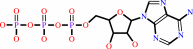 ATP
ATP
|
=
|
O-phospho-L-tyrosyl-[protein]
|
+
|
 ADP
ADP
|
+
|
H(+)
|
|
|
|
|
|
|
|
|
|
|
|
|
Molecule diagrams generated from .mol files obtained from the
KEGG ftp site
|
|
|
|
|
|
|
|
|
|
|
|
|
|
 |
|
|
|
|
|
|
| |
|
|
| |
|
DOI no:
|
Biochem J
460:211-222
(2014)
|
|
PubMed id:
|
|
|
|
|
|
| |
|
Selectively targeting an inactive conformation of interleukin-2-inducible T-cell kinase by allosteric inhibitors.
|
|
S.Han,
R.M.Czerwinski,
N.L.Caspers,
D.C.Limburg,
W.Ding,
H.Wang,
J.F.Ohren,
F.Rajamohan,
T.J.McLellan,
R.Unwalla,
C.Choi,
M.D.Parikh,
N.Seth,
J.Edmonds,
C.Phillips,
S.Shakya,
X.Li,
V.Spaulding,
S.Hughes,
A.Cook,
C.Robinson,
J.P.Mathias,
I.Navratilova,
Q.G.Medley,
D.R.Anderson,
R.G.Kurumbail,
A.Aulabaugh.
|
|
|
|
|
| |
ABSTRACT
|
|
|
|
| |
|
|
ITK (interleukin-2-inducible T-cell kinase) is a critical component of signal
transduction in T-cells and has a well-validated role in their proliferation,
cytokine release and chemotaxis. ITK is an attractive target for the treatment
of T-cell-mediated inflammatory diseases. In the present study we describe the
discovery of kinase inhibitors that preferentially bind to an allosteric pocket
of ITK. The novel ITK allosteric site was characterized by NMR, surface plasmon
resonance, isothermal titration calorimetry, enzymology and X-ray
crystallography. Initial screening hits bound to both the allosteric pocket and
the ATP site. Successful lead optimization was achieved by improving the
contribution of the allosteric component to the overall inhibition. NMR
competition experiments demonstrated that the dual-site binders showed higher
affinity for the allosteric site compared with the ATP site. Moreover, an
optimized inhibitor displayed non-competitive inhibition with respect to ATP as
shown by steady-state enzyme kinetics. The activity of the isolated kinase
domain and auto-activation of the full-length enzyme were inhibited with similar
potency. However, inhibition of the activated full-length enzyme was weaker,
presumably because the allosteric site is altered when ITK becomes activated. An
optimized lead showed exquisite kinome selectivity and is efficacious in human
whole blood and proximal cell-based assays.
|
|
|
|
|
|
|
|
|
|
|
|
|
|
|
|
|
|
 |
 |
 |
|


 Links
Links


